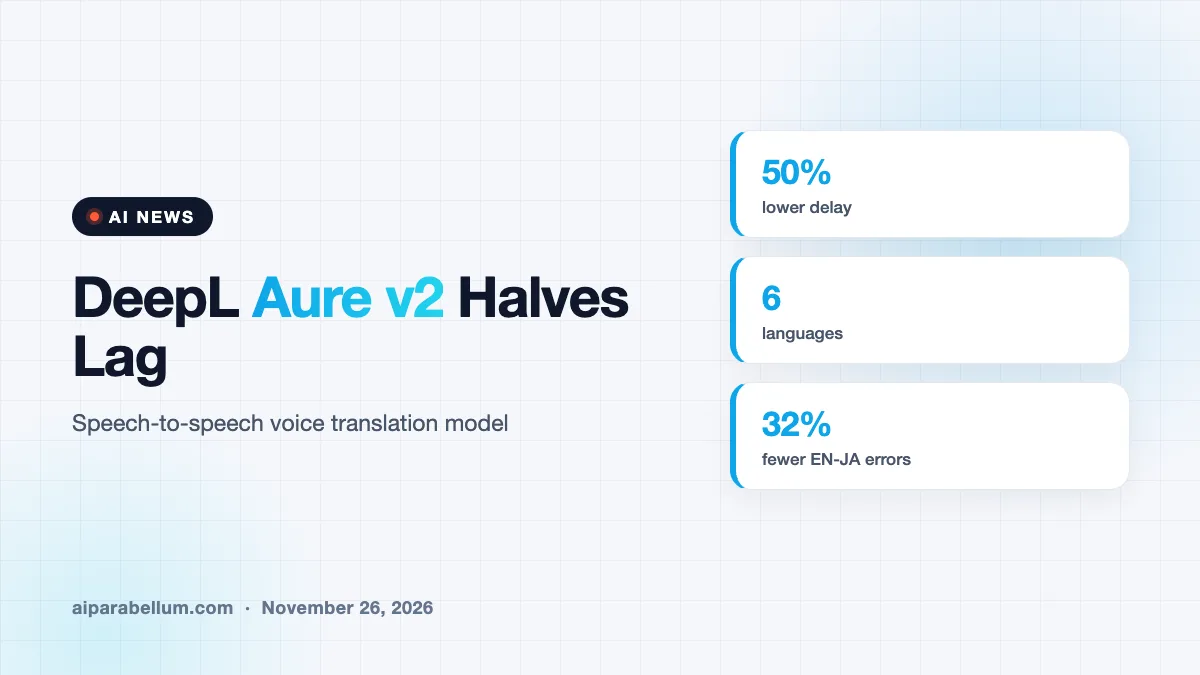
DeepL just released Aure v2, a new voice translation model that the company says cuts the lag in real-time spoken translation by 50% compared with the first Aure. The model went live on November 26 for DeepL Voice customers, unveiled at the company’s first Unmute Summit in Tokyo. If you have ever sat through an awkward pause while a translation tool caught up with a speaker, this voice translation upgrade is aimed squarely at that problem.
The launch comes only about two weeks after DeepL introduced the original Aure model. That first version focused on making translated speech sound more human by tracking a speaker’s tone and pace. Version two keeps that goal but rebuilds the engine underneath to make it faster.
What Aure v2 Changes in Voice Translation
The biggest change is the architecture. Older voice translation systems usually work in three separate stages: they transcribe speech into text, translate the text, then turn it back into speech. Each handoff adds a little delay.
Aure v2 uses what DeepL calls an end-to-end design, translating directly from speech to speech. Removing those separate steps is the main reason the company can claim such a large drop in lag.
Knowing When to Start Talking
Speed alone is not the hard part. A translator that jumps in too early can miss context and get the meaning wrong, while one that waits too long slows the whole conversation down. This is especially tricky with German and Japanese, where key words often land at the end of a sentence.
To solve this, DeepL trained the model with reinforcement learning. During training, Aure v2 earned rewards for translations that were both accurate and quick to begin, so it gradually learned when it had heard enough to start. DeepL says it used this approach partly because good recordings of real-time interpretation, with correct timing, are hard to find in large amounts.
How DeepL Says Aure v2 Performs
DeepL shared results from its own internal tests, run in November 2026 on one-minute recordings of real speech across 10 language pairs. These are company numbers, not independent benchmarks, and DeepL itself notes that results may differ in real conversations.
| Claim | DeepL’s reported result |
|---|---|
| Median translation delay | 50% lower than the original Aure |
| Quality vs. rivals | Higher than six competing systems, in every language pair tested |
| English-Japanese errors | 32% fewer than Google’s Gemini 3.5 Live Translate |
| Languages at launch | English, German, French, Spanish, Japanese, Korean |
| Availability | On by default for supported languages, no setup needed |
The head-to-head comparison with Google is notable, since Gemini has become a common choice for live translation. If you are comparing assistants more broadly, our Gemini comparison guide covers how Google’s model stacks up in other tasks.
Where You Can Use the New Voice Translation Model
Aure v2 is now running across three DeepL products. It switches on automatically for the six supported languages, and DeepL says more languages are coming soon.
- DeepL Voice for Online Meetings, for live translation during video calls
- DeepL Voice for In-Person Conversations, for face-to-face talks
- The DeepL API for Voice, so developers can build it into their own apps
The release lands in a busy month for voice AI. Rivals have been pushing hard too, such as the recent ElevenLabs realtime models and the Grok Voice 3 launch.
Growing Demand for DeepL Voice
DeepL also shared adoption figures alongside the launch. It says total DeepL Voice usage grew more than 8x year over year in the third quarter of 2026, and translated meeting minutes rose about 7x.
Growth was strongest in Asia, with meeting usage up more than 7x in Japan and 5x in South Korea, while the US and Germany each grew more than 6x. The company says it now serves more than 200,000 business teams and has over 900 employees.
Privacy Promises for Business Users
For enterprise customers, DeepL says audio, transcripts and translations are not used to train its AI models. Meeting data is deleted when calls end, subject to retention settings the customer controls.
The company also points to its ISO 27001 and SOC 2 Type II certifications and GDPR support. That matters if you handle sensitive calls, since meeting tools often record far more than people realize. For more on that topic, see our guide to AI meeting notes.
What This Means for You
If your team already pays for DeepL Voice, you do not need to do anything, since the new model turns on by itself. Here is what to keep in mind:
- Test it on your real calls. The benchmark numbers come from DeepL’s own study, so try it in your typical meetings before trusting it for high-stakes talks.
- Check your language pairs. Only six languages are supported at launch, so other pairs still run on older models.
- Review retention settings. Confirm how long meeting data is kept in your account, especially for client or legal calls.
- Developers can try the API. If you build customer support or travel apps, the voice API now offers the faster model.
Real-time translation is becoming a standard feature in many business AI tools, so expect competitors to answer with their own speed claims. You can follow those moves on our AI news page.
Sources
Primary source: DeepL’s Aure v2 announcement.
Conclusion
Aure v2 is DeepL’s attempt to make live voice translation feel less like a relay and more like a normal conversation. By translating speech straight to speech and training the model to judge when to start talking, the company claims it has halved the lag while improving accuracy. The numbers come from DeepL’s own tests, so real-world results will tell the full story. Still, for teams that run meetings across English, Japanese, Korean and major European languages, it is a meaningful upgrade that arrives without any setup.