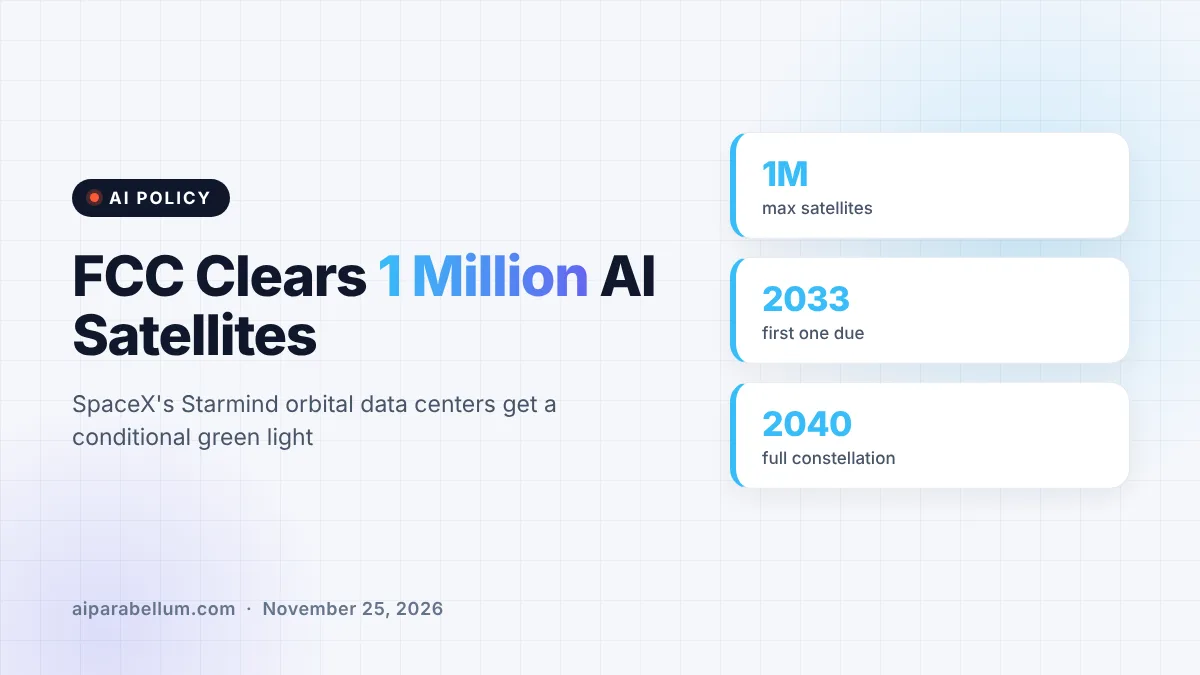
The Federal Communications Commission has given SpaceX the green light to launch up to one million data center satellites, a project the company calls Starmind. The order, released on November 25, 2026, lets SpaceX build a constellation of orbiting computers meant to power AI here on Earth. It also comes with firm deadlines and one big open question about what happens to old satellites.
What the FCC Approved for SpaceX Data Center Satellites
The approval came from the FCC’s Space Bureau in an order titled DA 26-1273. It covers the “SpaceX Orbital Data Center System,” which SpaceX first applied for on January 30, 2026. The Bureau said the grant serves the public interest by helping the U.S. lead in both space and artificial intelligence.
Technically, the license is about radio spectrum. The satellites will mainly talk to each other and to the ground through optical laser links, so the FCC only had to approve backup and emergency radio channels for tracking and control.
The key numbers
| Detail | What the order says |
|---|---|
| Maximum satellites | 1,000,000 |
| Orbit altitudes | About 500 km to 1,002 km |
| Main communications | Optical (laser) links |
| Backup radio bands | 18.8-19.3 GHz down, 28.6-29.1 GHz up |
| License term | 15 years from the first satellite in orbit |
| Status | Granted in part, deferred in part, with conditions |
The backup radio use is on an “unprotected and non-interference” basis. That means SpaceX can’t claim protection from other operators in those bands, and it must shut down any transmission that causes harmful interference.
Deadlines SpaceX Must Hit
A license for a million satellites doesn’t mean a million satellites will fly anytime soon. The FCC set a deployment schedule, and the authorization becomes void if SpaceX misses it.
- One satellite in orbit and operating by November 25, 2033
- 10% of the constellation by November 25, 2035
- 50% of the constellation by November 25, 2038
- The full constellation by November 25, 2040
SpaceX must also file reports twice a year. They will cover close-approach events with other objects, satellites taken out of service, re-entries and the total number deployed.
Why SpaceX Wants Data Center Satellites in Orbit
SpaceX has pitched Starmind as a way to capture solar energy in space and use it to run AI workloads for people on the ground. Data would travel back to Earth over laser links that connect with its Starlink network. The company says it plans to make chips for these satellites at an upcoming facility it calls Terafab.
SpaceX isn’t the only one chasing this idea. Google launched a test satellite for its Project Suncatcher effort last month, and we covered how that Suncatcher satellite ran an AI model in orbit. Blue Origin is set to carry out a dedicated heavy-lift launch for Suncatcher in 2029.
The push makes sense when you look at the energy crunch on the ground. Companies are spending huge sums on new AI data centers, and power supply has become a real worry, as seen in efforts like OpenAI’s grid protection program. AI is also already a large part of SpaceX’s business, according to its latest quarterly results.
The Debris Question the FCC Left Open
The order did not approve everything SpaceX asked for. Normally, satellites that end their missions below 2,000 km must be disposed of by burning up in the atmosphere. SpaceX wanted the option to move satellites above 600 km into disposal orbits or even orbits around the sun instead.
The FCC deferred that request, saying SpaceX had not provided enough information to judge whether its plan follows the rules. Before launching any Starmind satellites that won’t re-enter the atmosphere, SpaceX must apply for a change to the license and justify it.
Pushback from rivals and astronomers
The application drew petitions to deny from Amazon’s satellite unit, Viasat and the American Astronomical Society. Critics raised concerns about interference, collision risk and the effect on the night sky. The astronomers also warned that waste heat from so many computers could brighten the infrared sky and hurt research.
The FCC said SpaceX’s commitment to coordinate with the National Science Foundation addressed optical astronomy concerns. It ruled that the heat and environmental issues fall outside its authority, which only covers radio operations.
What This Means for You
For now, this approval won’t change how you use AI tools. The first required satellite isn’t due until 2033, and big questions about cost, cooling and debris remain unanswered. Still, it signals where the AI industry thinks future computing power could come from.
- Expect more AI companies to explore space-based compute as power on Earth gets tighter.
- Watch for SpaceX’s follow-up filing on satellite disposal, since it affects higher orbits.
- If you follow space or astronomy, the debate over sky brightness and orbital crowding is far from over.
You can keep up with more stories like this on our AI news page.
Sources
Primary source: FCC Space Bureau order DA 26-1273. Additional reporting from The Verge.
Conclusion
The FCC has cleared SpaceX to build an orbiting network of up to one million AI data center satellites, though only the backup radio side and with strict conditions. SpaceX must put its first satellite up by 2033 and finish by 2040, or lose the license. The agency also held back on SpaceX’s plan to park old satellites in higher orbits until it gets more details. Whether space-based AI compute becomes practical is still unproven, but this order makes Starmind the clearest test yet of the idea.