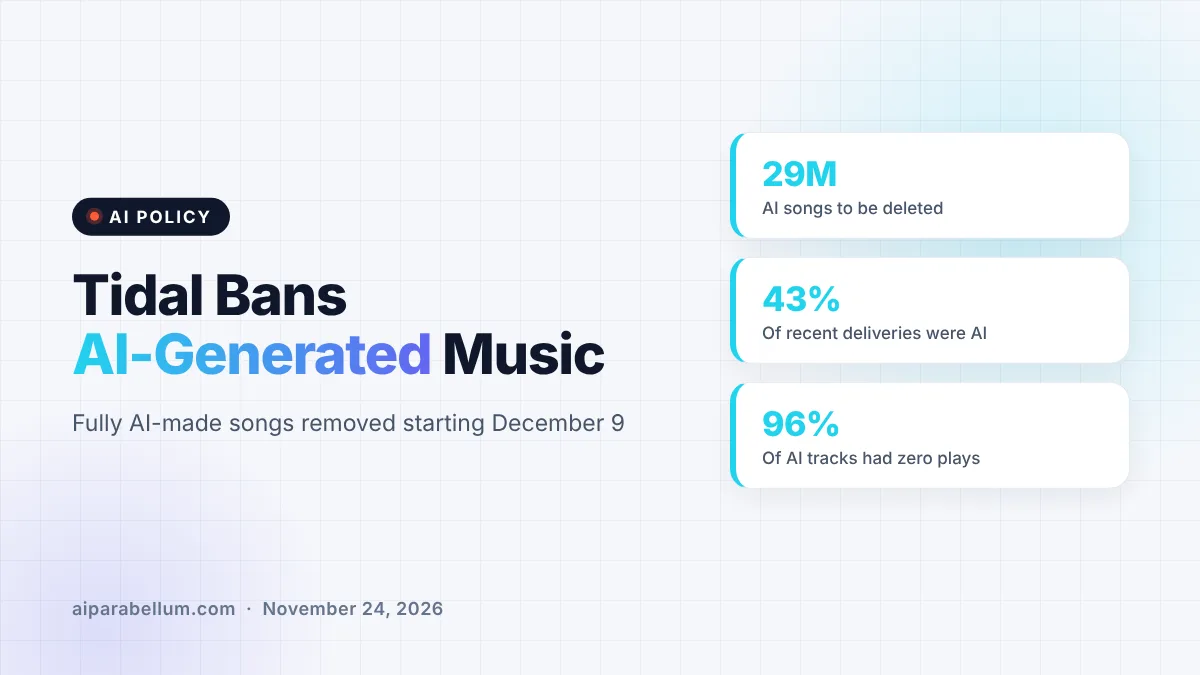
Tidal is banning fully AI-generated music from its streaming service, and the cleanup starts on December 9. The company expects to delete around 29 million AI-generated songs and turn away 80,000 to 85,000 new AI tracks every day. Songs made with help from AI tools can stay, as long as a human made real parts of the final track.
The announcement came on November 24 through posts on Instagram and X. It goes much further than the labels and filters most rival platforms have chosen so far.
What the Tidal AI Music Ban Covers
The new rule targets songs where AI is the sole output. Tidal is also cutting off the pipeline that brings those songs in, which is why the daily rejection number is so large.
- All tracks identified as 100 percent AI-generated will be removed, starting December 9.
- Individual uploaders can no longer add fully AI-made songs.
- Music distributors are banned from delivering fully AI-generated tracks.
- Submissions whose metadata says they were made entirely with AI will be rejected.
- Songs created with AI assistance are still allowed if they include human work.
Tidal says the removal should be finished by the start of 2027. The company has also already pulled about 66,000 tracks that impersonated real artists, which broke its rules even before this change.
Why Tidal Went From Labels to a Full Ban
Earlier this year, Tidal started labeling wholly AI-generated songs and blocking them from earning royalties. That did not slow the flood. Over the last 90 days, about 43 percent of tracks delivered to the service were detected as fully AI-generated, and on one day in early November the share hit 60 percent.
Tidal music lead Robert Andersen wrote on X that the platform needed a more drastic step. The company also points out that 96 percent of AI-generated tracks got zero plays, so it expects listeners to lose almost nothing.
The numbers tell the story: AI songs were taking up a big slice of uploads while almost nobody was listening to them.
The Royalty Problem
Tidal argues that fake and mass-produced AI tracks confuse fans and pull streams and royalties away from human artists. Impersonation is a big part of that worry, since some uploaders publish AI songs under the names of real musicians to grab payouts.
Tidal by the Numbers
Here is a quick look at the key figures behind the decision, based on what Tidal shared and how outlets reported it.
| Metric | Figure |
|---|---|
| Ban start date | December 9, 2026 |
| AI songs expected to be deleted | About 29 million |
| Tracks currently labeled fully AI | About 27 million (6.3% of catalog) |
| AI share of deliveries, last 90 days | 43% |
| AI tracks with zero plays | 96% |
| Expected daily rejections | 80,000 to 85,000 tracks |
| Impersonation tracks already removed | About 66,000 |
How Tidal Plans to Spot AI Songs
Detection is the hard part of any ban like this. Tidal says it will use the AI detection tool Ircam Amplify along with metadata checks to catch fully AI-made submissions.
Watermarks should help too. Nearly all of the AI songs on Tidal came from Suno, which added watermarking this year, and Google’s Lyria music model embeds SynthID marks in its audio.
Still, no system will catch everything. Open music models that run on a home computer, and services that skip watermarks entirely, could slip past the filters, so expect an ongoing cat-and-mouse game.
How Other Streaming Services Handle AI Music
Tidal is one of the first major services to follow Bandcamp with an outright ban. Most bigger platforms have picked softer approaches so far.
Spotify says it pulled millions of spammy tracks from its recommendation feeds and added badges for AI artist personas. YouTube rolled out AI music labels, Apple Music is planning labels of its own, and Deezer offers a filter toggle so listeners can hide AI songs.
Meanwhile, the legal fight over AI music keeps growing, including the Suno voice cloning case brought by the Elvis Presley estate.
What This Means for You
If you listen on Tidal, your playlists should feel cleaner, and you are unlikely to notice missing songs since almost none of them were being played. If you make music, here is what to keep in mind.
- Using AI as a helper is still fine on Tidal, but a track generated entirely by a tool will be rejected.
- Check how your distributor tags AI use in metadata, since that tag can trigger an automatic rejection.
- Expect other platforms to keep tightening rules, so it pays to document the human work in your songs.
- If you like experimenting with an AI music generator, treat the results as drafts you build on, not finished releases.
You can follow more stories like this in our AI news section.
Sources
Tidal announced the ban in social media posts and has no standalone announcement page. Reporting from TechCrunch, Ars Technica and The Verge.
Conclusion
Tidal is betting that a full ban on wholly AI-generated songs will protect artists without hurting listeners, and its own play counts back that up. The real test will be detection, since new and unwatermarked models will keep trying to sneak through. If the policy works, pressure will grow on Spotify, YouTube Music and Apple Music to go beyond labels.