
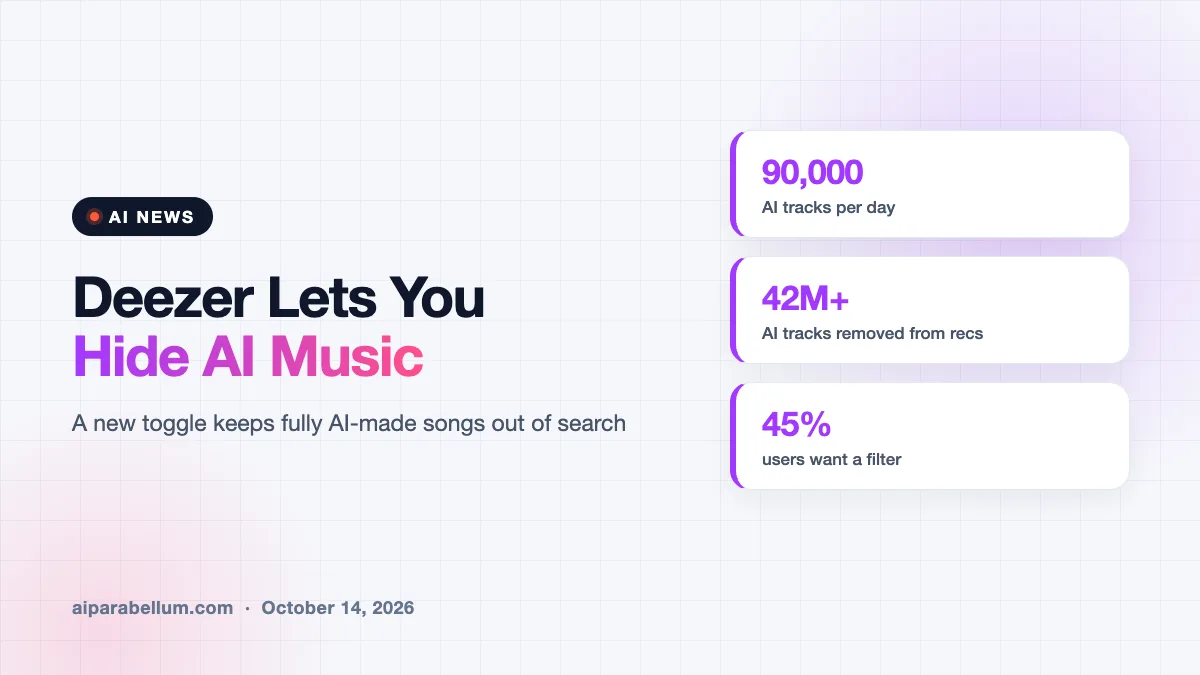
Deezer is building a simple on/off switch that hides fully AI-generated songs from your search results. The Deezer AI music filter is set to roll out globally before the end of 2026, and it is the strongest step yet by a major streaming service to give listeners a human-only option.
The move comes as AI tracks flood streaming platforms at a pace few people expected. Deezer says it now receives tens of thousands of fully synthetic songs every single day.
How the Deezer AI Music Filter Works
Once you turn the toggle on, Deezer will leave AI-generated tracks, albums and the artists tied to them out of your search results. If you change your mind, you just switch it off again and that music comes back.
The setting targets music made entirely by generative AI tools. Deezer says songs where AI played only a small part in a larger human creative process are treated differently, so a human artist who used an AI plugin should not vanish from your searches.
What the switch covers
- Fully AI-generated tracks in search results
- Albums made entirely with AI
- Related artist profiles behind those releases
- Easy reversal at any time from the same setting
Why Deezer Is Fighting the AI Music Flood
The numbers explain the urgency. Deezer says it gets close to 90,000 fully AI-generated tracks a day, and on peak days that is more than half of everything uploaded to the service. Back when it first launched its detection tool, AI made up around 10% of daily uploads.
Listeners are not streaming most of that music, though. The company says fully AI songs account for only about 1% to 3% of streams. Even so, it found that up to 85% of the streams on those tracks in 2025 were fraudulent, which is why it strips such plays out of royalty payments.
| Deezer AI Music Figure | Number |
|---|---|
| Fully AI tracks delivered per day | About 90,000 |
| Share of daily uploads on peak days | More than 50% |
| AI tracks removed from recommendations (Jan 2025 to Aug 2026) | More than 42 million |
| Albums tagged as AI-generated | More than 14 million |
| Share of streams going to fully AI tracks | About 1% to 3% |
| AI-track streams found to be fraudulent in 2025 | Up to 85% |
Built on earlier detection work
The toggle builds on tools Deezer has used since early 2025. Its in-house detector can spot songs from popular generators such as Suno and Udio. Flagged tracks are already kept out of algorithmic and editorial playlists, and since June 2025 Deezer has labeled AI-made albums on its app.
Deezer now licenses that detection tech to other music companies. It also says two patents covering its methods were published by the European and U.S. patent offices in June 2026.
What Listeners Say They Want
CEO Alexis Lanternier said the company has seen “clear user demand” for a way to drop AI music entirely. A Deezer and Ipsos survey from November 2025 found that 45% of streaming users wanted to filter out fully AI-generated songs.
The same study showed how hard this music is to spot by ear. In a blind test, 97% of people could not tell AI songs from human-made ones, and 80% said fully AI tracks should be clearly labeled.
How Other Streaming Services Handle AI Songs
Rival platforms have taken very different paths. Bandcamp has banned AI tracks outright, while Tidal has stopped paying out on AI uploads. Spotify has gone lighter, choosing to tag AI tracks and artists more visibly instead of hiding them.
Apple Music has reportedly been preparing its own AI labels for later this year, according to an earlier Variety report. Deezer’s toggle goes a step further than labels by letting each listener decide whether that music shows up at all.
What This Means for You
If you care about supporting human musicians, Deezer is about to become one of the easiest places to do that. Here is what to keep in mind:
- Watch for the toggle in your settings before the end of 2026. It will reach users worldwide.
- The filter works on search results. AI tracks are already kept out of Deezer recommendations and editorial playlists.
- Labels still matter. If you leave the toggle off, tagged albums help you see what was machine-made.
- Creators who use AI tools lightly should not be swept up, since the focus is on fully generated music.
On the other side, AI music tools keep getting better. If you are curious how these songs get made, our look at an AI music generator and the Mubert audio tool shows what creators are working with. You can explore more audio generation tools or catch up on the latest AI news.
Sources
This article is based on Deezer’s official announcement in the Deezer Newsroom and reporting from TechCrunch.
Conclusion
Deezer’s new switch turns a growing frustration into a simple choice for listeners. With AI uploads now making up more than half of new tracks on peak days, the company is betting that many fans want a clear way to stick with human artists. The toggle builds on years of detection, labeling and anti-fraud work, so it rests on more than a promise. Whether rivals like Spotify and Apple Music follow with their own filters could shape how AI music fits into streaming for years to come.
