
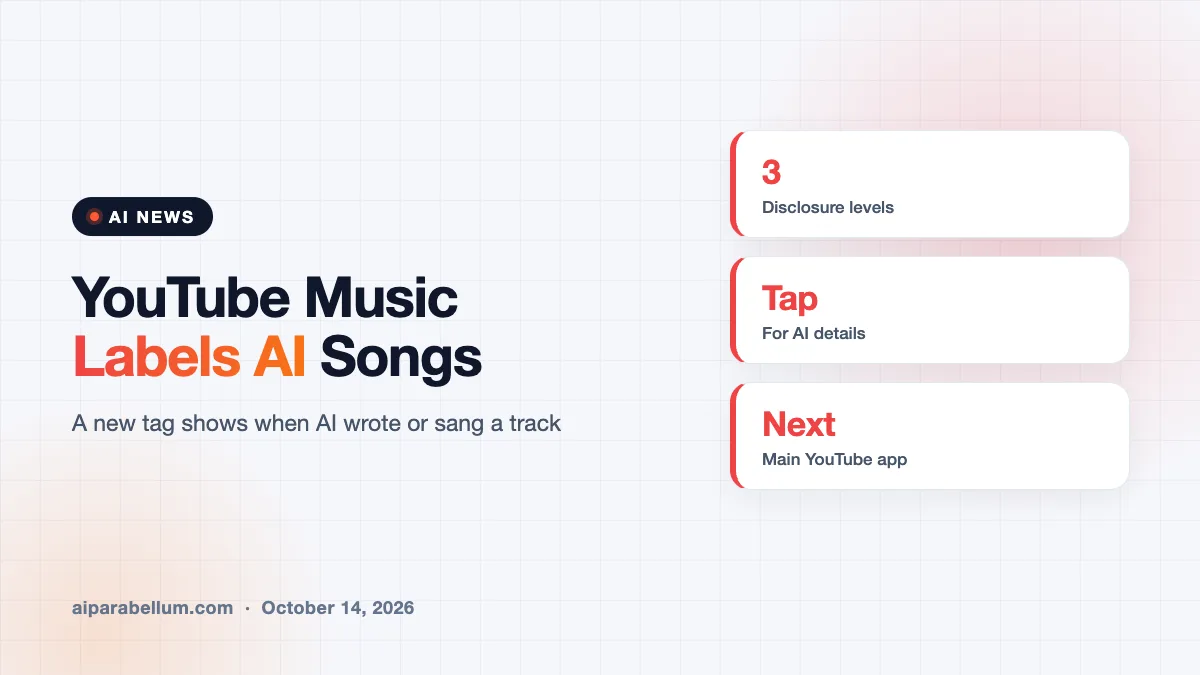
Ever wondered if the catchy track in your playlist was sung by a person or a model? YouTube Music AI labels started rolling out on October 14, putting a clear tag on songs where generative AI played a significant role. Tap the tag and you get a short explanation of how AI was used.
The labels arrive as AI-generated music pours onto streaming services. YouTube says the same labels will come to the main YouTube app later, which matters because so much music listening happens there.
How YouTube Music AI Labels Work
The label sits on the player page, right under the track name, so it is hard to miss. It covers songs that were fully generated by AI and songs where a model created major parts, such as the composition or the vocals. Tapping it opens a simple menu with more detail on AI’s role in that track.
YouTube says it is working with music partners and using its own detection tools to find AI tracks. The approach mirrors how it already labels AI-generated videos on the main platform.
Three disclosure categories for artists
Music partners who upload songs are asked to declare their use of generative AI. YouTube’s help page lays out three options:
| Designation | What it covers |
|---|---|
| Fully Gen AI | Tracks generated entirely by AI |
| Partly Gen AI | Works with AI-generated parts plus the artist’s own live elements |
| No Gen AI | Human-made music, including tracks edited with pitch-correction tools like Auto-Tune |
If a partner does not disclose, YouTube says it may rely on other signals to decide whether a song is AI-generated. That gives the system a backstop for uploaders who skip the question.
YouTube Music AI Labels Inform, Not Ban
YouTube is choosing disclosure over restriction. An AI label does not make a song ineligible to earn money, and AI tracks are not being pulled from the service. The company even runs its own AI music experiments, such as Dream Track, which lets select creators make soundtracks with AI versions of participating artists’ voices.
That puts YouTube in the middle of the pack. Some rivals are drawing much harder lines.
How Rival Streaming Services Handle AI Music
Every major platform is now working out its own answer to the flood of AI songs. Here is how the approaches compare:
- Spotify launched a voluntary AI label earlier this year, runs a music spam filter and says it will not recommend songs from AI personas.
- Apple Music is reportedly preparing its own AI tags later this year.
- Deezer labels detected AI music, keeps it out of recommendations and editorial playlists, and is adding a switch to filter it out. It reported in July that it was receiving close to 90,000 fully AI-generated tracks a day.
- TIDAL labels fully AI-made recordings, lets listeners turn them off and excludes them from royalties.
- Bandcamp went furthest, banning AI music outright earlier this year.
We covered Deezer’s approach in detail in our story on its AI music filter. Compared with that, YouTube’s move is gentler, but its reach is huge.
What This Means for You
If you listen on YouTube Music, you now have a quick way to see what you are hearing. A few practical points:
- Look under the song title on the player page. If you see the AI tag, tap it to learn how the track was made.
- There is no option to hide AI songs yet, so the label is information, not a filter.
- Small AI help, like Auto-Tune, will not trigger a label. Expect tags mainly on songs where AI wrote or sang major parts.
- If you make music, plan to disclose AI use when you upload. Being upfront beats having YouTube’s detection tools decide for you.
Creators who use AI music generators for background tracks should keep this in mind too, especially anyone building a faceless YouTube channel with AI audio.
Takeaway: YouTube is betting that listeners want to know, not that they want AI music gone.
You can explore more tools in our AI music category or catch up on the latest AI news.
Sources
This article is based on reporting from TechCrunch, The Verge and Engadget.
Conclusion
YouTube Music’s new AI labels give listeners a simple, visible signal about how a song was made. The system leans on artist disclosure, backed by YouTube’s own detection tools, and sorts music into fully AI, partly AI or human-made. It stops short of hiding or demonetizing AI tracks, which sets it apart from stricter rivals like Deezer and Bandcamp. With the labels heading to the main YouTube app next, millions more people will soon see them.
