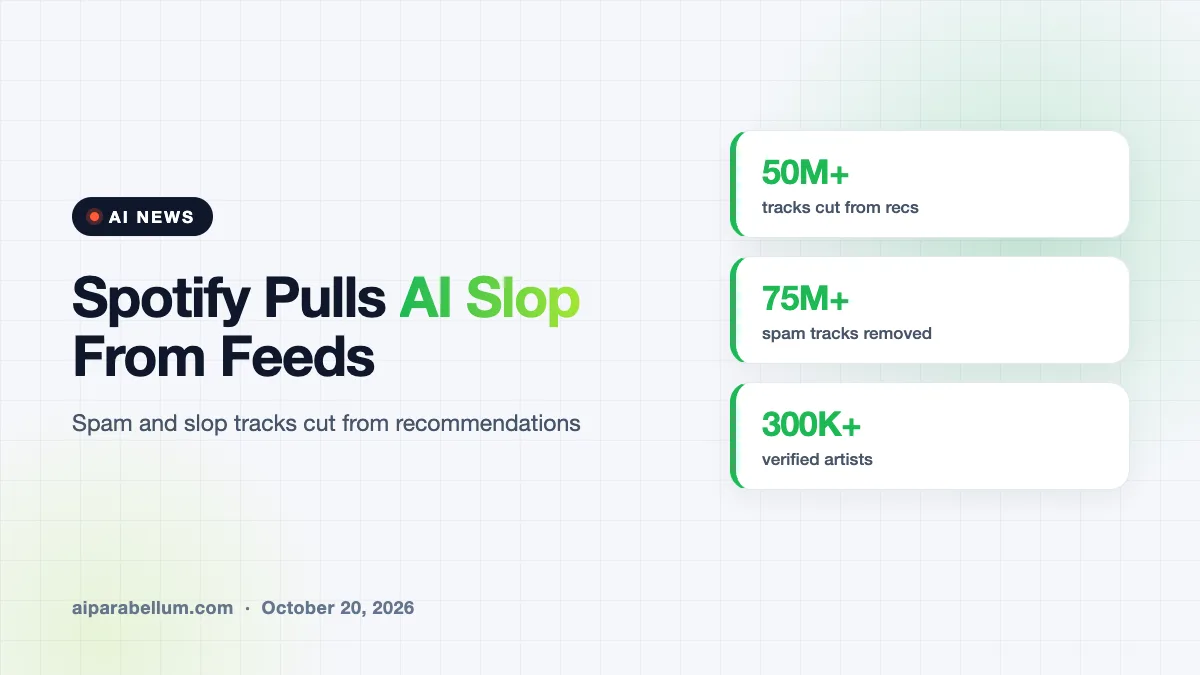
Spotify says it has taken more than 50 million AI slop and spam tracks out of its recommendations this year. The company shared the number on October 20 in a one-year update on its plan to put human artists first. If your Discover Weekly has felt less cluttered lately, this cleanup is probably why.
The 50 million figure is separate from tracks Spotify deletes outright. The company says it has also removed more than 75 million spammy tracks from the platform entirely for serious or repeated rule violations.
How Spotify Is Fighting AI Slop
Spotify says it started by studying the songs people kept skipping, ignoring, or flagging as unwanted. A clear pattern showed up: most of those tracks were ones it had already tagged as slop or spam.
Over the past six months, the company says it made a series of updates to its recommendation system to push that content down and lift up music from real, human artists. Spotify’s human editors follow the same rule and won’t add slop or spam to their playlists.
The real shift here is not deletion. It is quietly deciding what millions of listeners never get nudged toward.
The Signals Behind the Filter
Spotify admits that no single check can reliably catch AI slop. Instead, it combines several signals to make a more confident call:
- Listener engagement and direct feedback, such as skips and songs people say they don’t want
- Upload patterns, including mass uploads and duplicate tracks
- Metadata tricks, like keyword stuffing for search
- Results from several third-party AI detection tools
- Spammy playlist networks and artificially short tracks
The company also says AI detection tools have real limits and will get harder to rely on as generative music improves. That is why it leans on behavior and upload patterns, not just audio analysis. If you’re curious how these systems work in general, our AI detection tools category covers the basics.
Spotify’s Other AI Music Protections
The recommendation cleanup builds on several tools Spotify rolled out over the past year. Here is how they fit together, based on the company’s update.
| Tool | What It Does | Where It Stands |
|---|---|---|
| AI Credits | Lets artists disclose which roles or instruments used AI | Tens of thousands of credits submitted daily |
| Verified by Spotify | Badge showing a real, identifiable person is behind the music | 300,000+ artists verified, over 70% independent |
| AI Persona badges | Labels artists whose identity is AI-generated | Thousands labeled, excluded from recommendations by default |
| Artist Profile Protection | Lets artists review releases listing them before they go live | In beta, coming to all artists by year end |
| 1,000-stream royalty threshold | Tracks must reach 1,000 streams to earn royalties | In place since 2024 |
Spotify says verified artists account for more than 99% of what listeners search for. It also claims it is the only major streaming service that labels artist identities believed to be AI-generated.
Why the Royalty Threshold Matters
Spotify says tracks with strong signs of being AI-generated are 10 times more likely to fall below its 1,000-stream payout line. That makes it harder for bad actors to flood the service with cheap generated songs and siphon money away from real musicians.
How the AI Slop Crackdown Compares to Rivals
Spotify is not the only service wrestling with this problem, and it is not the strictest. It still doesn’t require labels on every AI-made track, which some listeners and artists have asked for.
Other platforms have taken different routes. YouTube Music has started putting labels on AI songs, Deezer lets users filter out AI music, and Bandcamp has banned AI-generated music outright. Meanwhile, major labels are pushing on the issue from the legal side, as seen in the AI songs subpoena fight.
Spotify’s approach sits in the middle. It allows AI music on the platform but limits how far that music can spread through its own recommendations.
What This Means for You
For most listeners, the change happens quietly in the background. Still, there are a few practical things worth knowing:
- Your skips and feedback matter. Spotify says that feedback helped it spot slop in the first place.
- Look for badges. The Verified by Spotify check and AI Persona label tell you who, or what, is behind an artist page.
- Check Song Credits. On mobile, the Now Playing view can show when an artist disclosed AI use in a track.
- If you follow an AI Persona on purpose, you can still hear it. Spotify only keeps those artists out of recommendations by default.
If you make music with AI yourself, transparency is the safest path. Disclosing AI use through credits keeps your tracks eligible, while mass uploads and keyword tricks are exactly what Spotify’s filters hunt for. Our roundup of AI music tools is a good place to see what creators are using today.
Sources
Primary source: Spotify’s one-year update on human artistry. Additional reporting from The Verge.
Conclusion
Spotify’s latest numbers show how big the AI slop problem has become: 50 million tracks pulled from recommendations and 75 million removed entirely. The company is betting that a mix of listener signals, detection tools, badges and payout rules can keep human artists in front without banning AI music. It is a softer stance than some rivals, and it admits detection will only get harder. For now, the best thing you can do is keep giving feedback and watch for the new labels as you listen. You can follow more updates like this on our AI news page.