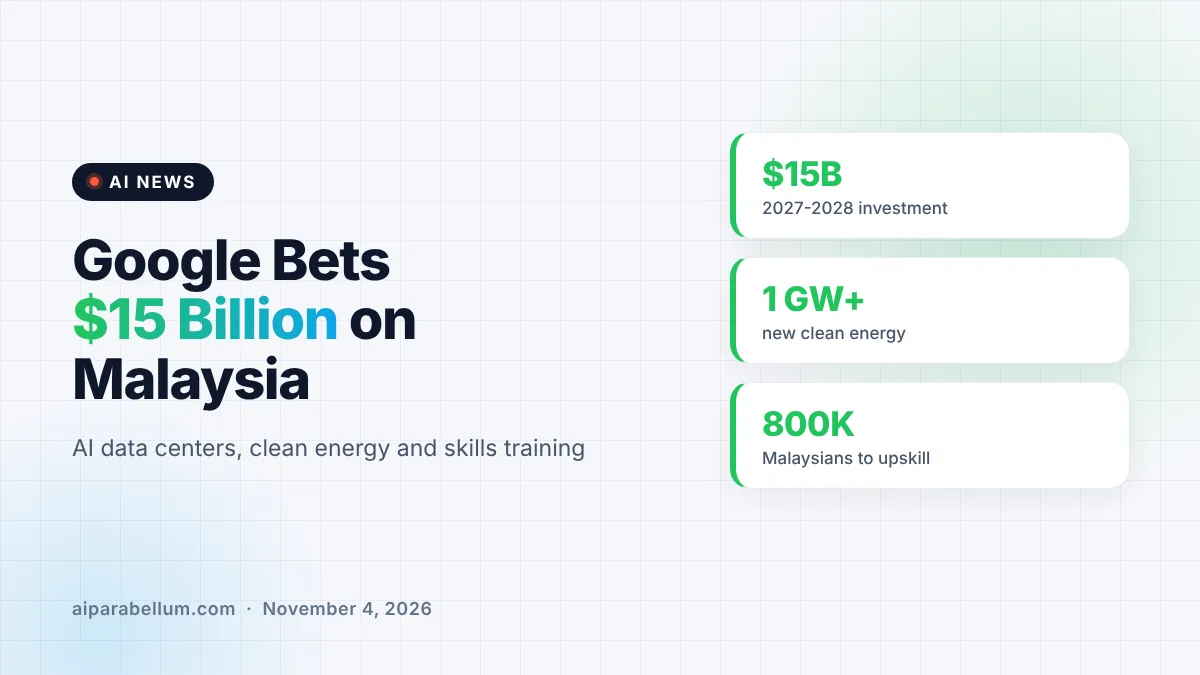
Google has announced a $15 billion Malaysia investment to expand its data centers and AI computing capacity in the country over 2027 and 2028. The Google Malaysia investment also covers clean energy, water projects and a plan to train roughly 800,000 people in digital and AI skills by 2031. The company unveiled the plan on November 4, 2026, with Prime Minister Anwar Ibrahim in attendance.
The plan expands on an earlier Google infrastructure investment in Malaysia announced in 2024. Its size shows how hard big tech companies are racing to build the computing power that modern AI tools need.
What the Google Malaysia Investment Includes
The money goes toward new data center campuses, plus programs meant to soften their impact on local power and water. Google says its first Malaysian campus, at Elmina Business Park in Selangor, is already running. New campuses are planned in Selangor and Negeri Sembilan.
The computing capacity in Selangor will also support an upcoming Google Cloud region in Malaysia. That matters for businesses that want their data and AI workloads to stay close to home for speed and compliance reasons.
The main pieces at a glance
| Area | What Google announced |
|---|---|
| Total investment | $15 billion across 2027 and 2028 |
| Data centers | Elmina campus live; new campuses in Selangor and Negeri Sembilan |
| Jobs during construction | More than 37,000 local jobs per year (company estimate) |
| Long-term jobs | More than 9,000 jobs per year once facilities run |
| Skills training | About 800,000 Malaysians by 2031 |
| Clean energy | More than 1 GW added to the National Grid |
Google also estimates the construction phase will add about $1.1 billion a year to Malaysia’s GDP. These are the company’s own projections, so treat them as targets rather than guarantees.
Why AI Is Driving Google’s Malaysia Investment
AI models need huge amounts of computing power, both to train and to answer everyday requests. Google says the Malaysian facilities will run local AI applications and also power services like Search, Maps and Chrome across the Asia-Pacific region. If you use tools such as Google’s Gemini models, this is the kind of hardware sitting behind every answer.
Ruth Porat, President and Chief Investment Officer of Alphabet and Google, said the plan provides “the foundational computing capacity to deliver the upside of innovation” while adding local power and water resources. The move fits a wider trend of cloud providers building closer to fast-growing digital markets. We have seen similar capacity races in recent Google Cloud deals.
Power, Water and Community Commitments
Data centers use a lot of electricity and often water for cooling, which has made them controversial in many places. Google is trying to get ahead of those concerns with specific promises. Here is what it says it will do:
- Bring more than 1 GW of new clean energy capacity to the grid, anchored by a partnership with Tenaga Nasional Berhad.
- Pay for 100% of the power its campuses use, plus the direct costs of connecting them to the grid.
- Fund two new water replenishment projects, including river basin work in Sungai Buloh and Sungai Selangor.
- Launch programs in 2027 aimed at lowering electricity bills for households in host states.
Google says its water risk studies found local supplies were not at high risk of scarcity, which is why it chose water cooling there. It also claims its facilities can run at a power efficiency score of 1.12 to 1.14 in tropical climates, compared with an industry average of 1.54.
Four new training programs
The skills push includes AI literacy lessons for students aged 11 to 14, digital clinics for small businesses and AI training for local council staff. Google also plans Data Center Institutes at selected polytechnics, offering a 10-week course for people seeking data center jobs.
What This Means for You
Even if you never visit Malaysia, investments like this shape how fast and how reliable your AI tools feel. More regional capacity usually means lower delays and better availability for cloud and AI services in that region.
- If you run a business in Southeast Asia, watch for the new Google Cloud region, which could cut latency for your apps.
- If you use Google’s AI products, expect continued heavy spending on infrastructure to keep services like Gemini responsive.
- If you follow the AI industry, note how companies now pair data center deals with energy and water pledges to win public support.
For more on how businesses can put this kind of capacity to work, see our list of business AI tools. You can also follow every update on our AI news page.
Sources
Primary source: Google’s Malaysia investment announcement. Additional reporting from TNGlobal.
Conclusion
Google’s $15 billion plan makes Malaysia a major hub for its AI and cloud infrastructure in Southeast Asia. The company is pairing new data centers with clean energy, water projects and large-scale skills training. Many of the job and economic figures are Google’s own estimates, so the real test will come as construction starts in 2027. For now, it is another clear sign that the AI boom is being built one data center campus at a time.