OpenAI published research claiming its GPT-6 model family has intrinsic protein design skills, using only reasoning and general coding tools instead of purpose-built biology models. The company says GPT-6.2 sketched three-dimensional protein shapes, proposed amino acid sequences, and predicted how molecules fit together. Lab partner Onava then made hundreds of those designs and measured whether they stuck to their targets.
The work is described in a preprint titled “GPT-6 as a Universal Foundation Model for Protein Biology: Beyond Specialized Models.” It is research, not a product launch, and OpenAI is careful about what it does and does not prove.
What the GPT-6 Protein Design Results Show
Proteins are chains of amino acids whose order decides how they fold and what they do. Designing one normally means stitching together several narrow AI models, each with its own input format. OpenAI’s argument is that a general model can now do parts of that job from a prompt.
Researchers could steer designs in plain language. They marked where a small protein should attach to its target, and even specified how many coils or strands it should contain. The company says an internal model followed those instructions with near-perfect fidelity.
Inside the Lab Tests With Onava
The headline experiment gave GPT-6.2 the structures of five target proteins and asked for minibinders, very small proteins that grip a chosen spot. Specialized models supplied sequences and helped filter candidates before anything reached the bench.
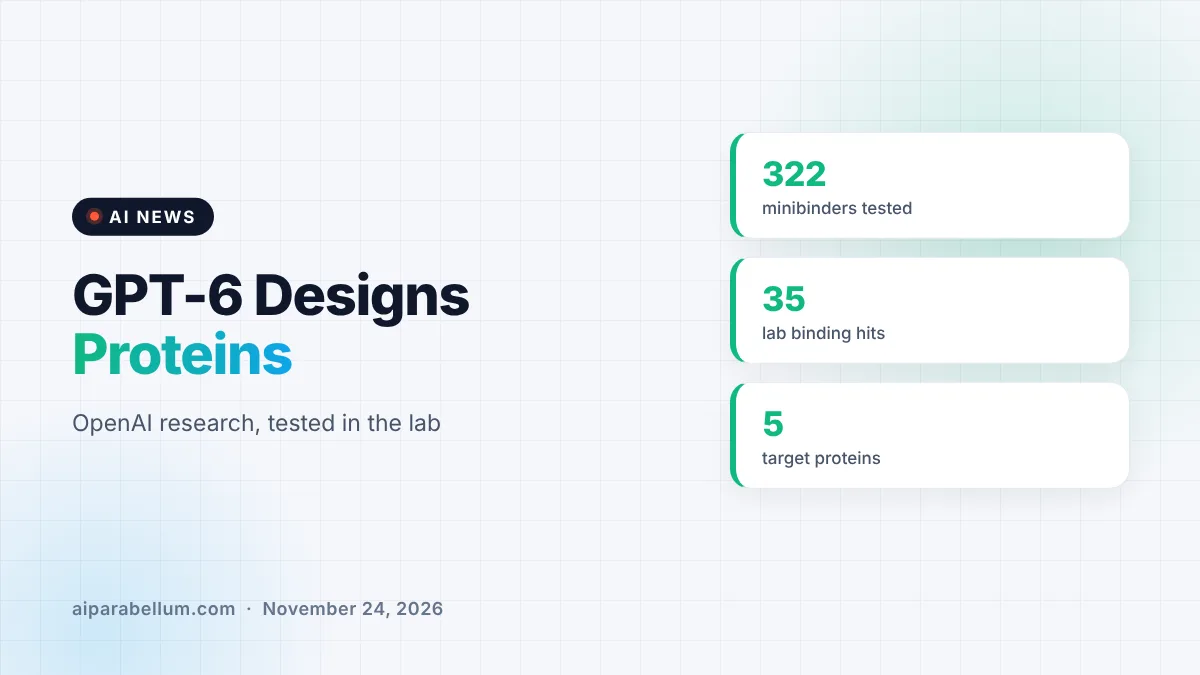
Of 322 minibinders tested against five targets, 35 showed evidence of binding, a hit rate of 10.9%. Hits broke down as 18 for IL-17A, 8 for VEGF-A, 5 for PD-L1, 3 for IL-7Rα and 1 for TrkA. OpenAI notes the original RFdiffusion study reported higher rates, and that such numbers swing with how strictly designs are filtered first.
A second test hid the sequences of known minibinders and asked the model to write new ones. Early screens showed binding in 85% of MDM2 designs, 62% for VEGF-A and 14% for PD-1, often with sequences that differed sharply from the originals. Antibody loop redesigns fared well too: 128 of 182 designs bound IL-4Rα.
| Task | GPT-6.2 or internal model | Specialized model |
|---|---|---|
| Small-molecule docking (PoseBusters) | 93% GPT-6.2, 96% internal | 50% (DiffDock-L) |
| Motif scaffolding (MotifBench) | 43.7% internal | 27.8% (RFdiffusion) |
| Fold-specified design | 18.9% internal | 17.1% (Proteina) |
| Full structure prediction (TM-score) | 0.38 internal | 0.93 (ESMFold2) |
Where GPT-6 Protein Design Still Falls Short
The weakest area is the most basic one. Predicting a complete protein structure from sequence alone averaged a TM-score of 0.38 for OpenAI’s best internal model, against 0.93 for a dedicated structure predictor. That is a wide gap, and the company says so plainly.
OpenAI also flags two other caveats:
- Specialized models such as Boltz-2 and ESMFold2 still filtered candidates, so the pipeline was not model-only end to end.
- Some benchmark scores may partly reflect memorization, because the structures used were public.
- Binding is one early step; specificity, stability and safety all remain unproven.
The biosecurity question
Tools that help design useful proteins can help design harmful ones. OpenAI says its Preparedness Framework guides how it assesses that risk and tests safeguards. The company has leaned on that framework before, including in recent safety proposals.
What This Means for You
If you are not a biologist, the practical signal here is about how general models are spreading into technical work. The same family behind consumer chat updates is being pointed at wet-lab science.
- Treat the hit rates as early evidence, not a validated drug pipeline.
- Expect prompt-driven design interfaces to show up in research software first, much like healthcare agent features did.
- Watch for independent replication before trusting any single benchmark figure.
For researchers, the attraction is flexibility. You can change the task by rewriting the prompt rather than retraining or rewiring a toolchain, which is the same shift developers saw with code assistant tools.
OpenAI lists three next steps: harder binding targets, designs that cause a specific biological effect, and a wider set of molecules including RNA and PROTACs. Related coverage sits on our AI news page.
Sources
Primary source: OpenAI’s research post on intrinsic protein design capabilities, which includes the preprint summary, benchmark figures and laboratory results described above.
Conclusion
This is a research claim with real lab numbers attached, which puts it a step ahead of most model-capability announcements. The binding hits are modest and the structure-prediction gap is large, so nothing here replaces specialized biology models yet. What it does suggest is that prompt-level control over molecular design is closer than it looked a year ago, and that OpenAI intends to push there. Independent replication will decide how much of this holds.