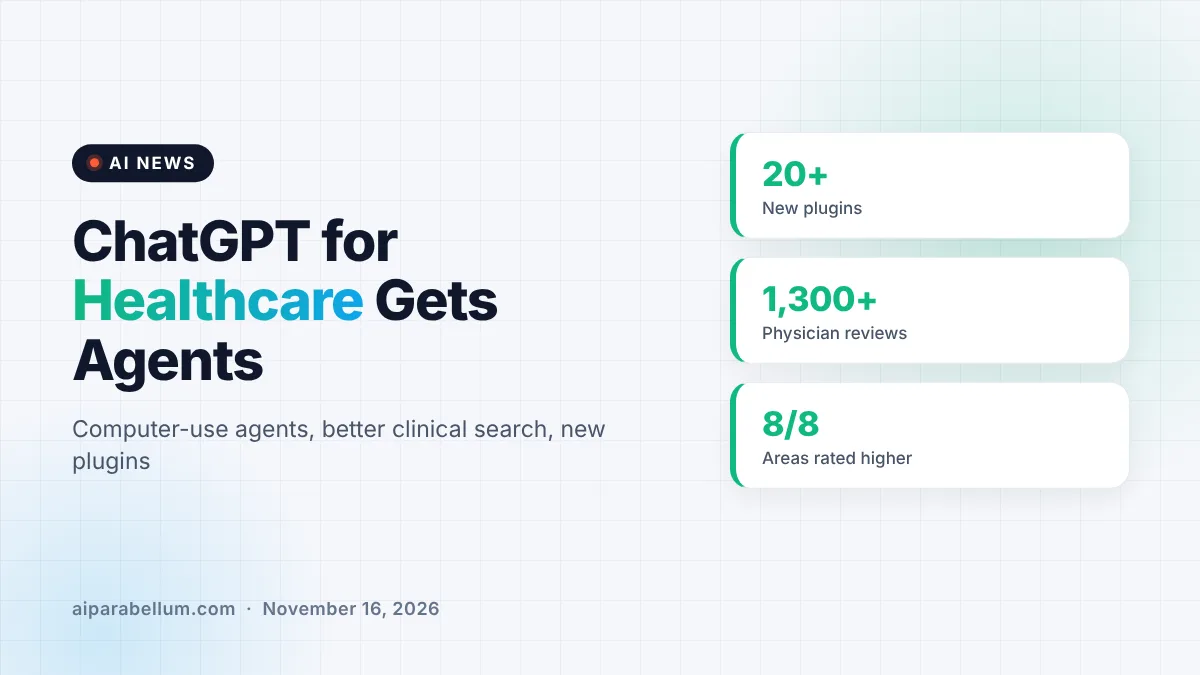
OpenAI is giving ChatGPT for Healthcare a big upgrade. On November 16, the company said hospital and clinic teams can now use computer-use agents that click and type through the software they already rely on, along with sharper clinical search and more than 20 new healthcare plugins.
The goal is simple to describe and hard to pull off. Care teams spend hours copying information between health records, scheduling tools and insurance portals, and OpenAI wants AI to handle more of that busywork while people keep the final say.
What’s New in ChatGPT for Healthcare
The update has three main parts. Each one targets a different slice of the daily grind in a clinic or hospital.
- Computer-use agents that can read screens, click buttons, type and move between applications to finish multi-step tasks.
- An improved “trusted clinical search” that finds, weighs and cites medical evidence when clinicians ask questions.
- More than 20 new plugins from healthcare software companies, covering clinical care, care coordination and business operations.
OpenAI says these pieces are meant to work together. A clinician could find evidence, check a patient’s records and line up next steps without jumping between a dozen browser tabs.
How the Computer-Use Agents Work in Healthcare
Many healthcare systems don’t talk to each other, and plenty of older tools have no modern API at all. Computer-use agents get around that by working the way a person would, navigating the screens directly.
In OpenAI’s demo, a clinician uses voice in the ChatGPT app to follow up on an MRI request. The agent reviews the patient’s chart, then drafts an order and a reply to the patient, and both wait for the clinician to review them before anything goes out.
Controls for hospitals
Organizations decide which applications an agent can touch and which steps need a human to sign off. OpenAI says the product includes access controls and audit logs, and that content shared with ChatGPT for Healthcare is not used to train its models.
There is a catch for patient data. To handle protected health information under HIPAA, organizations must use eligible services covered by a Business Associate Agreement with OpenAI and apply the required security and retention settings.
Who is already testing it
OpenAI named Abridge, Ambience, Cigna Healthcare and CVS Health as organizations deploying these agents. The company says they’re using them to process referrals, move documents between systems and pull together the information care teams need.
Better Clinical Answers and a Bigger Plugin Lineup
The clinical search upgrade applies to both ChatGPT for Healthcare and ChatGPT for Clinicians, the free version for verified U.S. clinicians. OpenAI says physicians compared old and new answers in a blind evaluation and preferred the updated version across all eight areas they scored, including factual correctness and safety, over more than 1,300 reviews.
The new plugins bring partner tools straight into a ChatGPT conversation. OpenAI’s examples include checking insurance eligibility, finding discharge summaries from other hospitals, pulling up hospital policies and comparing negotiated prices for a procedure.
| Task | Plugins OpenAI used in its examples |
|---|---|
| Confirm appointments and coverage | Luma Health, TriZetto |
| Find outside discharge records | Metriport, UpToDate |
| Look up hospital policies and on-call staff | AIVA, Amion |
| Estimate procedure costs | IMO Health, Stedi, Turquoise Health |
| Review referrals and scheduling | Assort Health, Ferry Health |
All of the new plugins are available now in ChatGPT for Healthcare, including inside ChartGPT, which brings ChatGPT into the electronic health record workflow. Workspace admins have to switch them on first.
Who Can Use It and When
OpenAI says computer-use agents in ChatGPT Work and Codex, plus the improved clinical search, are available today for ChatGPT for Healthcare customers, subject to workspace settings. Individual clinicians on the free plan get the same agents and search, along with a selection of plugins.
Developers can tap the same computer-use capability through the OpenAI API. Organizations can also buy ChatGPT for Healthcare directly or through an AWS Marketplace private offer.
What This Means for You
If you work in healthcare, this is one of the clearest signs yet that AI agents are moving from chat windows into real clinical software. It also follows a busy stretch for healthcare AI, from Suki’s agent funding to new agentic AI guidance from doctors.
- Start small: OpenAI itself suggests beginning with one workflow that spans existing apps, like referrals or prior authorizations.
- Keep humans in the loop: set clear review steps, since the agent drafts orders and replies rather than sending them on its own.
- Check your paperwork: patient data requires a signed BAA and the right security settings before you go live.
- Watch the accuracy questions: AI medical advice is still under scrutiny, as a recent ChatGPT medical lawsuit shows.
For everyday users, the takeaway is broader. The same computer-use skills behind this launch are spreading across ChatGPT tools generally, and you can follow more updates on our AI news page.
Sources
Primary source: OpenAI’s ChatGPT for Healthcare announcement.
Conclusion
OpenAI is betting that the fastest way to help healthcare workers is to let AI operate the clunky software they already use, instead of replacing it. Computer-use agents, better evidence search and a growing plugin lineup make ChatGPT for Healthcare a more serious workplace tool. The real test will be whether hospitals trust these agents with sensitive workflows and whether the human review steps hold up in practice. For now, the features are live, and early partners like CVS Health and Cigna Healthcare are already putting them to work.