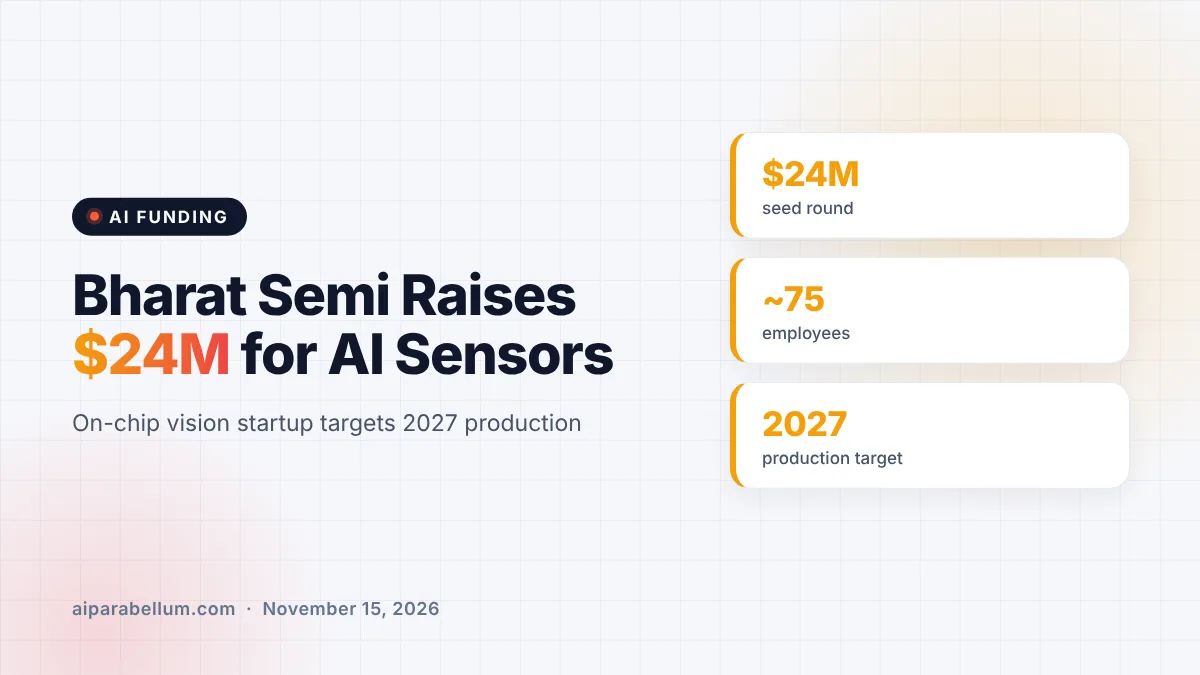
Bharat Semi, a New Delhi chip startup, has raised $24 million in seed funding to build AI image sensors that see and think on the same chip. The company has no revenue yet, but it says it already has design wins with U.S. defense firm General Atomics and India’s Kaynes Semicon. Its first sensors are aimed at commercial production in 2027.
What Bharat Semi Is Building
Most cameras today split the job across several parts. One chip captures the image, another cleans it up, and a third processor runs the smarts. Bharat Semi wants to fold all three steps into one programmable sensor.
The pitch is simple: if the sensor can understand what it sees, devices don’t need to ship raw video to a separate, pricier processor. Co-founder Vrinda Kapoor says this design could cut system costs by at least 70% compared with the usual three-chip setup. That figure is the company’s own estimate, and the sensors are still in development, so it remains to be proven in real products.
Kapoor summed up the goal as moving “from sensors to sense-making solutions.” In other words, the chip should report what is happening, not just hand over pixels.
Where the Sensors Could Show Up
The startup is chasing several markets at once. It gave a few examples of what on-chip vision could do, without naming specific customers or products:
- Smart home gear, like an air conditioner that notices an empty room and adjusts itself
- Industrial automation on factory floors
- Surveillance and security cameras
- Aerospace, including drones that process visual data without extra computing hardware
Inside the $24M Seed Round
The all-equity round was led by Info Edge Group, South Park Commons and Indus Bridge Ventures. Valour Capital, Micromax, Gaingels and individual investors also joined. For a seed round, $24 million is large, which reflects how expensive chip design is even for a company that does not build its own factory.
| Detail | What We Know |
|---|---|
| Amount | $24 million seed, all equity |
| Lead investors | Info Edge Group, South Park Commons, Indus Bridge Ventures |
| Founded | Late 2021, New Delhi |
| Team size | About 75 people across India and the U.S. |
| Design wins | General Atomics, Kaynes Semicon |
| Commercial production target | 2027 |
The company plans to spend the money on growing its engineering team, finishing product development and bringing its sensors to market. It has stated the funds will not go toward a separate chip factory project it announced back in 2024.
Bharat Semi’s Team and Timeline
Kapoor, a South Park Commons fellow with a background in healthcare technology, started the company with managing director Vinayak Dalmia, a former McKinsey and private equity professional. Its chief technology officer, Boyd Fowler, previously held that role at image-sensor maker OmniVision, which gives the team real sensor credibility.
The first-generation sensors are already in prototyping. A second generation with stronger AI features should reach the prototype stage by mid-2027, with the goal of getting them to customers by the end of that year.
Bharat Semi also wants to grow in the U.S. It has 10 to 12 people in Santa Clara working on engineering and business development, and it plans to roughly double that to around 20 by mid-2027. It has started hiring engineers in Europe too.
The Fab Project Stays Separate
In 2024, the startup announced a plan for a chip fabrication project in India with a technology partnership involving the U.S. Space Force. Kapoor says that effort is still in development, and the company is looking for domestic partners to build and run the facility. The sensor business itself will stay fabless, meaning outside foundries will make the chips while Bharat Semi focuses on design and software.
Why This Matters for India’s Chip Ambitions
India has committed billions of dollars to build a domestic semiconductor industry. The hope is to become an alternative to China as U.S. companies spread out their supply chains, though the country is not yet a major manufacturing hub.
The AI boom gives Indian startups another path: design specialized chips for global buyers instead of competing head-on in mass manufacturing. Kapoor framed it as a test of whether a global technology company can be built out of India. Other recent chip deals, like PowerLattice’s chiplet funding and Tenstorrent’s latest round, show investors still want specialized AI hardware.
What This Means for You
You won’t buy a Bharat Semi sensor directly, but chips like this could quietly change the gadgets you use. Here is what to watch:
- Smarter, cheaper devices: if on-chip vision works as promised, cameras and appliances could get AI features without big price jumps.
- More privacy by design: processing images on the sensor can mean less raw video leaving the device, though that depends on how makers use it.
- Edge AI keeps growing: this fits a wider shift toward running AI locally, a trend you can explore in our guide to computer vision tools.
- Long timelines: nothing ships at scale until 2027, so treat cost claims as goals for now.
Takeaway: Bharat Semi is betting that the future camera is a tiny AI brain, not just an eye. The money is real, but the product still has to prove itself.
For more hardware and startup stories, browse our latest AI news.
Sources
Bharat Semi has not posted an official announcement of the round; details come from an interview with co-founder Vrinda Kapoor reported by TechCrunch.
Conclusion
Bharat Semi’s $24 million seed round is a sizable early bet on AI image sensors that combine seeing and thinking on one chip. With design wins at General Atomics and Kaynes Semicon, a veteran OmniVision CTO and a growing U.S. team, the startup has a credible start. Still, it has no revenue and its sensors are not expected in commercial production until 2027. If it delivers, it could become a useful example of India designing advanced chips for the global market.