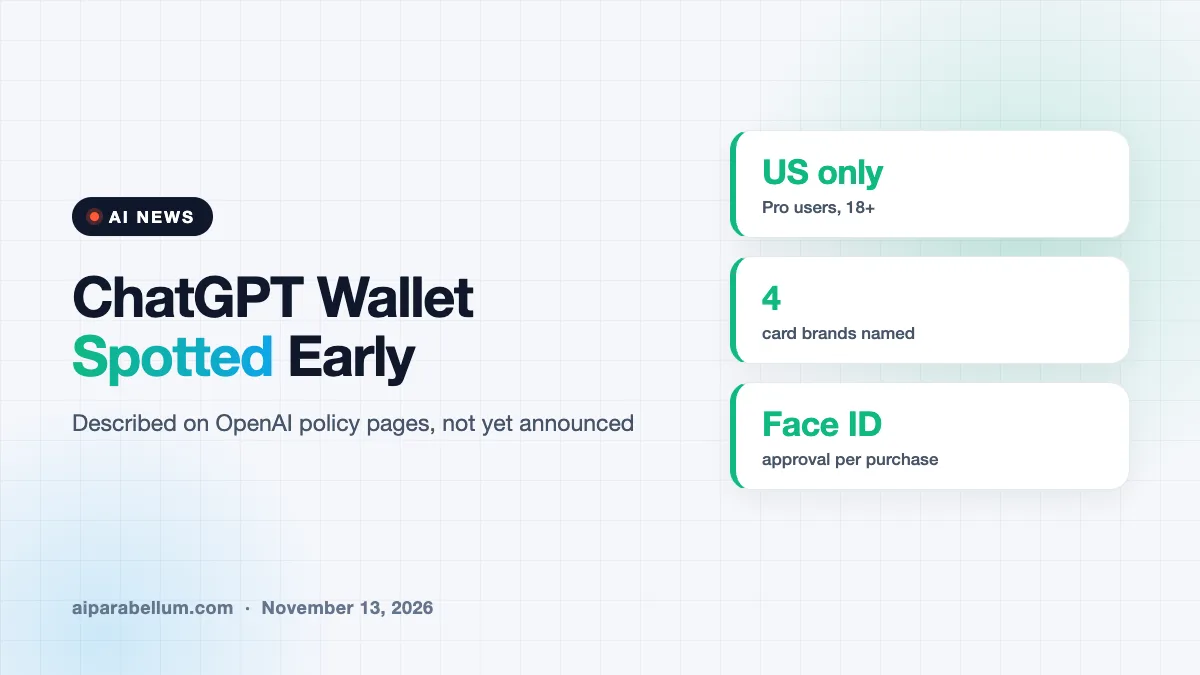
A feature called ChatGPT Wallet has quietly shown up on OpenAI’s own website. Two new policy pages and a help article describe a way to save a payment card inside ChatGPT so the assistant can pay for things on your behalf. OpenAI has not announced the feature, so treat everything here as a description of what the pages say, not a confirmed launch.
The pages surfaced in OpenAI’s public sitemap on November 13, 2026. We read all three in full. They do not give a launch date, and nothing in them says when or how widely the feature will roll out.
What the ChatGPT Wallet Pages Describe
According to the new Wallet Terms, the feature lets eligible users save a payment card and direct ChatGPT to use a credential linked to that card to buy something from a merchant. The terms are careful about what it is not. It does not create a bank account, hold a balance, extend credit or move funds.
The help article gives two everyday examples: asking for help finding a new sweater, or booking a hotel for a weekend trip. When it is time to check out, the assistant prompts you to set up the wallet and pay through it. This fits a wider push toward AI shopping carts across the industry.
One detail stands out. The help article says the wallet works in conversations with “your dot,” which it treats as a personal agent you set up first. It adds that the wallet is not available in Chat, Work or standalone Codex threads.
Who Could Use It, According to the Pages
The eligibility rules are narrow. The pages describe a US-only feature for adults, tied to the top consumer plan.
| Detail | What the OpenAI pages say |
|---|---|
| Plan | Pro users in the United States |
| Age | 18 or older |
| Location | US resident with a US billing address |
| Cards named | Eligible US-issued American Express, Chase, Mastercard and Visa cards |
| Chase cards | Primary cardholder only, verified in the Chase app |
| Approval | Biometric check such as Face ID or Touch ID |
| Not supported | Virtual cards, at launch |
The terms also say the card issuer, the payment network or OpenAI’s payment providers can decide a card is not eligible. The wallet may not work on every device, merchant or checkout.
How ChatGPT Wallet Purchases Would Be Approved
The pages put a human approval step in front of every purchase by default. Before an order goes out, the wallet shows the details it has, including the total or maximum price and whether the purchase creates a recurring charge. You then select Approve and pass a biometric check.
A substitute card number at checkout
After approval, the help article says a payment token is generated in place of your real card details. The merchant sees that substitute number, while the charge still lands on your actual card account. The privacy notice adds that OpenAI itself does not receive the full card number or security code, only a tokenized credential and limited details such as the last four digits.
Approval in advance
The terms say you must review and approve each purchase, or grant ChatGPT the authority to approve purchases in advance. The pages do not explain how that advance approval would work, so we will not guess. Given how agents behave unsupervised in recent tests, that option deserves close attention when details arrive.
What OpenAI Says It Is Not Responsible For
The terms draw a firm line around liability. The merchant is the seller of record, and OpenAI says it is not a bank, card issuer, payment network, lender or merchant for these purchases.
- Order problems, returns and refunds go to the merchant.
- Unrecognized charges and billing errors go to your card issuer.
- Wallet errors, or a purchase that differs from what you approved, go to OpenAI support.
- Removing a card does not cancel an order that was already submitted.
The terms also carry a blunt warning that AI systems can make mistakes, and tell users not to approve a purchase unless the details are correct. That caution matches outside findings that shopping models fail a large share of test tasks, and that chatbots sometimes recommend fake stores.
What This Means for You
Nothing changes for you today. If the feature does launch as described, these are the points to keep in mind:
- Never paste a card number or security code into a chat. The pages say card details belong only in the secure card form.
- Read every approval screen, especially the total and any recurring payment terms.
- Expect refunds and disputes to run through the store and your bank, not through OpenAI.
- Know what is collected. The privacy notice lists purchase details, delivery details, device data and fraud signals, and says this data is not sold or used for targeted advertising.
Banks and retailers are setting their own rules for this kind of buying too, from purchase intent checks to agent storefront controls. A wallet inside the ChatGPT app would put OpenAI in the middle of that system. You can follow updates in our AI news feed.
Sources
Primary source: OpenAI’s ChatGPT Wallet Terms. Also read: OpenAI’s ChatGPT Wallet Privacy Notice and the OpenAI Help Center article on Wallet purchases.
Conclusion
ChatGPT Wallet is not announced, but OpenAI’s own pages now describe it in detail: a saved card, a per-purchase approval with a biometric check, and a substitute card number at checkout. The pages limit it to adult Pro users in the United States and name four card brands. They also leave the hard parts of a purchase, such as refunds and disputes, with merchants and banks. Until OpenAI says something publicly, the timing and the final shape of the feature remain unknown. If you plan to let an AI assistant spend your money, the approval screen is the part to take seriously.