Nvidia chip tracking is back in the spotlight. Illinois Representative Bill Foster says Nvidia’s own staff privately told him the company could build location tracking into its advanced AI chips, even as an industry group it belongs to publicly called the idea potentially unworkable. The claim lands while Congress weighs new chip rules in the wake of the scandal that led to Jensen Huang’s resignation as CEO.
What Foster Says Nvidia Told Him About Chip Tracking
Foster, a Democrat on the House Committee on Science, Space, and Technology, cosponsors the Chip Security Act. The bill would require a way to verify where advanced AI chips end up, so they cannot be quietly smuggled into China. He shared his account in an interview published on Thursday, November 12.
According to Foster, Nvidia representatives took part in technical talks about the safeguards the bill calls for. Their reaction, he says, was that of course they could do it. He also says they never put that in writing.
Nvidia did not respond to requests to confirm or dispute his account. So for now, this is one lawmaker’s description of private conversations, not a company statement.
Why the Gap Matters
The private message stands in contrast to the public record. In March 2026, the Semiconductor Industry Association, which counts Nvidia as a member, opposed the bill and described its tracking mandates as new, untested, and potentially infeasible.
If Foster’s account is accurate, it suggests the technical barrier may be smaller than the industry has argued. That could shape how hard lawmakers push in the coming weeks.
How the Chip Security Act Would Track AI Chips
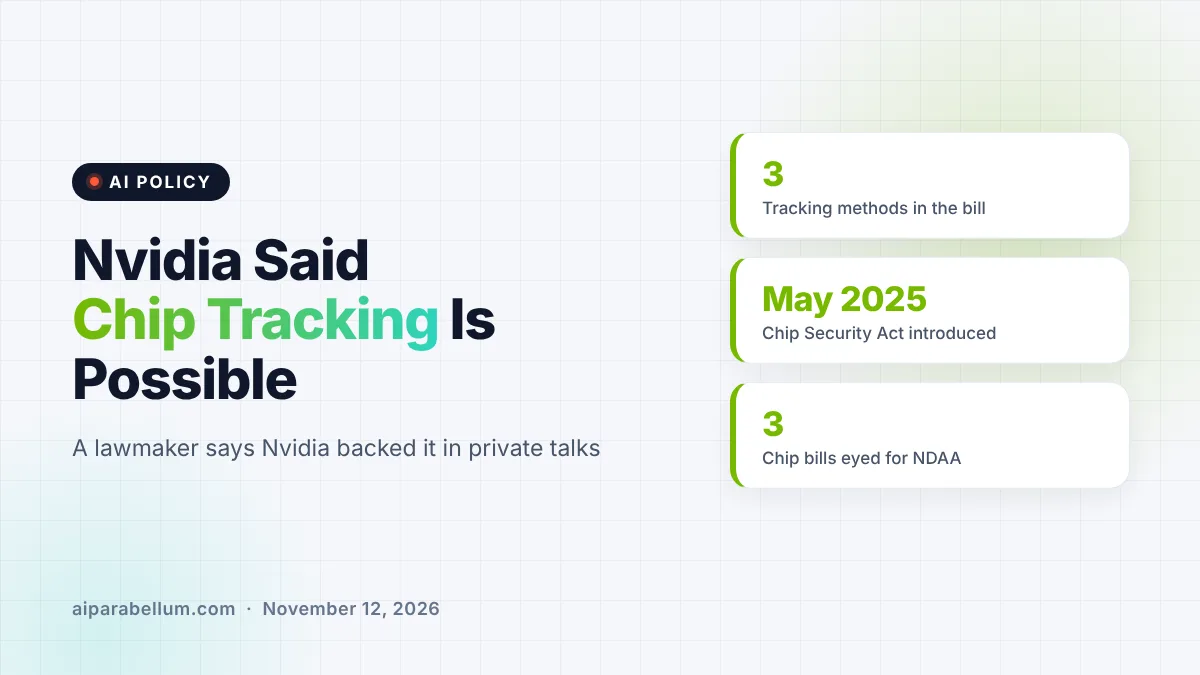
The bill was introduced in May 2025. It does not lock in a single method. Instead, it allows several ways to confirm a chip’s location, each with different strengths.
| Method | How it works | Key tradeoff |
|---|---|---|
| Facility inspections | Checks of data centers where chips are installed | Slow and labor heavy |
| Company attestations | Firms formally state where their chips are located | Relies on trusting the buyer |
| Ping-based location | The GPU sends a location signal when it comes online | Hardest to get around |
A September analysis from the Center for Security and Emerging Technology found the ping-based approach to be the most cost-effective option. It is also the one that would need the deepest cooperation from chipmakers.
A Clue in Nvidia’s Existing Tools
Nvidia already sells software that hints at what is possible. In December 2025 it announced Fleet Intelligence, a tool that lets customers monitor how their advanced chips are performing across data centers.
Nvidia confirmed at the time that the tool could indicate which country chips were in. The company has not said whether that ability could be used to stop smuggling, and it has played down the size of the problem, saying diversion of controlled products is tiny next to China’s own computing power.
Nvidia Chip Tracking and the Huang Fallout
The debate has new urgency. Jensen Huang stepped down after reports of an affair with Alice Huang, who runs Megaspeed, a Singapore firm now under investigation for allegedly smuggling advanced GPUs to China. You can catch up on Huang’s resignation and the board’s investigation in our earlier coverage.
The Chip Security Act is one of three chip security bills under consideration for the Senate’s National Defense Authorization Act. Foster says the scandal has built support among his colleagues, and he expects strong political pressure on companies to verify where their chips really are.
- The current bill would only show where chips are, not switch them off if smuggled.
- Foster plans stricter legislation next year that would require a license to operate advanced GPUs.
- Under that idea, a GPU would need a verified license before it could connect.
- Huang has also agreed to testify before Congress, which could put these questions on the record.
What This Means for You
Most people will never buy a data center GPU, but these rules could still touch the AI tools you use every day. Chip supply affects how much cloud computing costs, and that flows into the price and speed of AI services.
Here are a few practical takeaways:
- Expect tighter export rules. If tracking becomes law, chipmakers and cloud providers will add compliance steps that may slow some shipments.
- Watch the defense bill. The National Defense Authorization Act is the vehicle to follow over the next few weeks.
- Read company claims carefully. Public statements and private positions on AI chip policy do not always match.
For businesses that depend on GPU capacity, it is worth asking your cloud provider how new location rules might affect contracts. You can follow the story as it develops on our AI news page.
Sources
This report is based on an interview by MIT Technology Review with Representative Bill Foster.
Conclusion
Foster’s account suggests Nvidia believes chip tracking is technically doable, even as its industry group argued otherwise in public. Nvidia has not confirmed that, and the claim rests on conversations that were never written down. Still, with the Huang scandal driving attention to smuggling, the idea of tracking where AI chips go has more momentum in Congress than it has had in a long time. The coming defense bill debate will show whether that momentum turns into law.