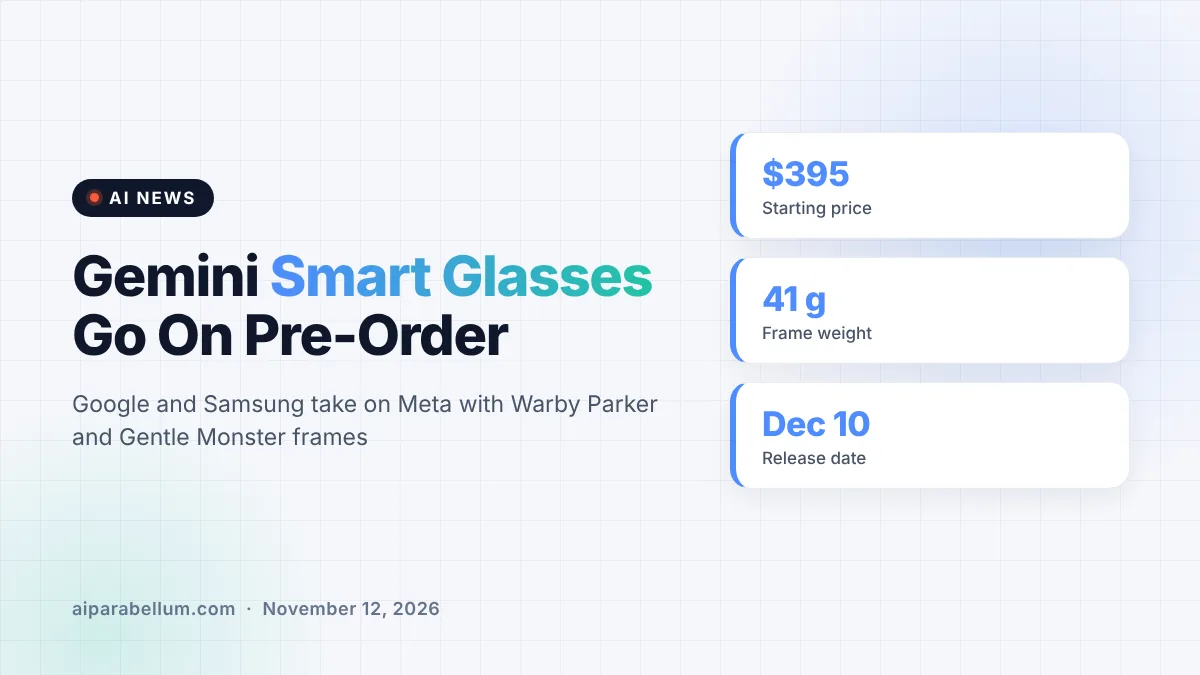
Google and Samsung just took direct aim at Meta’s lead in AI eyewear. Pre-orders opened today for new Gemini smart glasses built by Samsung, with frames designed by Warby Parker and Gentle Monster, and the first pairs ship on December 10. Prices start at $395, and the glasses work with Pixel, Galaxy and iPhone models.
What the Gemini Smart Glasses Can Do
Google calls the lineup “intelligent eyewear.” The idea is simple: Gemini can see what you see and hear what you ask, so you get help without pulling out your phone. You start a request by saying “Hey Gemini” or tapping the frame.
Google lists a long set of everyday uses. Here are the main ones:
- Ask about things in front of you, like a mural, a building or a book on a shelf.
- Look at an event poster and check your Calendar on the spot.
- Add items you are looking at to a grocery list or get meeting reminders.
- Hear turn-by-turn walking directions from Google Maps in your ear.
- Get live speech translation across more than 70 languages, with automatic language detection.
- Take photos and video with a 12-megapixel ultra-wide camera, play music and take calls.
There is also an accessibility angle. A feature called Guided Vision gives spoken descriptions of surroundings for people who are blind or have low vision. Users can also connect to Aira, a service with trained human visual interpreters, though both features need an Android phone at launch.
Early hands-on impressions
Reviewers who tried the glasses before launch came away impressed with translation. In demos with several languages playing at once, Gemini translated each one without the user picking language pairs first. That is an area where Meta’s glasses have stumbled, since they often require downloading a specific language pair.
Gemini also reportedly corrected itself in real time and asked for a better angle when it could not identify an object. These are small touches, but they make the assistant feel less brittle. If you have used the newest Gemini 4 models on your phone, this is the same assistant moving onto your face.
Prices, Specs and Release Date
The two collections aim at different tastes. Warby Parker goes for classic everyday frames, while Gentle Monster leans into bold colors and runway looks. Here is how they compare.
| Detail | Warby Parker collection | Gentle Monster collection |
|---|---|---|
| Starting price | $395 | $449 |
| Styles | 3 frames (Alden, Reid, Wren) | 6 frames |
| Colors | Pine, Saddle, Jet Black | Dark red, pink, gray, yellow and more |
| Markets | United States | United States and South Korea |
| Prescription lenses | Yes, wide range of options | Available for most frames |
Both lines share the same hardware. The frames weigh about 41 grams, the battery lasts up to nine hours, and the charging case can refill the glasses up to seven times. Samsung’s design also splits some computing work with the paired phone to lighten the load on the glasses.
Pre-orders are live at Warby Parker and Gentle Monster, and demos are available at select stores, including more than 360 Warby Parker locations. The glasses go on sale in stores and online on December 10.
Privacy Is the Big Selling Point for These Smart Glasses
Camera glasses have a reputation problem, and Google clearly knows it. The company published a separate post explaining how the glasses protect both the wearer and the people nearby. The core promise is that camera visuals Gemini uses are not saved in your Gemini History and are not used to train AI models or target ads.
The most notable choice is automatic face redaction. Google says the glasses blur bystanders’ faces before images reach Gemini, and early testers found Gemini refused to identify people for privacy reasons. That is a real tradeoff, since it gives up data that could make the assistant smarter, a topic we have explored in our piece on AI data anonymization.
Other safeguards Google built in
An outward LED lights up whenever you take a photo or video, and sensors are designed to block recording if that light is covered. Directional microphones focus on your voice instead of nearby conversations, and every pair has a physical off switch.
Google is also using its wider platform to discourage misuse. Google Play bans apps that use the glasses’ camera for real-time facial identification or social livestreaming, and Google Ads will not allow products that hide recording lights. Users must agree not to record people without permission, and Google says it may disable glasses that break those rules.
How This Changes the AI Glasses Race
Meta has owned this category so far. Market research firm Omdia estimates Meta shipped about 3.4 million AI glasses in the first half of this year, taking roughly 81% of the market. Samsung’s frames are also around 20% lighter than Meta’s second-generation Ray-Ban glasses.
Apple is expected to join too, with reports pointing to smart glasses built around Siri next year. With three of the biggest tech companies now in play, glasses are shaping up as the next major home for AI assistants after the phone. Gemini is already spreading fast across devices, from Android Auto to messaging tools that flag scam texts.
What This Means for You
If you have been curious about AI glasses but uneasy about Meta, you now have a serious alternative. Here is what to keep in mind before you order:
- Check your phone. Supported models include Pixel 7 and newer, recent Galaxy S, Fold and Flip phones, and iPhone 13 Pro and newer.
- Know the limits. The glasses need an 18+ Google account from the US or South Korea, and some features are Android-only at launch.
- Try before you buy. Store demos let you test fit, sound and translation before December 10.
- Review your settings. You control app access to the camera and mic, and you can delete Gemini chats at any time.
If you are still choosing an assistant, our Claude vs Gemini comparison breaks down where each one shines. You can also follow every launch like this on our AI news page.
Sources
Primary source: Google’s intelligent eyewear pre-order announcement. Additional details from Google’s eyewear privacy post, with reporting from The Verge and The Chosun Ilbo.
Conclusion
Google and Samsung’s Gemini smart glasses bring strong translation, everyday help and stylish frames at prices starting at $395. The bigger story is privacy, with face redaction, tamper-aware recording lights and platform-wide rules that go further than what Meta offers today. Whether that wins over shoppers will become clear after the December 10 launch. For now, Meta finally has real competition in AI eyewear, and that is good news for anyone thinking about buying a pair.