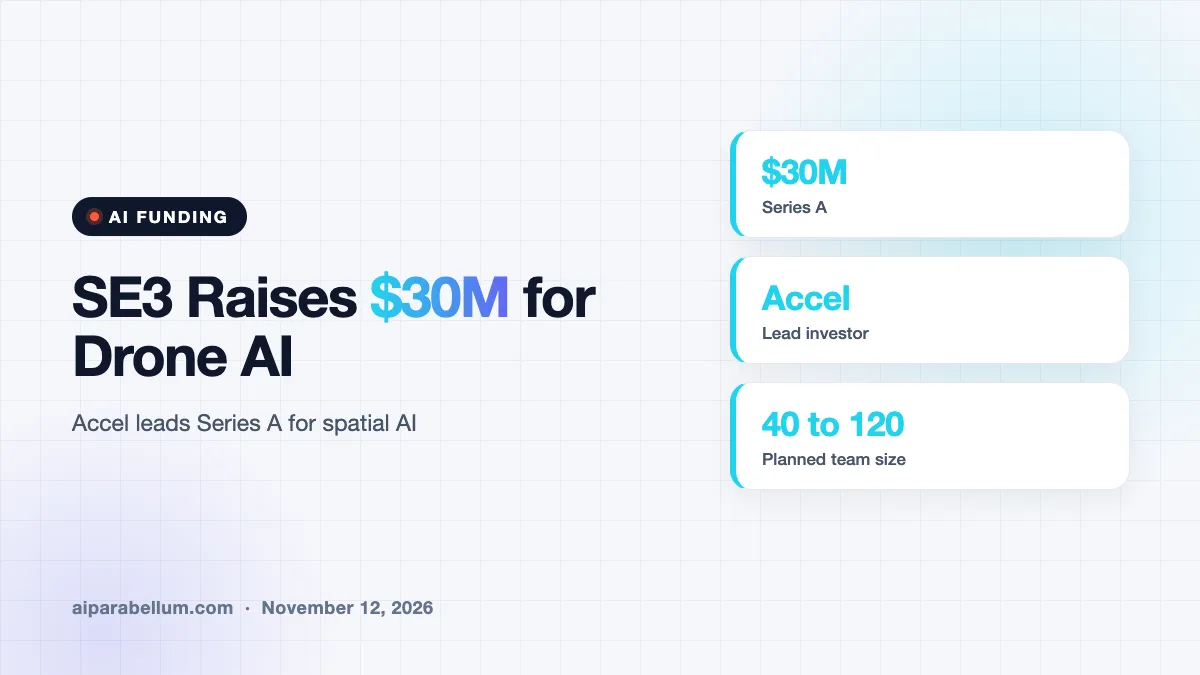
SE3, a Munich startup building spatial AI for military drones, has raised $30 million in a Series A round led by Accel. The company makes software that helps unmanned systems understand the 3D world around them, even when GPS is jammed. It is a big jump from the roughly $6.1 million seed round the company announced less than five months ago.
The round also includes Keen Venture Partners, Lakestar and Seedcamp. Here is what the company does, how its system works and why investors are paying attention.
What SE3 Actually Builds
SE3 spun out of a computer vision lab at the Technical University of Munich. Its CEO, Lukas Köstler, and CTO, Simon Klenk, did their PhDs there, and lab chief Daniel Cremers serves as chief science officer.
The software takes video and sensor feeds from several drones and ground vehicles and merges them into one 3D picture of the battlefield. A second layer labels objects and how they relate, so a soldier can ask questions in plain language. The company also builds the AI that runs inside the drones, handling navigation, object detection and swarm behavior.
How the Spatial AI Drone Software Works
SE3 does not hand raw sensor data to a chatbot. Instead, it uses classical computer vision to turn huge amounts of data into a database that a language model can query. The model then calls conventional tools, such as a path planner that avoids mountains or enemy lines of sight.
Köstler told Fortune that simply feeding raw data to a model would not work at all. Customers can swap in their own preferred frontier model as the “brains,” and the system can run fully offline. Actions like takeoff can be set to require a human operator’s approval.
Voice Commands Instead of Joysticks
The idea is that one operator can direct many vehicles by speaking. A soldier could ask for reconnaissance two kilometers north over a forest, and a suitable drone would take off, fly the mission and report back. The company says the high-level fleet command layer is still maturing and needs another year or two of work.
Funding, Customers and Growth Plans
| Detail | What We Know |
|---|---|
| Round size | $30 million Series A |
| Lead investor | Accel |
| Other backers | Keen, Lakestar, Seedcamp |
| Earlier funding | About $6.1 million seed (June) |
| Team size | About 40 now, about 120 planned |
| Customers | Bundeswehr and Ukraine contracts |
| Partners | Hensoldt, Auterion, ERC |
SE3 says it has shipped thousands of systems over the past two years. Its basic capability of locating a drone without GPS has reportedly been delivered thousands of times and is described as very robust. The new money will fund hiring and new offices in London, Berlin, the Nordics, the Baltics and Poland.
Why Spatial AI Matters for Drones
SE3 is betting that militaries will not want to be locked into one drone maker’s software. If each manufacturer controls its own stack, buyers struggle to mix equipment from different vendors. Procurement programs in the US and Germany push for open, modular systems, which favors software that works across many platforms.
- GPS jamming is widespread in Ukraine, so drones need to navigate without satellites.
- Large drone fleets overwhelm the people supervising them.
- Wider AI robots are moving into physical work too.
- Defense revenue will drive the business for at least the next 12 months.
- A small team will begin exploring civilian robotics.
What This Means for You
You may never use military software, but the approach is worth noticing. The system pairs a language model with ordinary, reliable tools instead of trusting the model to reason about physics alone. The same pattern shows up in the AI agents many businesses are now building.
It also shows how fast AI startup funding keeps moving into defense and autonomy. The story raises hard questions too: human approval steps, export laws and who decides how these tools are used. Fortune notes that military work makes some AI researchers uneasy, and SE3 says elected lawmakers ultimately set the limits for a German company.
Sources
Primary source: none was found, so this report relies on interviews and company statements published by Fortune. Additional reporting from Trending Topics.
Conclusion
SE3’s $30 million Series A shows investors are backing AI that can see and act in the physical world, not only chat. The company combines classical vision, conventional planning tools and a swappable language model to guide drones where GPS fails. The fleet command layer is still unfinished, so real-world results will matter more than the pitch. Watch how SE3 grows and which customers beyond defense it wins next.