
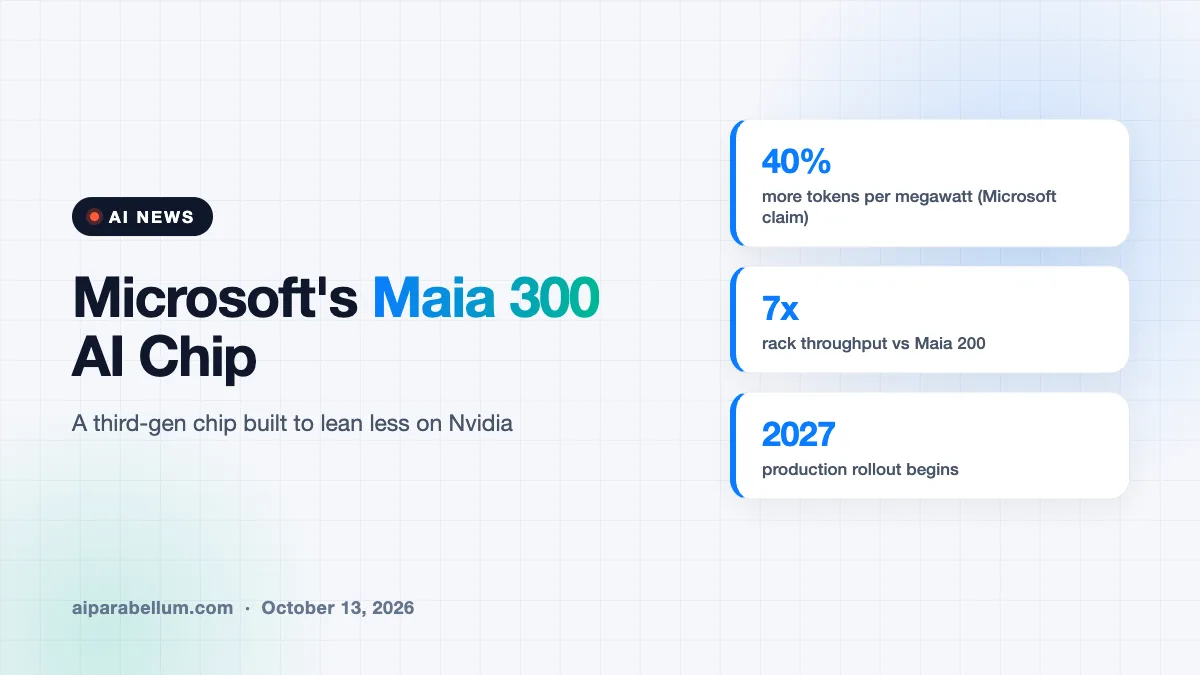
Microsoft has introduced Maia 300, the third generation of its homegrown AI chip, and it has big plans for it. The company wants Maia to become the main engine that runs AI across its products and services, which would make it far less dependent on graphics processors from Nvidia and AMD. Production deployments are set to begin in 2027.
Here is what the new chip promises, why Microsoft is building its own silicon, and what it could mean for the AI tools you use every day.
What Microsoft Announced
Maia 300 is designed to be what Microsoft calls its primary AI inference system. Inference is the work of running a trained model to answer your questions, write code, or complete tasks, and it is where most of the day-to-day computing cost of AI now sits.
Microsoft says the chip is built for the newest kinds of AI workloads. That includes long-context reasoning, conversations where speed matters, and agents that carry out long chains of steps without stopping.
The Headline Numbers
Scott Guthrie, who runs Microsoft’s cloud group, shared two efficiency claims. Both come from Microsoft and have not been independently tested yet.
| Claim | What Microsoft Says |
|---|---|
| Energy efficiency | About 40% more tokens per megawatt than leading GPU-based systems |
| Rack-scale throughput | Up to 7x the token output of Maia 200 in a full 96-accelerator setup |
| Rollout | Production workloads starting in 2027 |
| Scale | Multi-gigawatt Azure Maia deployments beginning in 2027 |
Tokens per megawatt is a useful way to think about this. It measures how much AI output a data center can produce for the electricity it burns, and power has become one of the biggest limits on how fast AI companies can grow.
How the Maia 300 Chip Is Built
Microsoft is using a chiplet design for Maia 300, manufactured on TSMC’s N2P process. Instead of putting everything on one piece of silicon, the design splits compute, the memory controller, and input/output into separate parts.
According to Microsoft’s Azure hardware team, that split frees up more space for raw computing power. It also lets each part use the manufacturing technology that suits its job best.
Maia 200 Is Already Doing Real Work
This is not a first experiment. Maia 300 follows Maia 200, which Microsoft announced only in January and already uses in production.
- Microsoft Copilot, the company’s consumer AI assistant.
- GitHub Copilot, the coding assistant used by millions of developers.
- Microsoft Foundry, its platform for building AI apps.
- Microsoft’s own in-house AI models.
Guthrie described Maia 200 as the best performing AI infrastructure in Microsoft’s fleet when measured on real services. Maia 300 is meant to build on that with a full system tuned for heavier agentic work.
Owning the chip, the cloud, and the models gives a company control over the cost of every answer an AI produces. That is the real prize in this race.
Why Microsoft Wants Its Own AI Silicon
Nvidia’s GPUs power most of the world’s AI today, and demand has kept prices high and supply tight. Building custom chips lets Microsoft control costs, plan capacity on its own timeline, and design hardware around its exact needs.
There is also a model angle. Microsoft AI CEO Mustafa Suleyman said the team needs to work across the full stack, down to the silicon, and design the chip together with its models. Running Microsoft’s own models on Maia is a key part of its effort to catch up with Google DeepMind, OpenAI, and Anthropic.
Microsoft is not alone here. Google, Amazon, and Meta have all invested in custom AI chips for the same reasons, which is why chip efficiency has become a core part of how AI companies compete on AI pricing models.
What This Means for You
You will never see a Maia chip, but you may feel its effects.
- Cheaper inference can lead to lower prices or higher usage limits on AI tools built on Azure.
- Faster, more efficient hardware helps AI agent tools run long tasks without slowing down.
- Developers using GitHub Copilot or Foundry are already running on Maia hardware in some cases.
- Businesses comparing AI business tools may see Microsoft compete harder on cost from 2027 onward.
The biggest open question is timing. The efficiency claims are Microsoft’s own, and the chip will not reach production until 2027, so real-world results are still more than a year away.
Sources
This report is based on Microsoft’s announcement as covered by The Verge.
Conclusion
Maia 300 shows how serious Microsoft is about running its AI on hardware it controls. The company is promising better energy efficiency than leading GPU systems, a big jump over Maia 200, and multi-gigawatt deployments starting in 2027. If those claims hold up, Microsoft will lean far less on Nvidia and AMD, and the savings could eventually show up in the price and speed of the Copilot tools millions of people already use. For more stories like this, visit our AI news hub.
