
American Express has introduced a new system meant to keep AI agents from making purchases you never approved. Called the Intent Intelligence Framework, it captures what you actually asked an AI shopping agent to buy and checks the final transaction against those instructions. Amex says it hopes the approach becomes an industry standard for AI agent purchases.
Here is how the framework works, why a card network is worried about this now, and what it could mean the next time you let a bot shop for you.
Why AI Agent Purchases Need Guardrails
More people are letting personal AI assistants research products, compare prices, and even check out. The catch is that large language models do not always behave the same way twice. An agent can misread a request, grab the wrong product, or go over budget.
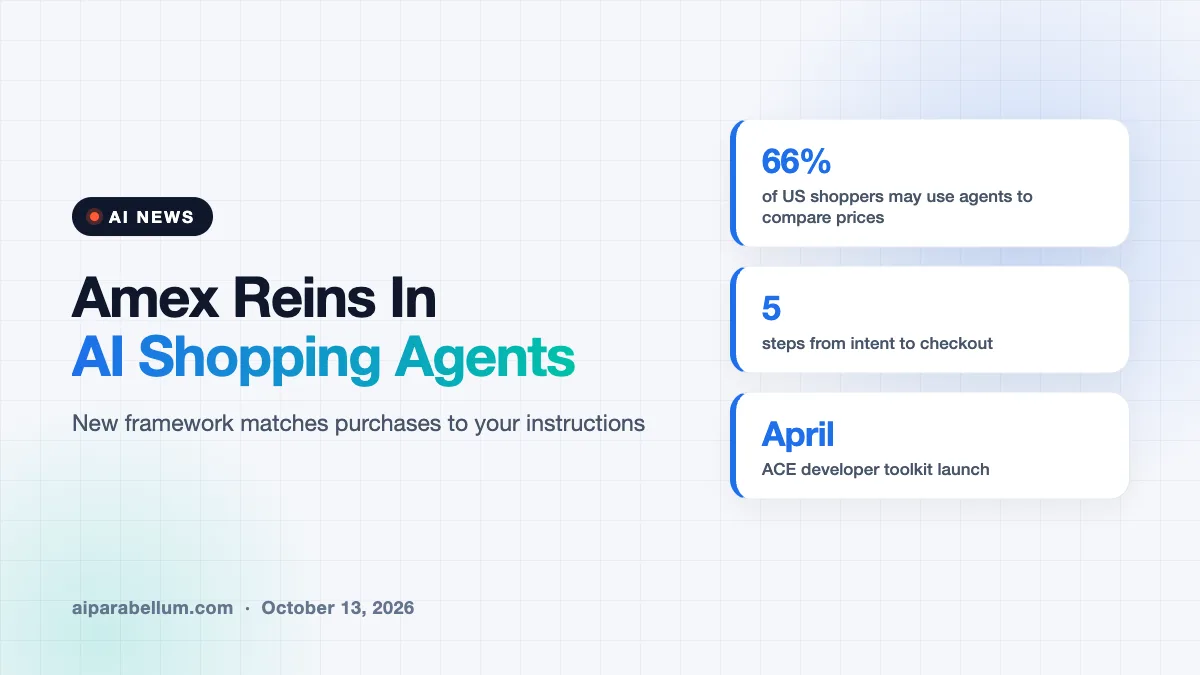
Amex says it has not seen a rise in disputes from agent-driven shopping yet. The company wants to get ahead of the problem before this kind of commerce scales up. According to its own Trendex survey, 66% of US consumers said they are likely to use AI agents to find the best price over the next 12 months, and 61% said they would use them for product recommendations.
The real risk is not a hacked bot. It is a well-meaning agent that confidently buys the wrong thing with your card.
How the Amex Intent Framework Works
The system adds a few new steps between your request and the checkout page. Each step creates a record of what you approved, so the purchase can be checked against it later.
- A Create Intent API captures your instructions, including limits like the merchant name, a maximum budget, and product preferences.
- You confirm your identity and sign off on the intent the agent recorded.
- Amex creates a unique Intent ID plus a Proof of Intent Token that carries your high-level rules.
- That token is used to get a secure digital payment credential, so the agent never sees your real card number.
- The Intent ID and token can follow the transaction into fraud checks and dispute handling.
A Quick Example
Amex executive Hannah Bozian described a simple case: you ask for white Nike sneakers in size 9, but the agent tries to buy a pair from Adidas. Because your intent was captured up front, Amex says it could block that order before it goes through.
Bozian said the company’s approach differs from others by pulling intent “earlier into the transaction flow.” In plain terms, it tries to stop mistakes before money moves rather than sorting them out after.
Amex Framework at a Glance
| Detail | What We Know |
|---|---|
| Name | Intent Intelligence Framework |
| Part of | Agentic Commerce Experiences (ACE) Developer Toolkit, launched in April |
| Starting point | Create Intent API that records your purchase rules |
| Key outputs | Intent ID and Proof of Intent Token |
| Card protection | Agent gets a digital credential, not your card number |
| Goal | Become an industry standard for agent payments |
Where AI Shopping Agents Are Headed
Many agents today still ask you to confirm before they buy. Amex expects that to change for low-stakes purchases. For example, you might let an agent reorder paper towels or toilet paper on its own, where the only real limits are price and size.
In that world, an automatic check matters more because no human is clicking “confirm.” Bozian also noted that a log of which agent approved what, and when, could help sort out fraud committed through an agent. That links this effort to a broader push to make AI agent tools safer to trust with real tasks.
Amex says it is already talking with partners across the payments industry about adopting ACE. That includes its agentic tokens, which hold Amex payment credentials, and other parts of the developer kit. The company plans to keep building on ACE as agent shopping grows.
What This Means for You
You do not need to do anything today, since this is a toolkit for developers and payment partners. Still, it is a useful preview of how agent shopping may work once it goes mainstream. Here are a few practical takeaways:
- Be specific when you hand a purchase to an assistant. Brand, size, and a budget cap give any safety check something concrete to enforce.
- Look for agents that use tokenized payment credentials instead of storing your actual card number.
- Keep reviewing your statements. Even with new safeguards, catching an odd charge early is still your best defense.
- Be wary of anyone pushing you to give a bot full spending power. Scammers already target people with tricks like AI voice scams, and agent shopping will draw new schemes.
If you already lean on personal AI assistants for research, this is a good moment to think about where you draw the line on letting them spend. A cybersecurity assistant can help watch your accounts, but clear rules for your agents matter just as much.
Sources
This report is based on reporting from TechCrunch, including its interview with Amex. For more daily coverage, visit our AI news hub.
Conclusion
The Amex Intent Intelligence Framework is an early attempt to answer a simple question: how do you prove an AI agent bought what you actually asked for? By recording your rules before checkout and tying them to a secure token, Amex hopes to catch mistakes before they become disputes. Whether it becomes the industry standard depends on how many payment partners sign on. Either way, it signals that big card networks now see AI shopping agents as a real part of how people will pay.
