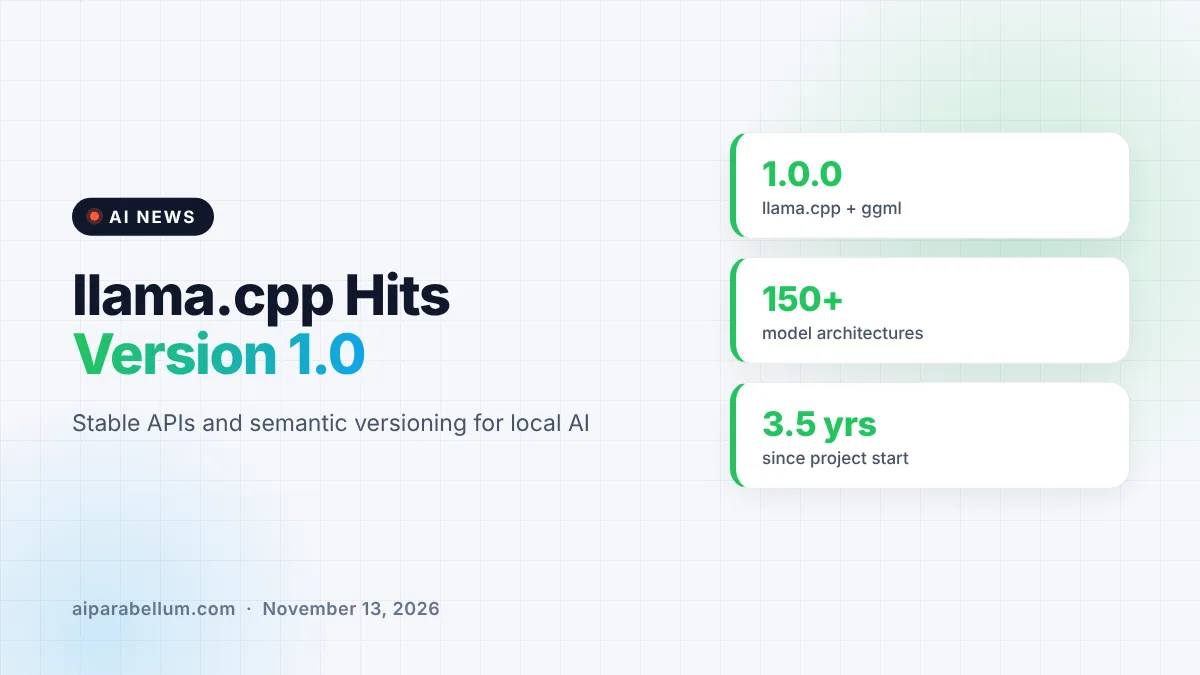
llama.cpp 1.0 is officially here. On November 13, 2026, the team behind the popular open-source engine for running AI models on your own hardware released version 1.0.0 of both llama.cpp and its underlying ggml library. The big news is not one flashy feature but a promise: from now on, any change that breaks the public API will come with a major version bump, so the apps built on top of it know exactly what to expect.
If you have ever run a chatbot on your laptop without sending data to the cloud, there is a good chance llama.cpp was doing the work behind the scenes. That is why a version number matters more here than it might for a smaller project.
What llama.cpp 1.0 Actually Changes
The project started about three and a half years ago and grew fast. Lots of downstream apps now depend on its code, and every new integration means more developers relying on its interfaces staying put. The team says the 1.0 release reflects that responsibility.
Going forward, the maintainers will follow semantic versioning across all ggml-org projects. In plain terms, the version number now tells you how risky an update is.
| Version bump | What it signals | Should you worry? |
|---|---|---|
| Major (2.0, 3.0) | A breaking change to the public C API | Yes, apps may need code changes |
| Minor (1.1, 1.2) | New features, backend updates, model support or API additions that stay compatible | Usually safe to update |
| Patch (1.0.1) | Bug fixes with no API change | Safe to update |
That may sound like housekeeping, but it is a real shift. Until now, developers who built on llama.cpp often had to watch for surprise changes that could break their tools after an update.
New Features in the 1.0 Release
The release notes on GitHub show that 1.0 is also a sizable update on its own. Here are the highlights:
- The old, deprecated public API is removed, and the speculative decoding API moves into the main header.
- New support for FP8 key-value caches and a memory cache for mixture-of-experts models that can share work with the CPU.
- Three new text model architectures, plus new vision and text-to-speech models.
- Security hardening for the built-in llama-server, covering issues like SSRF, CORS and DNS rebinding.
- A new speech endpoint and a redesigned web interface with chat groups and a markdown editor.
Broad hardware and model coverage
The ggml engine is built to run on almost any hardware through dedicated backends. Each backend can be compiled as its own library and loaded when the program starts. The team says llama.cpp now supports more than 150 model architecture variants and all mainstream speculative decoding methods.
Testing is getting more serious too. The project uses Hugging Face infrastructure to check every change, and hardware makers including NVIDIA, AMD, Qualcomm, Arm, IBM and Intel are helping add test machines across major platforms. That is a lot of industry backing for a tool that began as a side project.
Where You Can Get llama.cpp Now
The team also wants llama.cpp to be easier to install. It is now available through a long list of channels, so you may not need to build it yourself.
| Channel | Platforms |
|---|---|
| Pre-release builds | Linux, macOS, Windows, Android, iOS |
| Homebrew | macOS, Linux |
| Winget | Windows |
| conda-forge | Windows, macOS, Linux |
| Docker and Debian | Linux |
| MacPorts and XCFramework | macOS, iOS |
The same team also ships Llama desktop apps for macOS and Windows, which offer a simpler way in if you would rather not use the command line.
Why a Stable llama.cpp Matters for Local AI
Local AI has been booming as people look for privacy and lower costs. Hardware like the new RTX Spark machines and tools that run agents right on your computer, such as Perplexity Computer, show how much attention this space is getting. Many local apps use llama.cpp under the hood, even when they do not say so.
A stable foundation helps that whole ecosystem. When app makers can trust that minor updates will not break their code, they can ship new model support faster. That means quicker access for you to fresh open-weight models like the recent releases from Meta and NVIDIA.
The maintainers also addressed a hot topic: AI-written code. They say they use LLMs in their own development in a careful way, but that keeping a clean codebase and understanding the details will stay their top priority.
What This Means for You
You do not need to do anything dramatic, but this release is a good moment to check your setup. Here is a quick plan:
- If you use a local AI app, look for an update in the coming weeks that moves it onto llama.cpp 1.0.
- If you are a developer, review the removed deprecated API before upgrading, since older code may stop compiling.
- If you run llama-server on a network, update soon to pick up the security fixes.
- If you have avoided local AI because setup looked hard, try a package manager install or the desktop apps.
Want more on the models you can run? Browse our open model coverage or catch up on the latest AI news for new releases.
Our take: version 1.0 is less about new tricks and more about trust, and trust is what turns a hobby tool into infrastructure.
Sources
Primary source: llama.cpp v1.0.0 announcement from ggml-org. Additional details from the llama.cpp v1.0.0 release notes on GitHub.
Conclusion
llama.cpp 1.0 marks the moment one of the most important open-source AI projects formally commits to stability. The release adds new model support, security fixes and a refreshed web interface, but the real change is the versioning promise that lets developers update with confidence. For anyone who runs AI on their own hardware, that is quietly great news. Expect your favorite local AI apps to follow with updates soon.