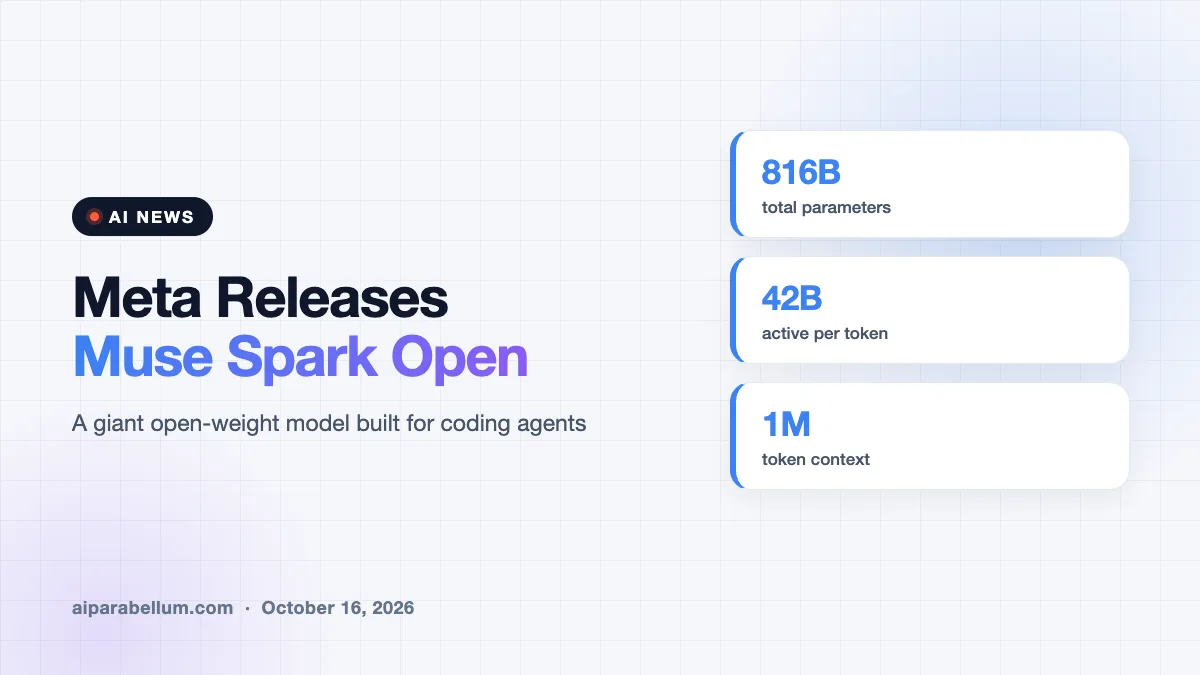
Meta has released Muse Spark Open, an open-weight AI model with about 816 billion parameters that anyone can download from Hugging Face. Meta calls it the most capable US open-weight model so far and says it was trained for agentic coding. It is also the first model tuned to run locally on Apple’s new M5 Ultra Mac Studio, as long as you have roughly a terabyte of memory.
What Muse Spark Open Can Do
Meta trained the model on real developer work, like multi-file refactors and long debugging sessions. It can read a codebase, write and fix code, call tools, and correct itself over long tasks.
It is not limited to text. Muse Spark Open accepts images, audio, and video as input, so it can read a screenshot, listen to a voice note, or watch a screen recording while it works.
The model supports a context window of about 1 million tokens, and that window includes media tokens. You can adjust how hard it reasons, from low to extra high, but you cannot switch reasoning off completely.
How It Compares to Chinese Open Models
Meta has argued that the US should not let Chinese labs lead in open AI. Its own benchmarks suggest Muse Spark Open beats two leading Chinese models, GLM 5.3 and Kimi K3, on agentic tasks and visual reasoning. These are company-reported results, so independent testing will matter.
Inside the Muse Spark Open Architecture
Muse Spark Open uses a mixture-of-experts design. Each layer holds 256 small expert networks, and a router picks 8 of them for every token.
That means the model only uses about 42 billion parameters per token, which keeps it much faster than its full size suggests. The catch is memory, since all the experts must stay loaded at once.
| Spec | Muse Spark Open |
|---|---|
| Total parameters | About 816 billion |
| Active per token | About 42 billion |
| Experts per layer | 256, with 8 active |
| Context window | About 1 million tokens |
| Inputs | Text, images, audio, video |
| Full-precision checkpoint | About 1.5 TB |
Meta also released a 4-bit NVFP4 version for Nvidia Blackwell GPUs. It is the bigger sibling of Muse Glimmer, a smaller dense model Meta released in August.
Running It on a Mac Studio
Meta worked with Apple so the model runs on M5 Ultra Mac Studios. Each machine can give its GPU up to 512 GB of unified memory, so Meta says two of them can hold the whole model like one terabyte-scale computer.
That setup is not cheap. Apple has not priced the 512 GB Mac Studio yet, and a four-machine setup with 256 GB each would run around $38,000, according to estimates in early coverage.
Other Ways to Try It
You do not need Apple hardware. Hugging Face lists several paths to use the model.
- Compressed versions for llama.cpp and Apple’s MLX tools, which still need more than 256 GB of memory
- Server setups with SGLang and vLLM on Nvidia data center GPUs
- Hosted Inference Endpoints with an OpenAI-compatible API
- Fine-tuning recipes through Hugging Face’s TRL library
Hugging Face says a 3-bit build on an older M3 Ultra produced about 21 tokens per second. That is usable for testing, though slower than a cloud service.
What This Means for You
For most people, Muse Spark Open is not something you will run at home. Its real value is for companies and developers who want a strong coding model they can host and control themselves.
- If your team spends heavily on tokens, compare the cost of a few high-memory machines with your API bills.
- Try it first through a hosted endpoint before buying any hardware.
- Run your own coding tests rather than relying on Meta’s benchmark claims.
- If you need a laptop-friendly option, smaller models like Liquid AI’s LFM2.5 are more realistic.
This release follows Meta’s closed flagship, covered in our Muse Wonder story, and lands days after Nvidia’s Nemotron open model. Hardware for local AI is moving too, as seen with RTX Spark laptops. For more updates, visit our AI news page.
Sources
This article draws on the technical write-up from Hugging Face and launch coverage from Engadget.
Conclusion
Muse Spark Open is Meta’s biggest open-weight bet yet, an 816-billion-parameter coding and agent model that takes text, images, audio, and video. Its mixture-of-experts design keeps it fast, but it still needs about a terabyte of memory to run in full. Meta claims it beats top Chinese open models, and it now runs on a pair of high-end Mac Studios. For teams that want a powerful model they fully control, it is worth testing, starting with a hosted endpoint.