
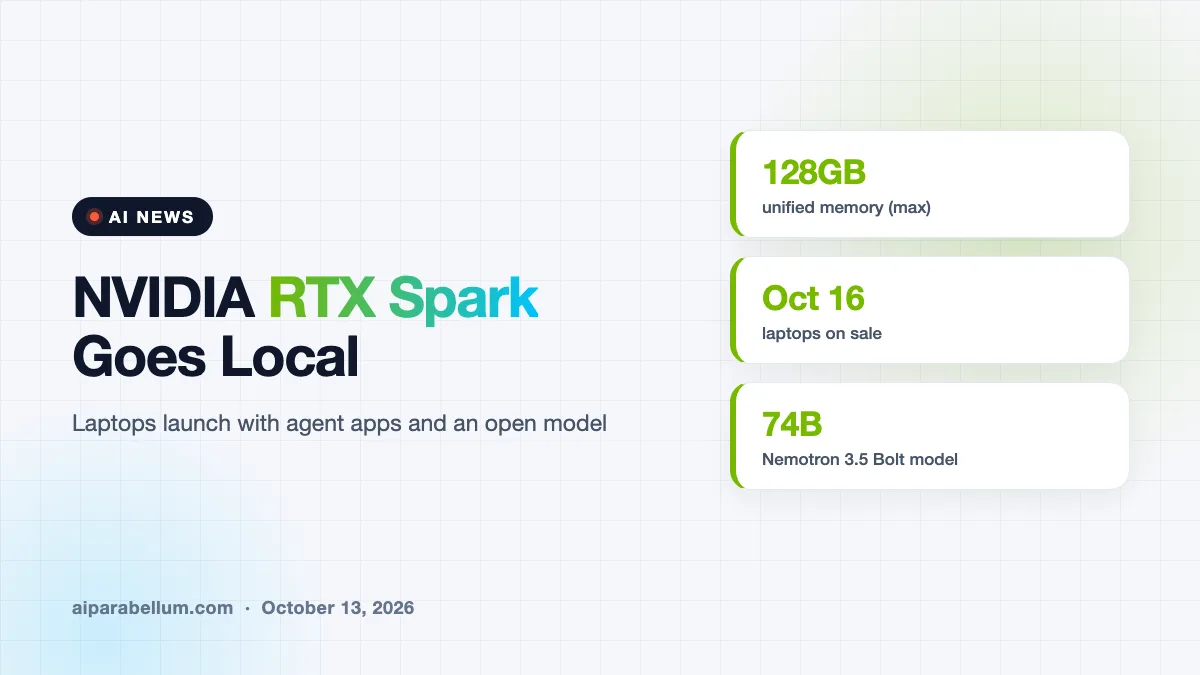
NVIDIA RTX Spark laptops go on sale Friday, October 16, and NVIDIA is using the days before launch to line up a wave of software built around local AI agents. The new chip pairs up to 128GB of unified memory with 1 petaflop of AI compute, and NVIDIA wants it to be a gaming rig, a creative workstation, and a personal AI machine in one thin laptop. Here is what is shipping, what is still coming, and why it matters if you use AI tools every day.
What NVIDIA RTX Spark Is
RTX Spark is a single “superchip” for Windows laptops, and NVIDIA announced the launch date together with Microsoft. The platform runs Windows on Arm, which is why so much of this week’s news is about getting popular apps and developer tools ready for it.
The big selling point is memory. With up to 128GB shared between the processor and graphics, these machines can hold much larger AI models than a typical laptop, which is what makes running agents locally realistic.
Local AI Agents Get First-Class Treatment
NVIDIA says local model downloads are already five times higher than all of last year, driven by open-source agent projects such as OpenClaw and Hermes. RTX Spark is designed to lean into that trend from the first boot.
When you turn on a new laptop, a “Getting Started” screen will let you pick and install an agent app. Supported apps include GitHub Copilot, Hermes Agent, OpenClaw, Perplexity, Pi, and WorkBuddy, and each one will suggest a local model and settings tuned for the hardware.
Security Sandboxing for Agents
Letting an AI agent loose on your PC raises obvious safety questions. NVIDIA and Microsoft are answering with two layers: Microsoft Execution Containers (MXC) for operating-system-level isolation, and NVIDIA OpenShell, which adds credential protection and security monitoring on top.
OpenClaw and GitHub Copilot already support MXC, and NVIDIA says Hermes Agent will add OpenShell controls by the end of October. That focus on containment echoes a wider industry worry, with leaders like Satya Nadella arguing that agents need hard limits.
Mixing Local and Cloud Models
Most people will still want frontier cloud models for hard tasks. NVIDIA’s open-source Switchyard library routes each request to a local or cloud model, so simple jobs stay on your laptop and only tough ones cost cloud tokens.
Key RTX Spark Updates and Dates
NVIDIA announced a long list of updates. These are the ones most likely to matter to everyday users and developers.
| Update | What It Does | Timing |
|---|---|---|
| Nemotron 3.5 Bolt 74B | Open model built for local agents, squeezed into 24GB | Thursday, Oct. 15 |
| RTX Spark laptops | Retail availability with hundreds of games and apps | Friday, Oct. 16 |
| NVIDIA PAIR | Out of beta; pools AI compute across PCs on your network | Available now |
| Adobe Photoshop and Premiere | Up to 2x faster AI, editing, and effects (NVIDIA claim) | Beta now, rolling out in phases |
| NVIDIA Broadcast 2.3 | New video effects, offline file processing, agent controls | Available now |
| Nemotron 3.5 Bolt E4B | Small 4GB model for AI game characters | Friday, Oct. 23 |
A New Open Model Built for Your Laptop
The headline model is Nemotron 3.5 Bolt 74B. It is a mixture-of-experts model with 74 billion total parameters, but only 9 billion are active at once, and NVIDIA compressed it to 24GB using 2-bit quantization.
NVIDIA says the model is fully open, including its training data, weights, and recipes. You will be able to run it through llama.cpp, vLLM, Ollama, Unsloth, and LM Studio, or directly inside agents like Hermes and OpenClaw.
Coding and Creative Tools Get Ready
Developers were a clear target. The launch brings the first PyTorch-CUDA build for Windows on Arm, a native-by-default Python 3.15 build, and a native Conda installer, and NVIDIA says 97% of the top 15,000 Python packages already work.
For people who rely on AI coding assistants, GitHub Copilot is adding local model support to its model router. Microsoft is also making coding models like MAI 1.1 Coding Flash available to run on the device.
Creators get faster tools too:
- Adobe is tuning Photoshop, Premiere, and Substance 3D for RTX Spark.
- ComfyUI adds RTX Video Frame Generation and HDR nodes for smoother AI video generation workflows.
- Blender 5.3 beta supports RTX Spark, with DLSS Ray Reconstruction arriving in November.
- A new Llama Windows app lets you download and run models without the command line.
The real story is not the chip. It is that agents, models, and security tools are being packaged so a regular buyer can run AI locally on day one.
What This Means for You
If you are shopping for a new laptop, here is how to think about this launch:
- Local AI is getting easier. Agent apps now handle model setup for you, so you do not need to be a developer to run AI offline.
- You may spend less on cloud AI. Routing simple tasks to a local model can cut how many paid tokens you burn.
- Treat performance numbers as claims. Speedups like “up to 2x” come from NVIDIA and partners and have not been independently tested yet.
- Check app support first. Windows on Arm compatibility is much better than before, but confirm your must-have apps run well before buying.
For more on how the AI hardware race is shaping up, see our coverage of Microsoft’s Maia 300 and the latest AI news updates.
Sources
This report is based on NVIDIA’s own announcement on the NVIDIA Blog.
Conclusion
NVIDIA RTX Spark is arriving as more than a new laptop chip. NVIDIA and its partners are pairing it with ready-to-run agent apps, sandboxing, an open 74B model, and faster creative tools, all aimed at making local AI feel normal. The real test comes after October 16, when buyers find out whether the speed and compatibility claims hold up. If they do, running a capable AI agent on your own laptop could quickly go from a hobby to the default.
