
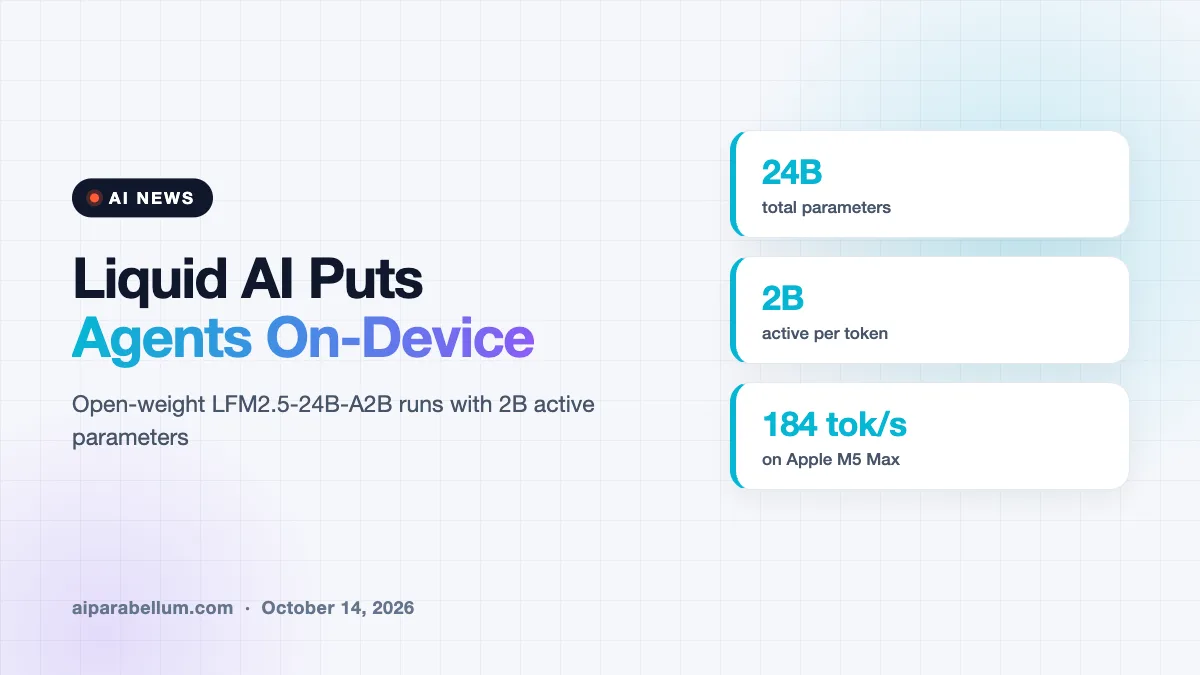
Liquid AI has released LFM2.5-24B-A2B, an open-weight model built to run AI agents directly on your own device. The Liquid AI LFM2.5 release has 24 billion total parameters but uses only about 2 billion for each token, which keeps it fast and light on memory. The company says it competes with larger open models on tool use while running at 184 tokens per second on an Apple M5 Max laptop.
That matters if you want an assistant that works privately, without sending every request to the cloud. Here’s what the new model does and where it still falls short.
What Liquid AI LFM2.5 Is Built to Do
LFM2.5-24B-A2B is a mixture-of-experts model. That means it has many smaller expert networks inside, and it only switches on a few of them for each word it writes.
Liquid AI designed it as a reasoning-only model, so it always works through a chain of thought before giving its final answer. Because so few parameters are active at once, each of those thinking steps is cheap to run.
The company’s main pitch is agents. It trained the model to call tools, follow instructions and work inside popular agent setups such as OpenClaw, Hermes Agent, Pi and OpenCode.
The key specs
| Spec | LFM2.5-24B-A2B |
|---|---|
| Total parameters | 24 billion |
| Active parameters per token | About 2 billion |
| Context window | 131K tokens, up from 32K |
| Vocabulary | 128K tokens, up from 65K |
| Pre-training data | About 33 trillion tokens |
| Speed on Apple M5 Max | 184 tokens per second |
| License style | Open weights on Hugging Face |
How the New Model Was Trained
The model builds on the earlier LFM2-24B-A2B and keeps its design of 40 layers and 64 experts per block. Liquid AI roughly doubled pre-training, from about 17 trillion tokens to about 33 trillion.
It then added extra training focused on reasoning, math, code, instruction following and long documents. Tool calls and multi-step conversations show up throughout, so agent skills are baked in early rather than bolted on.
The final stages use distillation from specialist teacher models, followed by reinforcement learning inside real agent harnesses. The larger vocabulary should also help with languages that don’t use the Latin alphabet.
Liquid AI LFM2.5 Benchmarks and Speed
Liquid AI tested the model on 16 benchmarks against Qwen3.6-35B-A3B, Gemma-4-26B-A4B-it and Nemotron-3.5-Lightning. These are company-reported results, so independent tests will matter.
- It leads or matches rivals on five of eight tool-use and agent benchmarks, according to the company.
- On AutomationBench, Liquid AI says it scored more than three times the next-best model.
- It scored 48.09 on LiveClaw, compared with 38.19 for Qwen3.6-35B-A3B.
- It led on all three instruction-following benchmarks in the test set.
- It decodes 114 tokens per second on an AMD Ryzen AI Max+ 395 and over 21,000 output tokens per second on a single NVIDIA B300 GPU at high load.
Where it falls behind
Liquid AI is upfront that larger models still win on knowledge-heavy tests like GPQA Diamond and Humanity’s Last Exam. They also do better on coding tests such as SWE-Bench Verified and SciCode.
The company suggests pairing the model with web search or retrieval for fact-heavy work. In plain terms, it’s built to act and use tools, not to be a walking encyclopedia.
What This Means for You
On-device models like this are part of a wider push to run agents locally, a trend we also saw with NVIDIA’s RTX Spark laptops. Here’s how to think about it:
- Privacy gets easier. Running an agent on your own machine means your files and prompts can stay local.
- You’ll need solid hardware. The speed numbers come from high-end chips like the M5 Max and Ryzen AI Max+ 395.
- Setup is developer-friendly. It works on day one with llama.cpp, MLX, vLLM, SGLang and ONNX, and can sit behind any OpenAI-compatible server.
- Add search for facts. Pair it with retrieval if your tasks depend on up-to-date or detailed knowledge.
If you’re new to agents, our AI agent tools directory is a good place to explore. Teams weighing local agents against cloud services may also like our look at agents replacing iPaaS.
For more stories like this, browse our latest AI news updates.
Sources
This article is based on Liquid AI’s release post on the Hugging Face blog.
Conclusion
Liquid AI’s LFM2.5-24B-A2B shows how much agent power can now fit on a laptop. It uses only about 2 billion active parameters, yet the company says it beats larger open models on many tool-use tests while staying fast and memory-light. It still trails bigger models on knowledge and coding, so it works best with search or retrieval. For anyone who wants private, local AI agents, it’s a release worth trying.
