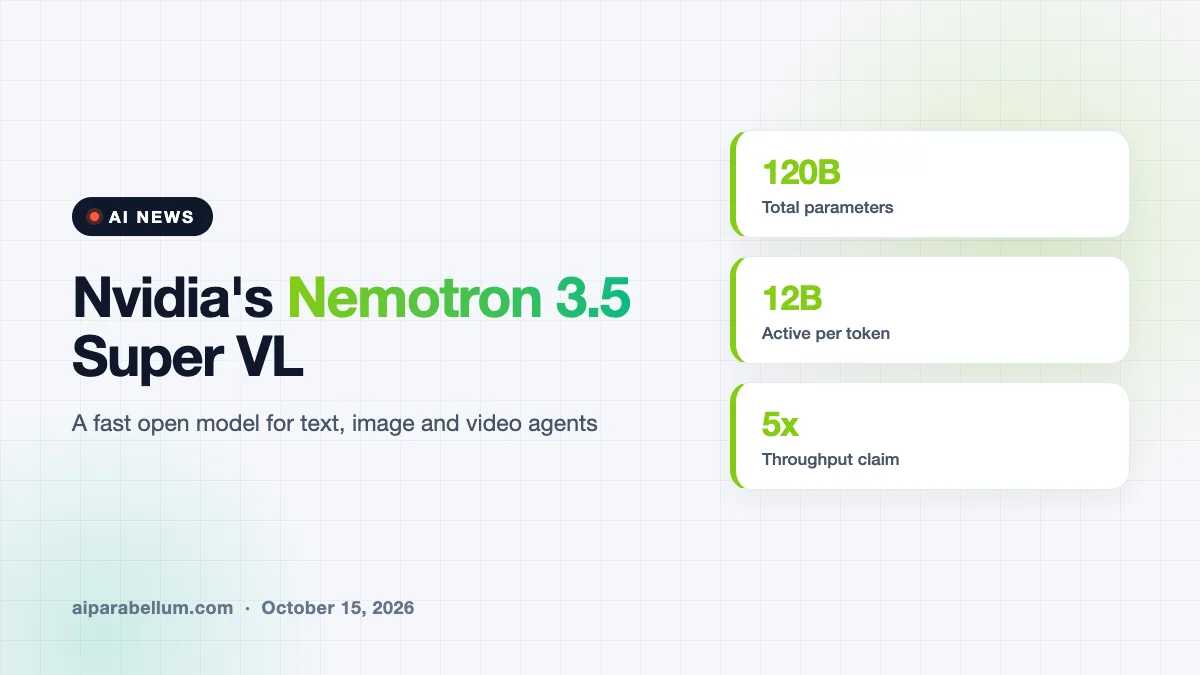
Nvidia has released Nemotron 3.5 Super VL, a new open-weight AI model built to power business agents that read text, images, documents, and video. The company says the 120-billion-parameter model is the fastest open agent model in its size class. Nvidia also launched two smaller Nemotron 3.5 Bolt models designed to run on local devices.
What Nemotron 3.5 Super VL Can Do
Super VL uses a mixture-of-experts design, which means only about 12 billion of its 120 billion parameters are active for each token. That keeps it big enough to be smart but light enough to run fast. Nvidia says it handles reasoning, following instructions, and using tools in one model.
It also understands charts, tables, scanned pages, multipage documents, and video. That matters because teams no longer need a separate vision model next to a text model. One agent can read a chart, match it with a table later in a report, and summarize both.
Built for Always-On Work
Nvidia pitches the model for agents that run for long stretches, sometimes across days or weeks. It lists jobs like coding and bug fixing, web research, document processing, cybersecurity triage, and video review. On a single GPU, Nvidia says it delivers up to 5x higher throughput than other open models of its size.
| Model | Size | Main purpose |
|---|---|---|
| Nemotron 3.5 Super VL | 120B total, 12B active | Specialized enterprise agents with text and vision |
| Nemotron 3.5 Bolt 74B-A9B | Fits in 24GB | Local agents on your own hardware |
| Nemotron 3.5 Bolt E4B | Fits in 4GB | Fast voice, device, and chat agents |
How Nemotron 3.5 Compares on Speed and Accuracy
Nvidia’s speed claim rests on testing by Artificial Analysis against similarly sized rivals. InclusionAI’s Ling 3.0 Flash and DeepSeek’s V4.1 Flash came in second and third, well behind Super VL. On CharXiv, a test of chart reasoning, the model scored 80.8%, up from 63% for the older Nemotron 3 Nano Omni.
The base model does not beat the top closed models on its own. The bigger promise is what happens after a company trains it on its own data. Nvidia says that in one medical insurance claims test, post-training lifted accuracy by 44% and put it ahead of Claude Opus 5.
Early Customers Report Big Gains
Nvidia named several companies that have already tuned the model for their own work:
- Scale AI trained it for vendor credit processing, cutting expected inference cost by 40x and latency by 5x.
- Ramp uses it to turn receipt photos into structured data, expecting up to 10x lower latency.
- AI21 tuned it for threat intelligence work and saw accuracy rise by 40%.
These are company claims, so treat them as early signals rather than independent results.
Why US Open-Weight Models Are Gaining Ground
For the past few years, Chinese labs like DeepSeek and Moonshot have led the race for strong open-weight models. That lead is now being challenged. Mistral, Reflection AI, and Nvidia have all shipped notable open models in recent weeks.
Interest in open models has also grown since the recent Hugging Face breach involving OpenAI. That incident weakened the old idea that only open models carry security risks. Businesses that want to keep data in-house often prefer models they can run on their own servers, much like the Liquid AI model we covered this week.
What This Means for You
If you build or buy AI tools for work, this release gives you more choice. Here is how to think about it:
- Open weights mean you can host the model yourself and keep sensitive files off outside servers.
- The small Bolt models point toward capable agents running on laptops, a trend Nvidia is also pushing with its RTX Spark laptops.
- The real payoff comes from tuning the model on your own data, so plan for that effort.
- Check independent benchmarks before switching, since most performance numbers so far come from Nvidia and its partners.
To see what agents can already do for teams, browse our AI agent tools or read about replacing old integrations with agents.
Sources
Details come from the NVIDIA Technical Blog announcement and launch coverage from ZDNet.
Conclusion
Nemotron 3.5 Super VL gives businesses a fast, open model that can read both words and visuals, and it can be tuned to beat bigger closed models on narrow tasks. The two Bolt models extend that push down to laptops and small devices. Most of the performance claims still come from Nvidia and its partners, so independent tests will matter. Even so, the release adds weight to the growing wave of strong US open-weight AI. Keep up with the latest launches on our AI news page.