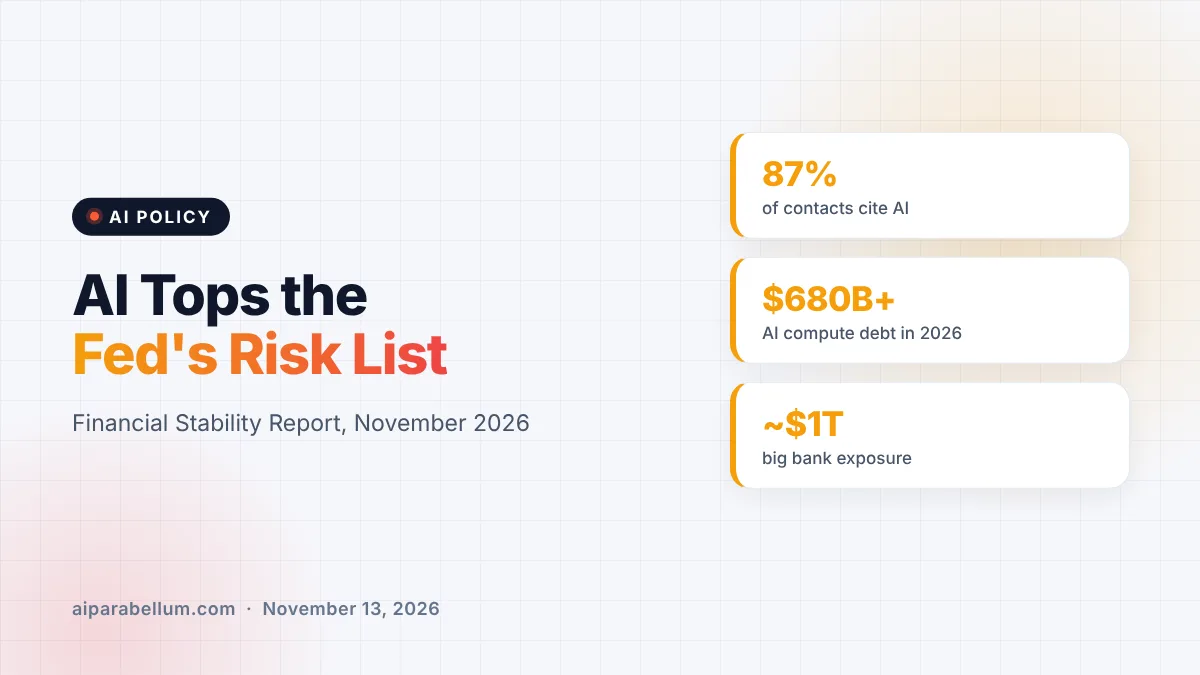
Artificial intelligence just jumped to the top of Wall Street’s worry list. In the Fed financial stability report released on November 13, 2026, 87% of the market contacts surveyed by Federal Reserve staff named AI as a risk to the U.S. financial system, more than any other threat. The same report warns that debt tied to the AI data center boom is piling up fast.
The twice-a-year report is the Federal Reserve Board’s main check-up on how sturdy the financial system is. This edition reads a lot like an AI report, from stock valuations to cyberattacks to the borrowing behind new data centers.
What the Fed Financial Stability Report Found on AI
The AI findings come from a survey run by staff at the Federal Reserve Bank of New York. During September and October, they collected views from 23 contacts at broker-dealers, banks, investment funds and advisory firms. The Fed notes that these are the views of the people surveyed, not official positions of the Board or the New York Fed.
Still, the result is striking. AI was the most-cited risk by a wide margin, and it saw one of the biggest jumps since the spring survey, when it ranked third behind geopolitical risks and an oil shock.
| Risk cited by survey contacts (Fall 2026) | Share of contacts |
|---|---|
| Artificial intelligence | 87% |
| Risk asset correction | 52% |
| Higher long-term interest rates | 48% |
| Cyberattacks | More than 4 in 10 |
| Fiscal debt sustainability | More than 4 in 10 |
Three Separate AI Concerns
Respondents did not treat AI as one single risk. Their worries fell into three buckets:
- Stock valuations: AI-linked shares are priced high, and weaker-than-expected earnings could trigger a sharp market drop.
- Cybersecurity: attacks by sophisticated state actors, or damage caused by frontier AI models themselves.
- Complex financing: new and tangled ways of paying for the AI buildout that are hard to track.
Many contacts also pointed to “circular financing” and heavy reliance on debt as things that could make losses worse if AI spending does not pay off. Some warned that a slump in risky assets could spill over into business investment and household spending.
Why AI Financial Stability Risk Is Rising
The Fed’s own assessment points the same way. It says stock valuations stay high, partly driven by market enthusiasm for what it calls super intelligence. The price-to-earnings ratio for S&P 500 companies remains well above its historical median.
On cyber risk, survey contacts said AI is lowering the barrier for sophisticated attacks by both state and non-state actors. They warned that disruptions to trading, settlement or payment systems could badly shake confidence in financial firms. That echoes the wider debate about AI and security, including tools like OpenAI’s cyber model that cut both ways.
The Data Center Debt Pile
A special section of the report looks at borrowing for AI infrastructure. Debt issued for advanced computing passed $680 billion by October 2026, about five times the $130 billion issued in all of 2023. That borrowing now makes up roughly 31% of investment-grade debt issued by nonfinancial companies, up from under 6% in 2023.
The Fed estimates outstanding public debt tied to advanced computing at more than $1.1 trillion. Off the balance sheet, leases that have not started yet top $1 trillion, and guarantees and other contract commitments exceed $2 trillion. The largest U.S. bank holding companies have close to $1 trillion of exposure to big tech firms, data center developers, related financing vehicles and utilities.
The report compares the boom to the late-1990s telecom buildout. It says AI investment by five hyperscalers (Amazon, Alphabet, Meta, Microsoft and Oracle) has been tracking that cycle closely and may soon outpace it.
Is the Financial System Still Sound?
The report is not sounding an alarm about a crisis. The Fed says the banking sector remains sound and resilient overall, with capital near historically high levels. It also notes that big tech firms could absorb some losses in a downturn, which would soften the hit to the rest of the system.
The catch is visibility. The Fed says these firms’ real exposure may be much larger than their balance sheets suggest, and links between big tech, private lenders and special purpose vehicles need close monitoring. Global regulators have been pushing in a similar direction, as seen in recent bank AI rules.
What This Means for You
You do not need to panic, but it helps to understand what the experts are watching. Here are a few practical takeaways:
- If your savings or retirement funds lean heavily on big AI stocks, check how concentrated you are.
- Expect more scrutiny of AI-related borrowing, which could affect how fast new data centers get built.
- Take AI-powered scams and hacks seriously, and review basic threat detection tips for your business.
- Watch company earnings: the main fear is that AI profits will not keep pace with AI spending.
For small businesses that rely on AI tools, nothing changes overnight. But if credit for AI projects tightens, prices and rollout timelines for some services could shift. You can follow these shifts in our AI news coverage.
Sources
Primary source: Federal Reserve Board, Financial Stability Report (November 2026).
Conclusion
AI has moved from a side note to the headline risk in the Fed’s latest look at financial stability. Market contacts worry about lofty valuations, AI-powered cyberattacks and the complex debt funding the data center race. The Fed still sees a resilient banking system, but it is clearly watching the AI money trail closely. For investors and businesses alike, the message is simple: the AI boom now carries real financial weight, and its risks deserve the same attention as its promise.