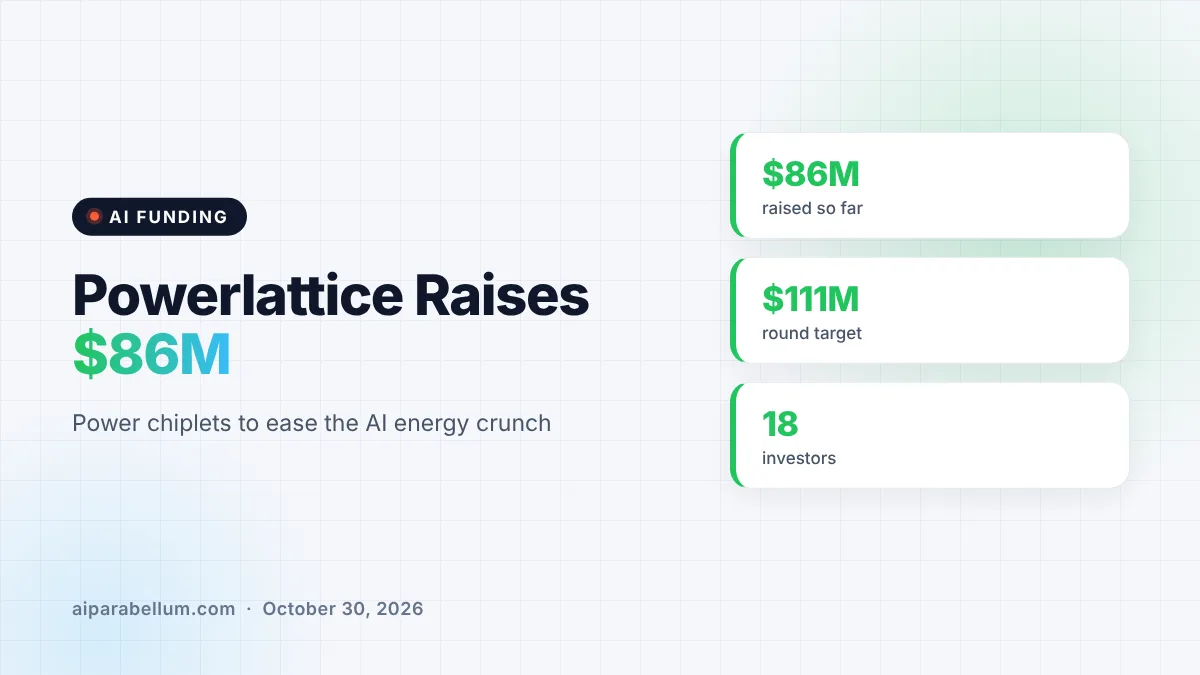
Powerlattice, a chip startup tackling one of AI’s biggest bottlenecks, has raised about $86 million, according to a federal securities filing made on October 30, 2026. The Powerlattice funding is part of a planned $111 million round. Its goal is simple to state and hard to pull off: get electricity into AI processors with far less waste.
The company has not announced the round itself and declined to comment on it. Still, the filing shows strong investor interest in hardware that eases the AI power crunch.
Inside the Powerlattice Funding Round
The Form D filing lists $86,009,965 in equity already sold out of a total offering of $111,010,000. That leaves roughly $25 million still open in the round.
Here are the key numbers from the filing:
| Detail | From the filing |
|---|---|
| Amount raised so far | About $86 million |
| Total round size sought | About $111 million |
| Investors so far | 18 |
| First sale in the round | October 15, 2026 |
| Security type | Equity |
The filing does not name the investors or the round. The new money is nearly triple the $31 million the company had raised when it came out of stealth last November with a $25 million Series A led by Playground Global and Celesta Capital.
A board with chip industry weight
Former Intel CEO Pat Gelsinger, now a general partner at Playground, sits on the board alongside Steve Fu of Celesta. Gelsinger has framed the opportunity bluntly in the past, saying AI is constrained by power rather than capital.
Why AI Chips Need Better Power Delivery
Modern AI chips pull huge amounts of electricity and throw off a lot of heat. Data center operators are running into hard limits on how much power and cooling they can get, which slows down new AI capacity.
In most systems, current travels a long path before it reaches the processor, and energy is lost along the way. Powerlattice wants to shorten that path dramatically.
How the Powerlattice Chiplet Works
The startup builds what it calls a power delivery chiplet, a small component that sits inside the processor package itself. Placing power regulation right next to the chip means less wasted energy and steadier power for demanding workloads.
- Powerlattice says its approach can cut energy use by more than half.
- The company says it also boosts processor performance.
- It has offered engineering samples for GPUs, CPUs and custom AI accelerators.
- Multiple chiplets can be linked to act as one, so chip designers can match the setup to their processors.
Earlier this week, the company said it had demonstrated what it calls the industry’s first monolithic integrated voltage regulator chiplet. That design puts the controller, power transistors and inductors on a single piece of silicon, and it was tested on a device built to mimic the fast-changing power loads of next-generation AI chips.
The team behind it
CEO Peng Zou founded Powerlattice in 2023 with Gang Ren and Sujith Dermal. All three are semiconductor veterans with backgrounds at Qualcomm, Intel and NUVIA, and the company is based in Washington state with offices in Arizona, California and Taiwan.
What This Means for You
You may never buy a Powerlattice chip, but this kind of hardware shapes the AI tools you use every day. Here is why it matters:
- Power is now a real limit on AI growth, as seen in moves like Microsoft’s Maia chip and the push for new AI factory standards.
- More efficient chips could make AI services cheaper to run, which can mean lower prices or higher usage limits.
- Startups like this one, and earlier raises such as Tenstorrent’s funding, show investors betting on the hardware layer, not just chatbots.
Keep in mind that the efficiency figures are the company’s own claims. Independent results in real data centers will be the true test, and you can follow more updates on our AI news page.
Sources
Primary source: Powerlattice Technologies Form D filing with the SEC. Additional reporting from GeekWire.
Conclusion
Powerlattice has quietly raised about $86 million toward a $111 million round, based on its latest securities filing. The startup is betting that moving power regulation inside the chip package can ease the energy squeeze facing AI data centers. With Pat Gelsinger on its board and 18 investors already in, it has the backing to try. Whether its claimed energy savings hold up at scale will decide how big a role it plays in the next wave of AI hardware.