
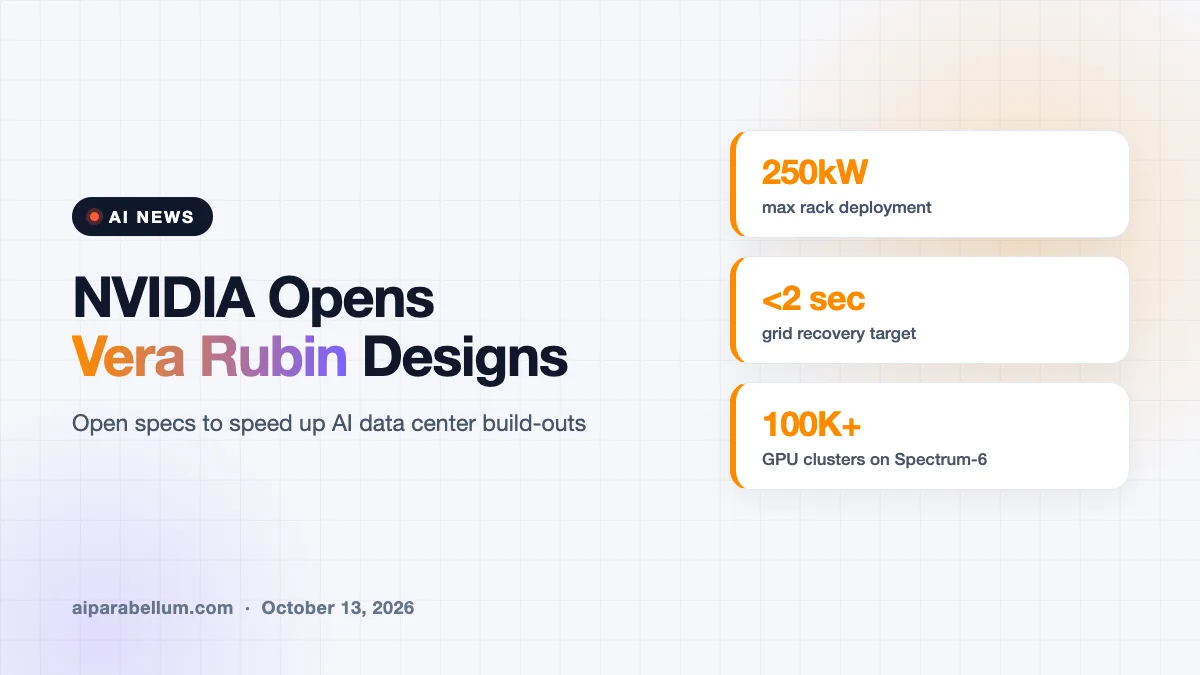
NVIDIA is sharing key NVIDIA Vera Rubin rack and compute tray designs with the Open Compute Project, the industry group that publishes open data center hardware standards. The move, announced at the OCP Global Summit in San Jose, comes with new open specs from AMD, Google, Meta, and Microsoft, plus networking deals with Meta, Cisco, and Google. Together, they aim to make the giant “AI factories” behind chatbots and agents faster and cheaper to build.
Why Open AI Data Center Standards Matter
AI data centers are growing from megawatts to gigawatts of power. Until now, much of the gear inside them has been built to custom specs from individual customers, which slows suppliers down.
Open standards give equipment makers one shared target. NVIDIA argues that manufacturers can now design power, cooling, and rack hardware without waiting for each big buyer to hand over its own blueprint.
What NVIDIA Shared About Vera Rubin Racks
Vera Rubin is NVIDIA’s next-generation AI computing platform. The company contributed its rack and compute tray designs through MGX, its open modular architecture, and helped shape the updated MGX 1.2 specification.
According to NVIDIA, MGX 1.2 adds several upgrades for high-power AI systems:
- Rack-scale liquid cooling that connects automatically when trays slide in.
- A liquid-cooled 5,000-amp busbar for delivering power.
- Fanless, liquid-cooled compute trays and configurable I/O bays.
- Support for rack deployments of up to 250kW.
A CPU Rack Built for AI Agents
NVIDIA also published a design for a Vera CPU rack. While the Vera Rubin NVL72 system handles large-scale training and inference, the CPU rack is meant for the work AI agents do around a model, such as calling tools, coordinating tasks, and running code in sandboxes.
That is a sign of where demand is heading. As more people use AI agents that take actions instead of just answering questions, data centers need more general-purpose computing alongside GPUs.
New Open Specs for AI Factory Power and the Grid
Two facility-level specifications were published at the summit. NVIDIA, AMD, Google, and Meta released the Open Data Center Specification v0.7, a shared blueprint covering power, cooling, and physical layout for next-generation AI facilities.
Google, Meta, Microsoft, and NVIDIA also published the OCP Grid Resilience Specification. It sets out how large AI sites should behave when the power grid hiccups, including staying connected and returning to near-full load in under two seconds.
Power, not chips, is becoming the hardest limit on AI growth. Standards that make data centers friendlier to the grid could matter as much as faster GPUs.
Vera Rubin Networking Deals at a Glance
Moving data between thousands of GPUs is one of the hardest parts of running AI at scale. Several partners announced networking work at the event.
| Partner | Announcement | Why It Matters |
|---|---|---|
| Meta | Adopting Spectrum-6 102.4Tb/s Ethernet switches for Vera Rubin AI factories | Supports clusters of more than 100,000 GPUs on open networking |
| Cisco | New USFP optical module standard for 400Gb/s-per-lane fabrics | About 4x the bandwidth density and roughly 1.3x better power efficiency, per NVIDIA |
| Falcon Transport support on future ConnectX-10 SuperNICs and BlueField DPUs | More reliable data delivery over Ethernet under congestion | |
| Visionbay | K-1, an 800-volt DC AI factory design for Vera Rubin | Simpler power delivery for dense racks |
Meta’s new Spectrum-6-based switch runs FBOSS, Meta’s own open-source network software. The partnership follows Meta’s recent push into frontier models with Muse Wonder, which will need huge amounts of computing to train and serve.
Open Source Software for Running AI Factories
NVIDIA also released new open-source pieces of DSX OS, the software layer for its AI factory platform. They include tools that automate network switch setup, stress-test GPU clusters before training starts, manage racks, and speed up bare-metal provisioning.
What This Means for You
You will never walk into one of these data centers, but the ripple effects reach the business AI tools and personal apps you already rely on.
- Faster build-outs could ease the compute shortages that cause rate limits and waitlists.
- More efficient power and networking can lower the cost of each AI answer, which may show up in pricing over time.
- Grid-friendly designs could reduce pushback from utilities and communities worried about AI’s energy use.
- NVIDIA still sets much of the agenda, even when the standards are open, so its lead in AI hardware looks set to continue.
Rivals are building their own paths too, as shown by Microsoft’s Maia 300 chip. You can follow more developments in our AI news section.
Sources
This report is based on NVIDIA’s announcement from the OCP Global Summit on the NVIDIA Blog.
Conclusion
By opening its Vera Rubin rack designs and backing shared specs for power, cooling, and the grid, NVIDIA is trying to turn its own playbook into the industry’s default. Partners like Meta, Google, Microsoft, AMD, and Cisco signing on gives those standards real weight. Most of the performance and efficiency figures come from NVIDIA and still need to prove themselves in real deployments. Even so, the direction is clear: the race to build AI capacity is now as much about power and plumbing as it is about chips.
