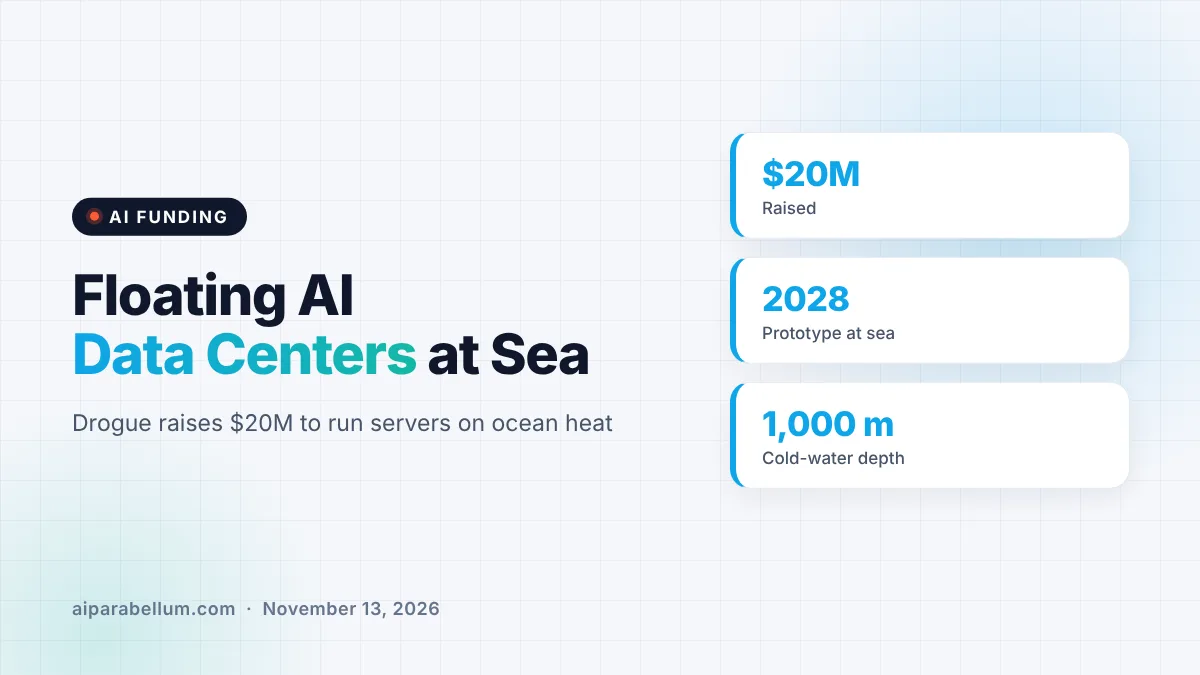
A six-month-old startup called Drogue has raised $20 million to build floating AI data centers that run on power pulled from the temperature gap in the ocean. The DC-based company plans to put a multi-megawatt prototype on a ship and send it to sea in early 2028. It is one of the more unusual answers yet to a question the whole AI industry is asking: where will all the electricity come from?
Who Is Building Floating Data Centers for AI
Drogue was founded about six months ago and had stayed quiet until this week. Its co-founder and CEO, Sam Sipe, is a former U.S. Navy pilot who flew E-2D Hawkeye aircraft off carriers, which gave him a close-up view of how much energy the open ocean holds.
The company says it has already raised $20 million. Investors named so far include XYZ Venture Capital, Toyota Ventures, Tamarack Global, Dream, FDVC, Garuda Ventures, Flexcap, Boost VC and Slow Ventures, among others. The funding was first disclosed in an exclusive interview, and Drogue has not posted a public announcement of its own.
| Detail | What We Know |
|---|---|
| Company | Drogue, based in Washington, D.C. |
| Age | Founded about six months ago |
| Funding raised | $20 million |
| CEO | Sam Sipe, former U.S. Navy E-2D Hawkeye pilot |
| Technology | Ocean thermal energy conversion (OTEC) |
| First prototype | Multi-megawatt system on an ocean-going ship |
| Target launch | Early 2028 |
| Regulatory step | “Approval in principle” from the American Bureau of Shipping |
How the Floating AI Data Centers Would Work
Drogue’s system uses a decades-old idea called ocean thermal energy conversion, or OTEC. Think of it as a heat pump running backward: instead of using electricity to move heat, it uses a temperature difference to make electricity. Surface water is warmed by the sun, while water about 1,000 meters down averages roughly 39°F.
Here is the basic loop the company describes:
- Warm surface water is pulled in and first used to cool the servers.
- That now-warmer water boils ammonia, which turns to gas at a very low temperature.
- The ammonia gas spins a turbine to generate electricity for the data center.
- Cold water pumped up from about 1,000 meters deep turns the gas back into a liquid.
- The warmed deep water is sent back down, and the sealed ammonia loop starts over.
The design neatly pairs cooling and power, two of the biggest costs for any AI facility. The servers’ waste heat even helps boil the ammonia that drives the turbine.
Why put the servers at sea
Shipping power back to shore would need long, expensive undersea cables. Data centers avoid that problem because the servers are compact and moving data off a vessel is cheap. Sipe says each vessel would stay at sea for about a decade.
Why AI Power Demand Is Pushing Ideas Like This
Sipe argues that traditional data center projects run on 8- to 10-year timelines because developers must line up land, utilities and grid operators. “AI demand has increased 10x in just the last three years. It’s completely incompatible,” he said.
That squeeze is showing up everywhere. OpenAI has launched a program to help protect local grids from data center power cuts, and Anthropic’s IPO paperwork flagged natural gas risks tied to its compute plans. Other startups are attacking the problem from different angles, like Mount Thor’s $45M bet on Mac-based facilities and PowerLattice’s chip-level power savings.
Drogue’s idea is a bit like proposals to put data centers in orbit: move the computers to where the energy is. The difference is that a ship needs no rocket launch.
The Big Questions Still Facing Drogue
OTEC is not new. It was first developed in the 1950s and tested in the 1980s, then largely set aside. Sipe says pipe and heat-exchanger manufacturing has improved a lot since then, and that earlier engineers told him the core physics works if someone can raise enough money to build at scale.
Still, plenty is unproven. Drogue is only now buying its first ship, and the prototype is more than a year away from the water. Corrosion, storms, marine growth and the cost of operating far from shore are all real hurdles.
The company has not shared pricing, power output targets per vessel beyond “multi-megawatt,” or any named data center customers.
Our take: Drogue is an early, bold bet, not a ready product. Its value right now is showing how far the AI industry is willing to look for new power sources.
What This Means for You
If you use AI tools every day, you will not notice floating data centers any time soon. But the power crunch behind them affects the price and speed of the services you rely on.
- Expect more news like this. Energy is now one of the main limits on AI growth, so watch for funding in power, cooling and new data center designs.
- AI costs may stay sticky. As long as power is scarce, providers have less room to cut prices on heavy AI workloads.
- Treat early timelines with care. A 2028 prototype is a plan, not a promise, and ocean energy has a long history of setbacks.
- Keep an eye on the wider AI news cycle for signs of which power bets are actually working.
Sources
Funding and technology details come from TechCrunch, which reported the round in an exclusive interview with Drogue’s CEO. Drogue has not published its own announcement.
Conclusion
Drogue’s $20 million round backs a striking idea: power AI servers at sea using the temperature gap between warm surface water and the cold deep ocean. The team has investors, a design and a preliminary sign-off from a key shipping safety body, but its first prototype will not sail until early 2028. Whether ocean thermal energy finally works at scale is an open question. What is clear is that the hunt for AI power is now reaching well beyond the grid.