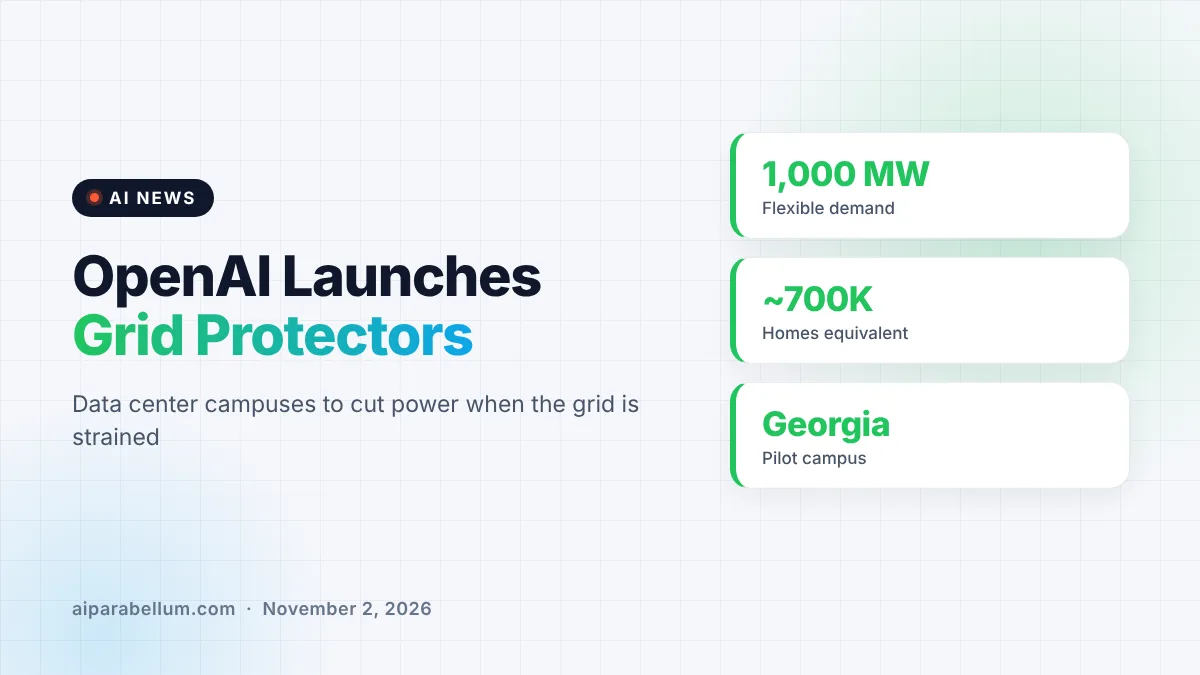
OpenAI has launched the Grid Protectors Program, a national plan for its future data center campuses to cut their electricity use when the power grid is under strain. The company says it will work with utilities, regulators and policymakers so its campuses can act like a backup resource during heat waves, cold snaps and other emergencies. The first test case is a planned campus in Effingham County, Georgia.
What the Grid Protectors Program Promises
The idea is simple: when the grid is stretched thin, OpenAI’s sites draw less power so homes and businesses keep theirs. OpenAI says each local deal will spell out how much demand it can drop, how fast, and for how long. Those terms will differ from place to place, and the company says it will share more commitments as they are finalized.
The program covers more than just switching things down. Depending on the site, OpenAI says it may also:
- Supply power to the grid from on-site generation or storage
- Use batteries and power controls to smooth out swings in demand
- Pay the full cost of the grid upgrades its campuses require
- Sign long-term contracts and financial guarantees that protect other customers if a project is delayed, shrunk or canceled
OpenAI is also using a new label for these sites. It now calls them “compute campuses” and argues they are built differently from data centers of just a few years ago, which makes flexible power use possible.
Georgia Is the First OpenAI Grid Test
The Effingham County campus is still in development, but OpenAI wants it to serve as the pilot for the whole program. The company says it has committed to pay the full infrastructure and electric-service costs needed to serve that project.
Its agreement with Georgia Power includes up to 1,000 megawatts of flexible demand response. OpenAI says that equals the average electricity demand of roughly 700,000 households, which it notes is more than Washington, D.C., and Boston combined.
| Detail | What OpenAI says |
|---|---|
| Pilot site | Planned campus in Effingham County, Georgia |
| Flexible demand | Up to 1,000 megawatts |
| Household equivalent | About 700,000 homes at average use |
| Projected utility savings | About $950 million a year from 2029 (Georgia Power estimate) |
| Typical home benefit | At least $15 a month at 1,000 kWh (Georgia Power estimate) |
Where the Savings Numbers Come From
The savings figures are not OpenAI’s alone. Georgia Power projects roughly $950 million in yearly customer savings starting in 2029, but that number covers its whole portfolio of large-load deals and expected growth, including a project called Camellia. So the Georgia Power estimate should not be read as savings from OpenAI’s campus by itself.
Why AI Companies Are Under Pressure on Power
AI’s hunger for electricity has become a political issue. OpenAI cites projections that U.S. data center capacity could pass 100 gigawatts by 2030, and many communities worry that new facilities will push up their power bills. The program arrives as OpenAI moves to build more of its own data centers while that backlash grows.
OpenAI’s head of energy policy, John McCarrick, said the plan reflects a shift in industry thinking, better technology and feedback from communities, according to Axios. Other tech giants, OpenAI included, have already made pledges to be good grid neighbors and avoid raising costs for ratepayers.
The real test is not the pledge itself but the fine print: how many megawatts each campus actually gives back, and how quickly, when the grid hits a real emergency.
OpenAI’s pitch goes a step further. It argues that big, steady customers can help spread the fixed cost of power lines and substations across more electricity sales. The company compares itself to a regular customer at a vacation-town restaurant who helps cover the bills in the slow season.
What This Means for You
If you live near a planned AI campus, this program could shape what you pay for power and how reliable it is. Here is what to keep an eye on:
- Check your utility’s filings. Large-load agreements usually go before state regulators, and the terms are often public.
- Look for real numbers. A useful deal names how much power a campus will shed and for how long, not just a goal.
- Watch the cost split. OpenAI says families should not subsidize its electricity, so see whether local rate cases back that up.
- Remember the limits. OpenAI itself says flexibility cannot replace new power plants and transmission lines.
For businesses that rely on ChatGPT and OpenAI tools, the program is also a sign of how much new capacity the company plans to build. Rivals face the same scrutiny, as shown by the data center risks Anthropic flagged in its own filing. You can follow more developments like this on our AI news page.
Sources
Primary source: OpenAI’s Grid Protectors Program announcement. Additional reporting from Axios.
Conclusion
OpenAI’s Grid Protectors Program turns a familiar promise into a national framework, starting with up to 1,000 megawatts of flexible demand in Georgia. The company says its future campuses will pay their own way and ease off the grid when communities need power most. Whether that holds up will depend on the details of each local deal, which OpenAI says are still being worked out. For now, Georgia is the place to watch.