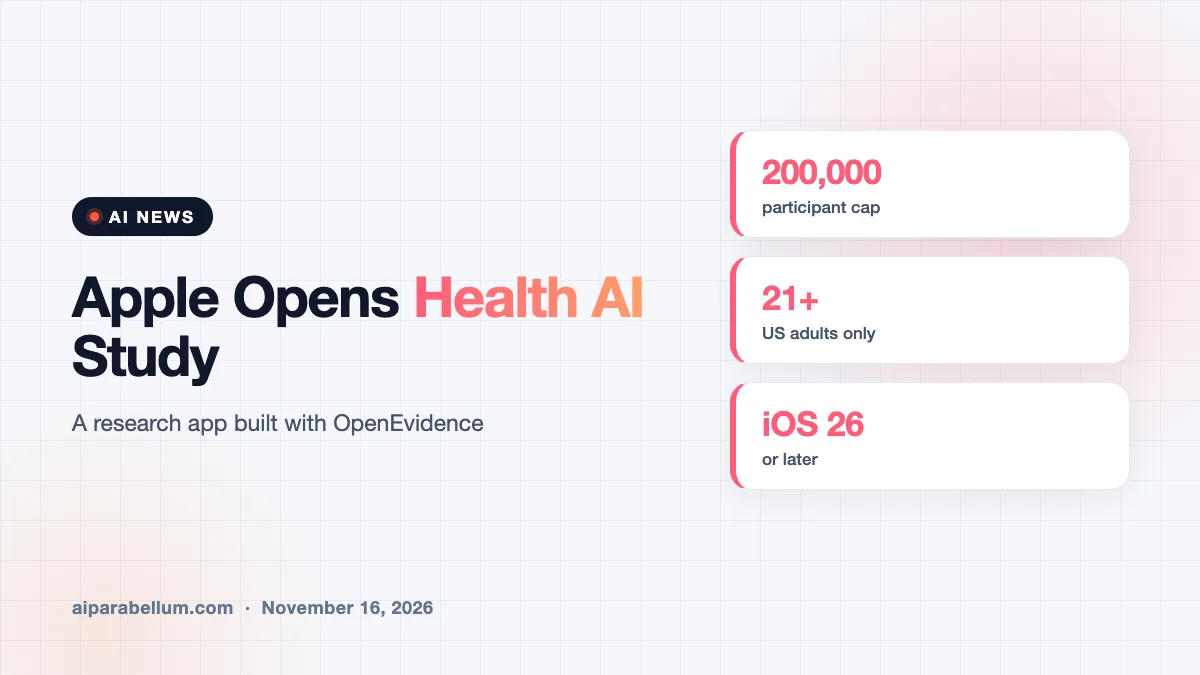
Apple has opened a new Apple Health AI study in the United States, and it comes with its own iPhone app. The Apple Health AI Usage Study lets volunteers ask a chatbot everyday health questions while researchers watch how much people trust, understand and act on the answers. Apple built it with OpenEvidence, a clinical AI company whose tools are already popular with doctors.
What the Apple Health AI Study Actually Is
This is a research project, not a new feature in the Health app or Siri. Apple describes it as a virtual study with a companion app, announced on November 15, 2026. The goal is to learn how people use conversational AI for health, so future products can be designed more carefully.
Inside the app, you type a health question and get an answer written in plain language. Each answer comes with linked, peer-reviewed clinical citations, so you can see where the information came from. The underlying medical AI comes from OpenEvidence, while Apple designed the research experience around it.
Apple says OpenEvidence draws on established medical sources, including The New England Journal of Medicine, the Journal of the American Medical Association and Nature. That is a different approach from a general AI chatbot that pulls from the open web.
What Researchers Want to Learn
Apple lists four things it wants to measure:
- What makes people trust a health answer from AI
- How good the responses are
- How well people understand what they read
- Whether the answers change everyday health actions
The study will also look at whether AI can help you prepare for a visit with your own doctor. Apple admits that consumer health tools built on large language models can sometimes give incomplete or unclear answers, which is part of why it wants research before a product.
Who Can Join and What You Need
The study is limited to the United States and has a cap on enrollment. Here are the requirements Apple has published.
| Requirement | Details |
|---|---|
| Location | United States only |
| Age | 21 and older |
| Device | Apple Intelligence-enabled iPhone (iPhone 15 Pro or later) |
| Software | iOS 26 or later |
| Enrollment cap | Up to 200,000 eligible participants |
| How to join | Download the study app and choose to enroll |
According to TechCrunch, the study is expected to run for more than 12 months. Its report adds that participants can rate answers, leave feedback and will be asked to fill out monthly surveys.
How Your Health Data Is Handled
Sharing personal data is optional. You can choose to share HealthKit data such as resting heart rate, activity, sleep or lab results, and the study will test whether that makes answers more relevant and easier to understand. You stay in control of which metrics and survey responses you share.
Apple says study data will not be used to train AI models. It also says it has put security measures in place to protect the data it holds and the confidentiality of participants. That matters at a time when more chatbots want access to your medical records.
The app includes safety guardrails too. They are meant to spot certain concerning questions and suggest that you follow up with a provider or other resources. Apple is clear that the app is not meant to diagnose or treat any condition, or to replace a medical professional.
Why the Apple Health AI Study Matters Now
Health questions are already one of the biggest uses of AI chatbots. Rivals have moved quickly, with OpenAI and Anthropic adding health features and partners such as Athenahealth letting patients connect health records to an assistant. Apple is taking a slower route by studying the behavior first.
There is also real risk in this area. A recent lawsuit claims a chatbot’s medical advice contributed to a mental health crisis, and doctors’ groups have started publishing rules, such as the AMA’s healthcare AI framework. A large, structured study gives Apple evidence before it ships anything to hundreds of millions of iPhones.
Apple has not said whether the findings will lead to AI answers in the Health app or Siri. In its announcement, Apple health chief Sumbul Desai said the work should help ensure the company keeps “building trusted tools” as the technology changes.
Takeaway: Apple is testing health AI in public, with citations and consent, before deciding what to build into the iPhone.
What This Means for You
If you already ask AI about symptoms, test results or medications, this study is a chance to try a tool that shows its sources. A few practical points:
- You can join only if you are in the US, at least 21, and have a recent iPhone with Apple Intelligence.
- Sharing HealthKit data is your choice, and you can take part without it.
- Check the linked citations instead of taking any answer at face value.
- Use the answers to prepare questions for your doctor, not to replace the visit.
- Expect a research app with surveys, not a finished Apple product.
If you do not qualify, you can still follow the same habits with other research tools that cite sources. You can keep up with related stories in our AI news section.
Sources
Primary source: Apple’s Health AI Usage Study announcement. Additional reporting from TechCrunch.
Conclusion
Apple is entering health AI with a study instead of a product launch. Up to 200,000 US adults can ask health questions in a dedicated app, see clinical citations and optionally share HealthKit data, while Apple measures trust, understanding and real-world impact. The company says the data will not train AI models and that the app is not a substitute for a doctor. What Apple learns here will likely shape whatever health AI it eventually brings to the iPhone.