The American Medical Association has published a governance framework for agentic AI in healthcare, laying out how it thinks AI agents should be judged before they take on clinical work. The core idea is simple: an AI system has to earn clinical authority with evidence and keep it by performing well over time. The framework arrives as hospitals rush to deploy AI agents faster than rules can keep up.
What the Agentic AI Healthcare Framework Says
Agentic AI is different from a chatbot that answers questions. These systems can carry out multi-step tasks on their own, such as drafting clinical notes, flagging test results, or monitoring patients.
That independence is the point, but it is also the risk. If an agent makes a wrong or biased call, it could harm a patient before a doctor notices and steps in.
Authority Is Earned, Not Assumed
The AMA’s starting principle is that clinical authority should follow proof. An AI agent should only be trusted with a task after evidence shows it can handle that task, and it should keep that trust only while its performance holds up.
The group also says oversight should not be frozen in place. As evidence, risk levels, or the technology itself change, the amount of freedom an agent gets can change too.
Four Questions for Clinical AI Agents
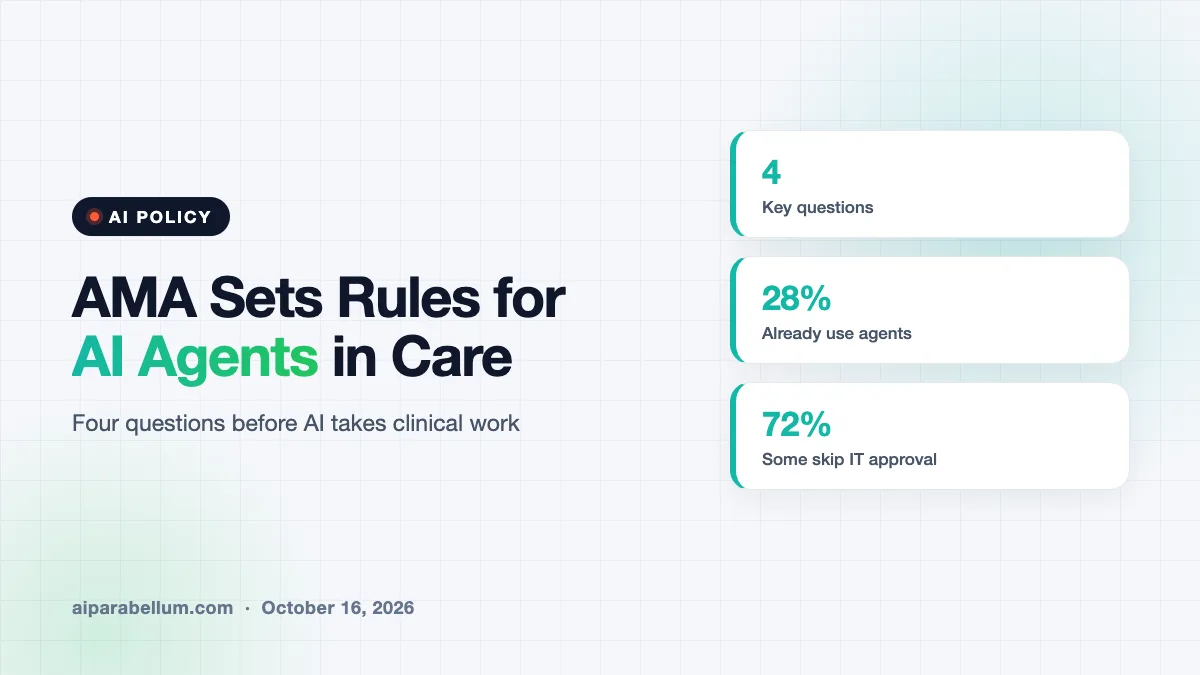
The framework boils the AMA’s approach down to four connected questions. Each one targets a different weak spot in how AI agents are rolled out today.
| Focus area | The question it asks |
|---|---|
| Function | What clinical job is the AI actually doing? |
| Evidence and risk | What proves it can do that job, and what happens if it fails? |
| Authority and oversight | What should it be allowed to do, and under which conditions? |
| Accountability | Who is responsible for the risks and the results? |
The AMA says these questions will shape its work with physicians, tech builders, and regulators on liability, licensure, and regulation. In its own words, evidence, authority, oversight and accountability “must remain aligned” as AI capabilities grow.
Doctors Stay at the Center
The framework puts physicians in the middle of how AI agents are built and deployed. The AMA’s Center for Digital Health and AI will bring doctors together with developers and policymakers to help set benchmarks for safe use.
Why AI Agents in Healthcare Need Guardrails Now
Adoption is moving fast. In a recent survey of 250 U.S. healthcare leaders, about 28% said their organization already uses agentic AI tools, and 44% said they are running pilots or proof-of-concept projects.
Oversight is lagging behind. In the same survey, 72% said AI agents are sometimes put in place without IT approval, and more than half named compliance violations or unauthorized access to protected health information as major worries.
A Patchwork of State Rules
There is still no major federal law covering health AI, so industry groups have stepped in with their own guidance. Meanwhile, states are going in different directions, with 47 states introducing more than 250 health AI bills in 2025, according to the law firm Manatt.
- Some states are reining in AI use in care settings.
- Others are experimenting with AI-based care.
- Hospitals operating in several states face different rules in each one.
That mix helps explain why a national physician group is trying to set shared expectations. It also follows a wave of investment in the space, like the recent Suki funding round aimed at building clinical AI agents.
What This Means for You
If you are a patient, AI agents may already be helping with your care, from writing visit notes to tracking your vitals. The AMA framework will not change that overnight, but it signals that doctors want clear proof and clear responsibility before these tools take on bigger roles.
- Ask your doctor or clinic whether AI tools are part of your care and how a human reviews them.
- If you work in healthcare, use the four questions as a checklist before adopting a new agent.
- Watch for unapproved “shadow” AI tools, which the survey shows are common.
- Expect liability and licensing debates to heat up as agents take on more clinical work.
For background on the wider trend, read our guide to AI medical imaging and our look at why chatbots want your medical records. You can also browse medical AI tools or see more stories on our AI news page.
Sources
This article draws on the framework announcement from the American Medical Association and reporting from Healthcare Dive.
Conclusion
The AMA’s new framework asks four plain questions about any clinical AI agent: what it does, what proves it works, what it may do, and who answers for it. Its central rule is that AI must earn clinical authority through evidence and keep it through performance. With adoption climbing and many tools slipping in without IT approval, the guidance lands at a useful moment. It is not a law, but it gives hospitals, developers, and regulators a shared starting point.