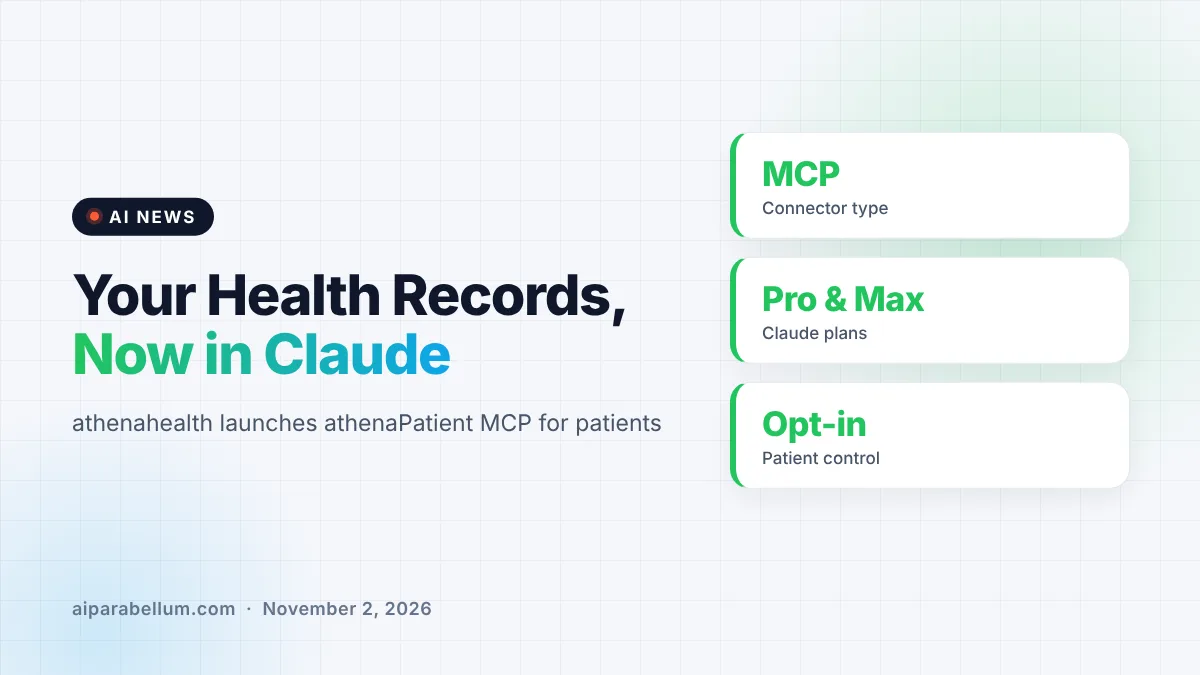
Athenahealth just launched a way for patients to connect their health records to Claude, Anthropic’s AI assistant. The new athenahealth Claude connection, called athenaPatient MCP, lets patients ask plain-English questions about their own lab results, medications and visit history. Patients decide what Claude can see, and they can switch access off at any time.
What the Athenahealth Claude Connector Does
Athenahealth makes cloud-based electronic health record (EHR) software used by many small and independent medical practices. Its new tool is a server built on the Model Context Protocol, or MCP, an open standard that lets AI assistants pull in data from outside systems. The server links Claude to athenahealth’s athenaOne platform, where patient records live.
Once a patient approves the link, Claude can use that record to answer questions with real context. Instead of generic health information, you get answers based on your own chart. The company says Claude can reference these types of data:
- Lab results and vitals
- Medications, allergies and immunizations
- Health conditions and diagnostic reports
- Visit history, procedures and care plans
A patient could ask something like “What was my most recent cholesterol result?” or “What should I ask at my next appointment?” Anthropic’s head of healthcare, Syed Mohiuddin, said the goal is to help patients feel “more confident and prepared” in conversations with their care team.
Who Can Use It and How Setup Works
The connector is available to Claude Pro and Claude Max subscribers in the US. You add it from the connector options in your Claude settings, then sign in with your athenahealth patient portal login. Athenahealth says your portal credentials are not shared with Claude.
Privacy controls at a glance
The company is leaning hard on patient control and data protection. Here is how the main safeguards line up, based on what athenahealth has said.
| Feature | What athenahealth says |
|---|---|
| Who can use it | US Claude Pro and Max users who are athenahealth patients |
| Sign-in | Patient portal login; credentials not passed to Claude |
| Data choices | Patients pick which kinds of records Claude can read |
| Turning it off | Access can be revoked at any time |
| Model training | Data accessed through the link may not be used to train Anthropic models |
| Security | Information is encrypted in transit |
Athenahealth also says it will only open athenaPatient MCP to AI assistants that do not train on patient information. Paul Brient, the company’s chief product and operations officer, still encouraged patients to read the privacy policy of any AI service they connect.
Not a Replacement for Your Doctor
Athenahealth is clear that the tool does not give medical advice and should not replace a clinician’s judgment. The idea is to help you understand information your care team already gave you. That matters because lab results often arrive after an appointment, and questions tend to pop up once you get home.
Some doctors worry that AI chatbots reading health records could lead to more follow-up messages from patients. Brient argues the opposite: better-informed patients can make visits more productive. Whether that plays out in real clinics is still an open question.
Why the Claude Health Records Launch Matters
More people already use chatbots for health questions. An August Pew Research Center survey found that 34% of US adults have used AI assistants for health-related purposes. Until now, most of those chats ran on generic information or whatever details patients typed in themselves.
This launch also shows MCP spreading into regulated industries. We have seen Claude connectors arrive in areas like real estate with the Zillow Claude connector, and healthcare is a far more sensitive test. Rivals are moving too, with OpenAI technology now tied into health record tools from Epic and Oracle.
Claude is the first assistant athenahealth has enabled, but the company says it will not be the only one. It has not named which AI assistants could come next.
What This Means for You
If your doctor’s office uses athenahealth and you pay for Claude, you may soon be able to chat with your own records. Here is how to approach it wisely:
- Share only the record types you actually need for your question.
- Use answers to prepare questions for your doctor, not to change treatment yourself.
- Review Anthropic’s privacy terms, and revoke access when you are done.
- Double-check any number or date Claude cites against your patient portal.
If you are new to the assistant, our Claude AI guide covers the basics. Healthcare AI is moving fast, as recent moves like the AMA’s new agentic AI framework show. You can follow more stories like this on our AI news page.
Sources
Reporting from Fierce Healthcare, which interviewed athenahealth executives, and ZDNet.
Conclusion
Athenahealth’s athenaPatient MCP gives US Claude Pro and Max users a permission-based way to bring their own health records into an AI chat. The company promises patient control, encryption and no model training on the data, while stressing that Claude is not a stand-in for medical advice. It is an early but important step toward AI assistants that understand your real medical history. How well it protects privacy and helps patients in practice will be the real test.