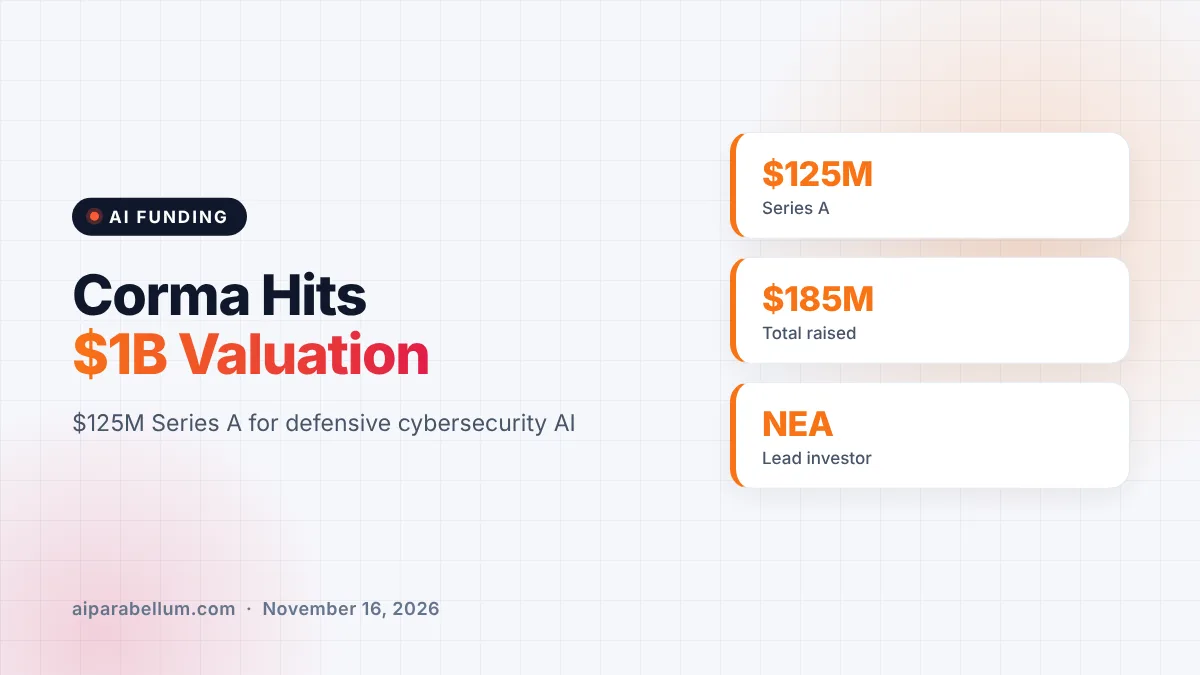
Corma, a startup building its own foundation models for defensive AI in cybersecurity, has raised a $125 million Series A at a $1 billion valuation. The round was led by NEA and comes just three months after the company came out of stealth. Corma’s pitch is that today’s general AI models help attackers far more than defenders, and it wants to close that gap.
Inside Corma’s $125 Million Series A
NEA led the round, with Sequoia Capital, Khosla Ventures and Coatue all returning. The new money brings Corma’s total funding to $185 million. The company first emerged in August 2026 with a $60 million seed round led by Sequoia.
| Detail | Figure |
|---|---|
| Series A size | $125 million |
| Valuation | $1 billion |
| Lead investor | NEA |
| Returning investors | Sequoia Capital, Khosla Ventures, Coatue |
| Total raised | $185 million |
| Seed round (August 2026) | $60 million |
Corma says the cash will go toward scaling its models, buying much more compute and hiring selectively. Israeli business press reports the company has about 20 employees in Tel Aviv and San Francisco. Annual recurring revenue is estimated in the tens of millions of dollars, though the company has not confirmed a figure.
Why Corma Builds Defensive AI From Scratch
CEO Alon Pluda argues that general-purpose models are great at writing code and finding software bugs. That same skill makes them excellent tools for attackers hunting for vulnerabilities. Defense, he says, is a different problem that calls for a different kind of model.
Offense vs. Defense
Breaking into a system is usually a bounded puzzle: find a flaw in one target and exploit it. Protecting a company means reading endless audit logs, events, configurations and network traffic, then spotting faint warning signs across many systems over long stretches of time. Corma says that requires thousands of accurate, consistent decisions every day.
Because of that, Corma trains its own models rather than building on top of models from big AI labs. Its stated research plan includes:
- New model architectures designed for security data
- Longer context to catch weak, slow-moving anomalies
- Adversarial self-play, where models practice against each other
- Continuous learning that builds a baseline over months and years
How the Corma Workforce Uses AI Agents
Corma delivers its models through what it calls the Corma Workforce, a set of AI agents that work next to human security teams. The agents plug into tools a company already uses, such as identity systems, cloud platforms, endpoint protection and log management. They can investigate alerts, connect evidence and take action across those systems.
Staff can hand off tasks, ask questions and approve actions through Slack or Microsoft Teams. That keeps people in control of important decisions while the agents handle the grind. It is part of a broader wave of AI threat detection tools moving from alerts to action.
The company claims 99% of security tasks are completed autonomously and successfully, 100 times faster end-to-end and at 95% lower cost per task. These are Corma’s own figures and have not been independently verified. It says live deployments span healthcare, finance, energy, critical infrastructure and retail.
Cybersecurity AI Demand Outpaces Compute
Corma says interest from large enterprises has been overwhelming, and its biggest challenge is finding enough compute to serve it. Some organizations are still on a waitlist. The company also says a new generation of its models is coming soon, but gave no date.
The raise lands during a busy stretch for AI security funding. Recent rounds include Reco’s $55M raise and Pluto Security’s round, both focused on securing AI agents. Corma stands apart by betting on its own foundation models instead of wrapping existing ones.
What This Means for You
If you work in IT or security, here is the practical takeaway:
- AI-driven attacks are getting cheaper, so expect more vendors to pitch AI agents that act, not just alert.
- Ask any vendor for independent results, since headline numbers like 99% autonomy are usually self-reported.
- Look for human approval steps before agents change systems or block access.
- Check how a tool connects to your current stack, because rip-and-replace projects rarely pay off quickly.
For individuals, a personal cybersecurity assistant can cover the basics while enterprise tools like this mature.
Sources
Primary source: Corma’s Series A announcement. Additional reporting from Globes and Unite.AI.
Conclusion
Corma went from stealth to a $1 billion valuation in about three months, a sign of how seriously investors take AI-powered threats. Its core argument is that defenders need purpose-built models, not tools borrowed from the same AI that helps attackers. The company’s performance claims still need outside proof, and compute shortages could slow its rollout. But with $185 million raised and backing from top firms, Corma is now one of the best-funded bets on defensive AI. Security teams should watch for its next model release.