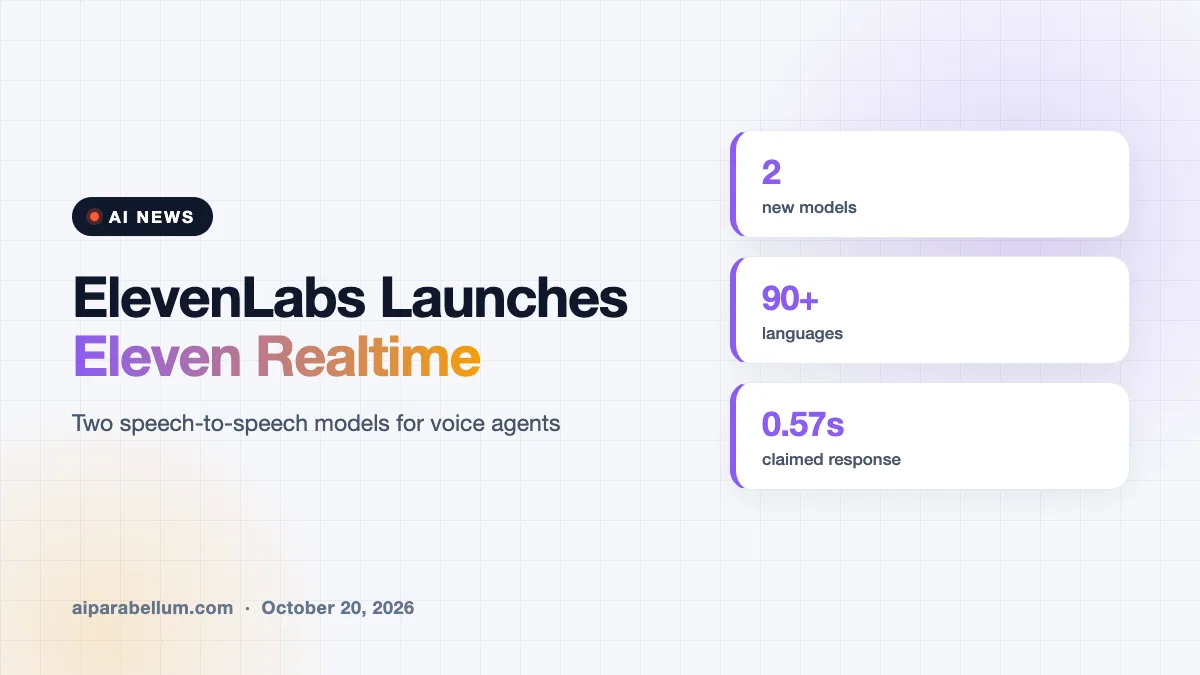
ElevenLabs has launched Eleven Realtime, a new family of speech-to-speech models built for voice agents that hold natural, live conversations. The launch includes two versions, v1 Mini and v1 Max, and both work inside the ElevenAgents platform or through a Realtime API that copies the format of OpenAI’s own. If you build or buy AI phone and chat agents, this could change how much setup work a voice agent needs.
What Eleven Realtime Speech Models Do
Most voice agents today are stitched together from separate parts. One system turns speech into text, a language model writes a reply, and a text-to-speech engine reads it out loud.
Eleven Realtime folds those pieces into one model choice. ElevenLabs says speech recognition, turn-taking, the language model and the voice are tuned together as a single system. The company pitches this as a way to get an agent that sounds natural without picking and tuning each part yourself.
The models are aimed at messy, real conversations. ElevenLabs says timing and tone stay natural through interruptions and quick back-and-forth exchanges, and the smaller model can tell the difference between a person who has finished talking and one who is just saying “mm-hmm.”
Mini vs. Max: Two Realtime Voice Models
The two models target different jobs. Mini is the cheaper, conversation-first option, while Max adds reasoning for harder tasks and tool use.
| Feature | Eleven Realtime v1 Mini | Eleven Realtime v1 Max |
|---|---|---|
| Main focus | Natural, expressive conversation | Complex tasks with reasoning |
| Suggested uses | AI assistants, tutors, interactive characters | Customer support, lead qualification, multi-step workflows |
| Tool calls | Fine for simpler flows | Built for multi-step tool calls |
| Zero Retention Mode and HIPAA | Not available | Available |
| Relative cost | Lower | Higher per token |
ElevenLabs recommends starting with Mini and moving to Max only when an agent follows long instructions, relies on chained tool calls, or must meet stricter compliance rules. Max also needs a token limit of at least 1,024, and it is not offered in the India and Singapore data residency regions.
Speed and benchmark claims
According to coverage of the launch, ElevenLabs says the Max model scored 98.8 percent on the Big Bench Audio reasoning test with a response time of about 0.57 seconds. The company claims no other model on the Artificial Analysis leaderboard is currently both faster and more accurate. These are company figures, though ElevenLabs says Artificial Analysis ran the evaluations independently.
A single model that listens, thinks and talks could make voice agents far easier to ship, but real-world calls will be the true test.
How Developers Can Use It
There are two ways in, and they do not mix. You pick one based on what your product needs.
- ElevenAgents: open an agent, switch its Voice mode to Realtime, and choose Mini or Max. Your prompt, voice, tools and knowledge base keep working as before.
- Realtime API: point an existing OpenAI Realtime client at ElevenLabs by changing the endpoint and model name. ElevenLabs says client and server events arrive in the same shape, so existing handlers and logging keep working.
- Channels: agents built on ElevenAgents can be deployed to phone, a web widget, WhatsApp and contact center platforms.
- Languages: the company says realtime conversation works in more than 90 languages.
There are limits worth knowing. The Realtime API connects over WebSocket only at launch, so apps using WebRTC have to switch first.
Agents that use a custom LLM, Amazon Bedrock, or workflow nodes that override managed settings must stay in the older Custom mode. ElevenLabs also notes that Realtime models are rolling out gradually, so some workspaces will not see the option yet.
Pricing basics
Inside ElevenAgents, Realtime agents pay the standard per-minute rate plus LLM token costs. Through the Realtime API, you pay per minute of connected audio plus tokens. Max costs more per token than Mini, and ElevenLabs lists current rates on its pricing page.
What This Means for You
If you already use ElevenLabs voice tools, this is mainly a simpler path to a working agent. Here is how to think about it:
- Building support or sales lines? Test Max on real call scripts before switching, and compare it with your current setup on accuracy, not just speed.
- Running on OpenAI’s Realtime API? The compatibility layer makes a side-by-side trial cheap, since you mostly swap an endpoint and model name.
- Handling health data? Only Max supports HIPAA and Zero Retention Mode, so Mini is off the table for those cases.
- Watching costs? Start with Mini for simple assistants and check the estimated per-minute cost shown in the model selector.
Faster, more natural AI phone agents also raise the stakes for trust. As cloned and synthetic voices get harder to spot, it is worth reading up on AI voice scams and how to verify who is really on the line.
Where Voice Agents Go From Here
The launch puts ElevenLabs in more direct competition with OpenAI and other labs selling all-in-one realtime voice models. Copying OpenAI’s API format is a clear bid to win over developers who have already built on that standard. It also follows a busy month in voice AI, including the Grok Voice 3 voice model launch and new voice sales features from other software makers.
For teams comparing platforms, our voice generation tools and AI agent directory are good places to see what else is out there. You can follow more updates like this on our AI news page.
Sources
Primary source: ElevenLabs’ Eleven Realtime announcement. Additional details from ElevenLabs’ Realtime models documentation and reporting from The Decoder.
Conclusion
Eleven Realtime bundles listening, reasoning and speaking into one model choice, with a cheaper Mini for everyday chat and a stronger Max for support work and tool use. Its OpenAI-compatible API lowers the cost of trying it, while gradual rollout and a few setup limits mean not everyone can switch today. The benchmark claims are promising, but they come from the company’s own launch materials. If voice agents are part of your product plans, a hands-on test against your real conversations is the smart next step.