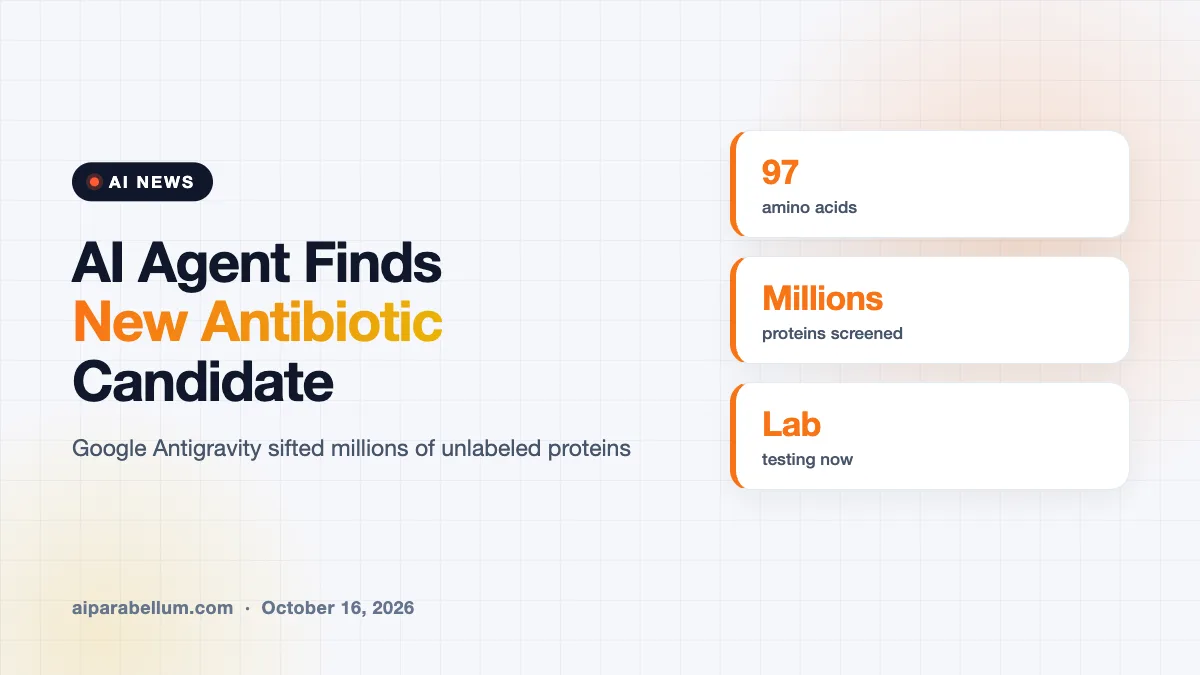
Google has shown how its Google Antigravity agent platform helped biologists spot a brand-new antimicrobial peptide that may fight bacteria behind respiratory infections. The candidate came from millions of unlabeled proteins, and it is now being tested in a real lab. Google is also adding a 3D protein viewer to Antigravity so scientists and the AI can study molecules together.
Why the Search for New Antibiotics Is Urgent
Bacteria keep getting better at surviving the drugs we use against them. Google’s researchers point to estimates that antimicrobial resistance could cause about 10 million deaths a year worldwide by 2050.
One promising alternative is a group of natural molecules called antimicrobial peptides. Bacteria make some of these, known as bacteriocins, to attack rival bacteria, and they hit weak spots that are hard for germs to evolve around.
The problem is finding them. Public databases hold millions of protein sequences that nobody has ever labeled, so useful molecules can sit unnoticed for years.
How Google Antigravity Ran the Search
Antigravity is Google’s agentic development platform, and the company is now pitching it as a science workbench too. A researcher sets a goal, and an AI agent does the heavy lifting across databases, structure tools, and research papers.
A key piece is ProtNLM, a Google model that reads raw amino acid sequences and predicts what a protein does. It has added function labels to millions of previously unnamed entries in UniProt, the leading public protein database.
From Millions of Proteins to One Lead
In this walkthrough, the team asked the agent to find and check new antimicrobial peptides in a bacterium called Streptococcus pseudopneumoniae. The researcher steered the strategy while the agent handled the searching and analysis.
- The agent filtered millions of database entries down to a handful of candidates.
- It flagged a 97-amino-acid bacteriocin from the Lactococcin 972 family.
- A check against curated proteins found no meaningful match, suggesting the molecule is new.
- Its predicted 3D shape from AlphaFold closely matched a known, lab-confirmed bacteriocin.
- Nearby genes looked like the machinery bacteria use to make and export bacteriocins.
- Published research pointed to a possible way it works, by disrupting bacterial cell division.
Finally, the agent drafted a lab plan covering protein production, tests against bacteria, target checks, and toxicity screening. Google says this candidate and several others found the same way are now in wet-lab validation.
| Step | Tool used | What it showed |
|---|---|---|
| Function prediction | ProtNLM on UniProt | Likely antimicrobial role |
| Novelty check | BLAST against Swiss-Prot | No close reviewed match |
| Structure check | AlphaFold Database | Fold resembles a known bacteriocin |
| Gene neighborhood | Genomic context review | Sits beside transport genes |
| Lab planning | Antigravity agent | Ready-to-run test protocol |
A New 3D Viewer Inside Google Antigravity
Google is also launching the Biomolecular Structure Viewer, a 3D tool built right into Antigravity. Both the scientist and the agent can work on the same model of a protein at the same time.
The agent can highlight important regions to explain its ideas. In the other direction, a researcher can mark a spot on the structure and ask a question about it, and the agent sees exactly what they selected.
Before, this kind of work meant juggling custom scripts, separate 3D programs, and different experts. Google’s pitch is that one session can now replace days of scattered database work.
The Important Caveat
None of this proves the molecule works yet. Google itself says the lead is biologically plausible and backed by structural and genetic evidence, but it still needs lab confirmation.
Many computer-predicted drug candidates fail once they hit real experiments. The value here is narrowing a huge search to the most promising options before spending money in the lab.
What This Means for You
You won’t find this antibiotic at a pharmacy anytime soon. Even if lab tests go well, new drugs usually take many years to reach patients.
- AI agents are moving from writing code to running real scientific research workflows.
- Faster screening could mean more antibiotic candidates enter testing each year.
- Researchers and students can expect tools like Antigravity to show up in more labs.
- Treat early AI drug discovery news as promising, not proven, until lab results arrive.
AI is spreading fast in medicine, from AI-designed cancer drugs to healthcare AI agents for doctors. If you want to explore similar tools, see our picks of AI research tools and the wider AI agent directory. Google’s latest model, Gemini 4 Argon, is also worth a look, along with our daily AI news.
Sources
This article is based on the technical walkthrough published by Google DeepMind, written by Pengfei Tian, Lucy J. Colwell, and colleagues.
Conclusion
Google used its Antigravity agent platform and the ProtNLM model to sift millions of unlabeled proteins and surface a new antimicrobial peptide candidate. The agent checked the molecule’s novelty, structure, and genetic context, then wrote a lab plan, and the lead is now in wet-lab testing alongside several others. A new 3D structure viewer lets scientists and the AI explore proteins side by side. The results are still predictions, so lab data will decide whether this becomes a real drug lead. Even so, it is a clear sign of how AI agents could speed up the fight against drug-resistant bacteria.