
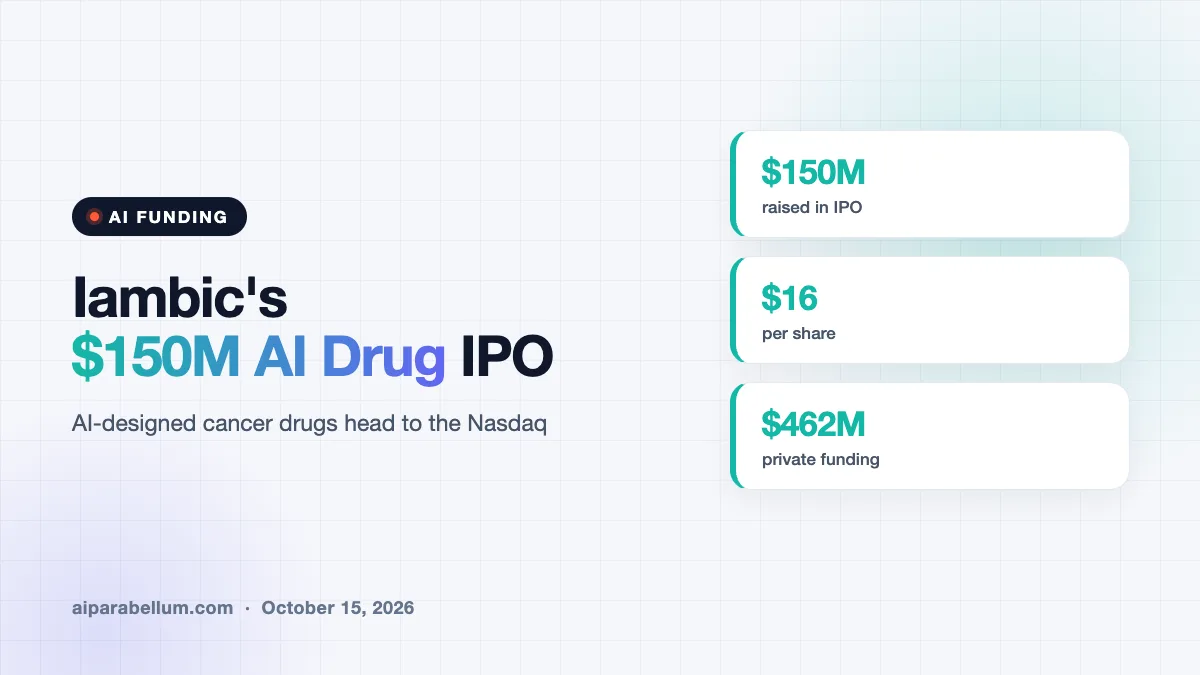
Iambic Therapeutics, a biotech startup that uses AI to design new medicines, has raised $150 million in its initial public offering. This AI drug discovery IPO is one of the clearest tests yet of whether public investors will back the idea that machine learning can make better drugs, faster. The company priced its shares at $16 and is set to start trading on the Nasdaq on Thursday.
Inside the Iambic IPO
Iambic sold close to 9.4 million shares at $16 each, bringing in about $150 million before fees. Its stock will trade under the ticker IAM. The money adds to a sizable private war chest the company built over the past several years.
Since its founding in 2019, Iambic has raised $462 million from private investors. Earlier backers include Nexus, Catalio Capital Management, Abingworth and Illumina Ventures. That funding carried its first drug candidate into early human trials.
| Detail | What We Know |
|---|---|
| IPO proceeds | About $150 million |
| Share price | $16 per share |
| Shares sold | Close to 9.4 million |
| Exchange and ticker | Nasdaq, IAM |
| Private funding before IPO | $462 million since 2019 |
| Lead drug | IAM1363, for HER2-positive solid tumors |
How AI Drug Discovery Shapes Iambic’s Pipeline
Iambic’s pitch is that its AI platform can find molecules with shapes and properties that older methods might miss. The company says the strength of that approach shows up in its pipeline, which it describes as aimed at multi-billion dollar markets. All three of its main programs target cancer.
IAM1363, the lead cancer drug
The lead candidate, IAM1363, is an oral pill in a class called tyrosine kinase inhibitors. It targets HER2, a protein that drives several solid tumors, including some breast and lung cancers. Iambic says the drug’s distinct structure could make it very selective while still covering many HER2 variants.
Early Phase 1 results showed signs of anti-tumor activity and an encouraging safety profile. Those patients had already tried and failed several earlier treatments, which makes any response worth noting. According to a regulatory filing, a registrational trial, the kind used to support approval, could start as soon as 2027.
Two more programs behind it
Iambic is also developing a few earlier-stage drugs. Here is how the rest of the pipeline lines up:
- IAM217 targets a protein called KIF18A and is planned for certain ovarian cancers, triple-negative breast cancer and other solid tumors.
- A third candidate hits two targets, CDK2 and CDK4, and could treat a common type of breast tumor.
- Both of these programs could enter human testing next year, the company says.
The company has also signed deals with large drugmakers such as Takeda and AbbVie, plus biotechs like Jazz Pharmaceuticals and Revolution Medicines. Those partnerships suggest the industry sees real value in its AI tools, not just its own drugs.
Why This AI Drug IPO Matters for Biotech
Iambic is part of a growing wave of startups betting that AI can speed up drug discovery and raise the odds of success. Venture investors and big pharma companies have poured billions of dollars into the space. Alphabet-backed Isomorphic Labs, one of the most high-profile players, is reportedly raising a large new round.
Still, the track record is mixed. Several AI-first drug companies have struggled after going public, and critics worry that hype can lead some firms to overpromise. A clinical trial does not care how a molecule was found, only whether it works safely in patients.
Our take: AI can help scientists pick better starting points, but the real proof for Iambic will come from trial data over the next two to three years, not from its stock debut.
The listing also lands in a warmer market for biotech. Twenty-five biotech companies have priced IPOs so far in 2026, a much faster pace than in 2025. Other drug developers could follow before the year ends.
What This Means for You
Most people will never buy shares in an early-stage biotech, but this story still touches everyday life. If AI really can shorten the path from lab to pharmacy, new treatments could reach patients sooner. That is the same promise driving AI across health care, from tools like the one in our story on Suki’s healthcare agents to apps for medical image analysis.
Here are a few practical takeaways:
- Treat AI drug claims with healthy skepticism until late-stage trial results are public.
- If you invest, remember that early biotech stocks are high risk, and this is not financial advice.
- Watch for IAM1363 trial updates, since a 2027 registrational study would be a key milestone.
- Expect more AI-native companies to test public markets as the IPO window stays open.
If you want to explore how AI is used in science more broadly, our roundup of AI research tools is a good starting point. You can also follow the latest stories on our AI news page.
Sources
Details on the offering, pipeline, partners and the 2026 biotech IPO count come from BioPharma Dive.
Conclusion
Iambic’s $150 million IPO gives one of the better-funded AI drug discovery startups fresh cash and a public stage. Its lead HER2 drug has shown early promise, and two more cancer programs could reach patients in trials next year. The bigger question is whether AI-designed medicines will deliver where earlier AI biotechs stumbled. For now, the debut shows investors are still willing to place that bet, and the coming trial results will decide whether it pays off.
