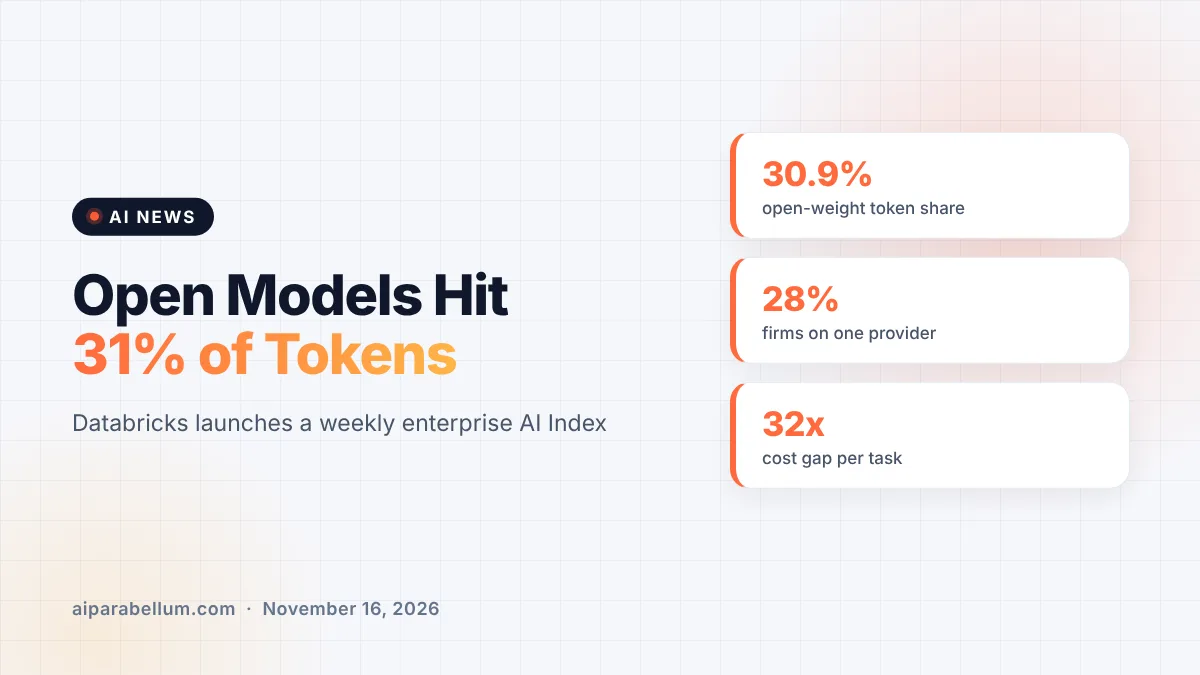
Databricks has launched the Databricks AI Index, a free public tracker of how big companies actually use and pay for AI models. Its first edition finds that open-weight models now carry about 30.9% of enterprise token traffic through its gateway, up from 7.3% in July. The index also shows companies switching between AI providers faster than ever, with Anthropic’s Claude Opus 5.5 grabbing a big share in just six weeks.
What the Databricks AI Index Is
The new index pulls together two kinds of data. The first is aggregated, anonymized usage and spending from more than 10,000 companies that route model traffic through Unity Gateway, Databricks’ tool for accessing and governing AI models. That traffic includes calls to outside providers such as Anthropic and OpenAI.
The second part is a coding-agent benchmark built from real engineering work inside Databricks. Tasks come from the company’s private codebase and are scored against hidden tests instead of an AI judge, which Databricks says lowers the risk of models having seen the answers during training.
Databricks says the index will be updated every week as new models come out. The first dataset covers September 21 through November 7, 2026.
Enterprise AI Model Adoption Is Shifting Fast
According to the company, most organizations leaned on a handful of Anthropic models at mid-year. Since then, usage has spread across more providers and model versions, with OpenAI’s share growing on the back of its 6 series models.
Model quality still moves the market, though. Databricks says that after the Opus 5.5 launch, Claude Opus 5.5 rose from 7.2% to 37.9% of proprietary-model tokens in six weeks. That lifted Anthropic’s overall share of proprietary tokens from 57.6% to 68.8%.
Fewer companies stick with one provider
In July, roughly 64% of enterprises on Unity Gateway used a single model provider. By November 2, that figure had dropped to 28%. In other words, most companies now mix models from two or more AI labs.
Key Numbers From the First Report
Here are the headline figures Databricks shared in its launch post:
| Metric | Earlier | Latest |
|---|---|---|
| Open-weight share of enterprise tokens | 7.3% (July) | 30.9% (November) |
| Enterprises using only one provider | About 64% (July) | 28% (November 2) |
| Claude Opus 5.5 share of proprietary tokens | 7.2% | 37.9% (six weeks later) |
| Anthropic share of proprietary tokens | 57.6% | 68.8% |
| Claude Fable 5.1 share of proprietary tokens | 5.5% | 0.6% (six weeks after launch) |
Coding Agent Costs Vary Wildly
The benchmark side of the index tests models from nine AI labs inside two coding harnesses, Claude Code and Codex. Databricks says five models from four labs, OpenAI, DeepSeek, Meta and Anthropic, sit on the best cost-versus-quality line.
The cost gaps are striking. GPT-6 Luna and Claude Opus 5.5 both solved 89.1% of tasks, but Luna averaged about $0.05 per task while Opus 5.5 averaged $1.62, a roughly 32x difference.
Cheap tokens do not always mean cheap tasks
Gemini 3.8 Flash has a low price per token, yet it averaged 140 turns per task and ended up costing about $11.97 per task. That made it one of the most expensive models in the test.
At the top end, Claude Fable 5.1 led the benchmark at a 96.0% success rate for $7.47 per task. Muse Wonder scored 94.9% for $1.53, so the last 1.1 points of quality cost nearly five times as much.
Open-weight models compete on quality
Three open-weight models made the top 10. DeepSeek V4.1 and GLM 5.3 tied for third with a 93.1% pass rate, which helps explain why their share of real traffic is climbing.
How Much Individual Users Spend
Spending per person is very uneven. Databricks says the median user spent $2.49 on AI, while a user at the 99th percentile spent $699.74, about 281 times more.
Median weekly spending more than doubled from $1.10 over six weeks, while the heaviest users stayed relatively flat. The company reads this as everyday workers using AI more, even though a small group still drives most of the bill.
What This Means for You
If you pick AI tools for a team, or just pay for your own Claude subscription, this data offers a few practical lessons:
- Judge models by cost per finished task, not price per token. A cheap model that needs many turns can cost more.
- Do not assume the top-scoring model is the right default. Mid-tier options may handle routine work for a fraction of the price.
- Give open-weight models a fair test. Several now score near the top on real coding work.
- Track spending by user. A few heavy users can dominate costs, a theme we also saw in this Claude spending cap story.
- Expect to switch models often. With a major release arriving roughly every week, locking into one provider may cost you.
Keep in mind that these numbers come from Databricks customers and its own engineering tasks. Results can differ for your workloads, so treat the index as a starting point, and compare it with our roundup of business AI tools.
Why Databricks Is Publishing This
The index doubles as a showcase for Unity Gateway features like usage dashboards, trace replay and Smart Routing, which sends tasks to cheaper models when quality allows. Databricks has been building out its agent lineup, including its Genie AI coworker. You can follow more updates like this on our AI news page.
Databricks also shared how it uses the data internally. It says Opus 5.5 delivered better quality at 29% lower cost per session than its predecessor, so it became the company’s default model for Claude Code.
Sources
Primary source: Databricks’ AI Index announcement.
Conclusion
The first Databricks AI Index paints a picture of enterprise AI that is more crowded and more price-sensitive than a few months ago. Open-weight models have jumped from a small slice to almost a third of token traffic, and most companies now use more than one provider. At the same time, a strong release like Claude Opus 5.5 can still swing market share within weeks. For anyone choosing models, the clearest lesson is to measure cost per completed task on your own work before picking a default.