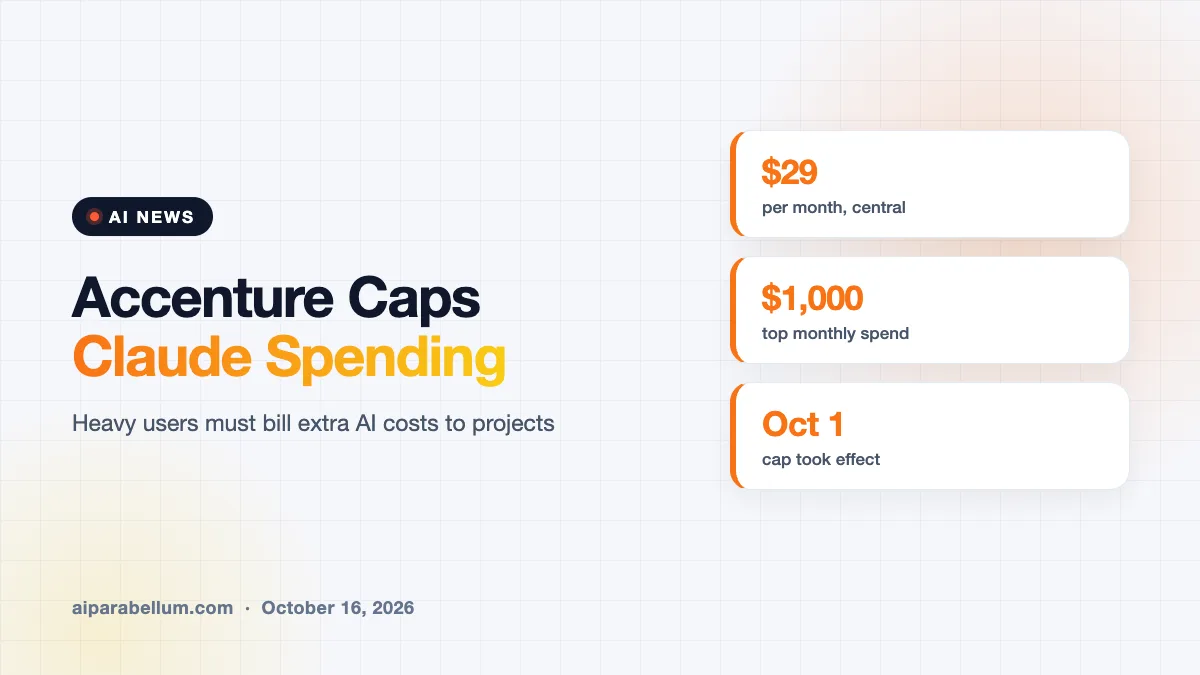
Accenture, one of the world’s biggest consulting firms, now pays for only $29 of Claude usage per employee each month. The Accenture Claude spending cap took effect on October 1, and workers who go past it must find a client project or internal team to cover the extra cost. Some staff had reportedly been spending $500 to $1,000 a month on Anthropic’s AI assistant before the change.
How the Accenture Claude Spending Cap Works
The change was laid out in an internal notice to Claude Enterprise users about licensing and usage costs, according to 404 Media, which reviewed the message. Under the new rules, the company centrally funds $29 per person per month. Anything above that is billed on a pay-as-you-go basis.
The notice says plainly that all costs are consumption-based. In practice, that means usage beyond the allowance has to be charged to a specific budget code. Accenture calls these codes a Work Breakdown Structure, or WBS, and they usually tie spending to a client project or team.
The notice also makes clear that a license is not permanent. Accenture says it will review Claude licenses from time to time and may move them based on business priorities, job needs, usage patterns, and workforce changes.
Two Plans, Two Very Different Budgets
Not every Accenture worker is affected the same way. Employees on a Premium plan get $250 in token usage per week, which is far more room to work. Many people, though, are on the General plan, and that is where the $29 limit bites hardest.
| Detail | What We Know |
|---|---|
| Start date | October 1, 2026 |
| Central funding | $29 per employee per month |
| Premium plan allowance | $250 in token usage per week |
| Who pays for overages | A client project or team budget (WBS code) |
| Reported heavy-user spend | About $500 to $1,000 per month |
| License status | Reviewed periodically and can be reassigned |
Why Accenture Is Reining In Claude Costs
The math explains a lot. If a heavy user burns through $1,000 a month and the company now covers $29, that is a gap of more than 30 times. Spread across a workforce the size of Accenture’s, those bills add up fast.
Coding is a big driver. Tools like Claude Code can run long, multi-step tasks that chew through huge numbers of tokens. One employee said they use Claude Code heavily to build and test an AI accelerator for several Accenture clients, with monthly usage usually landing between $500 and $1,000.
There is some irony here too. Accenture has spent years urging its clients to invest heavily in AI, and now it is trimming its own staff’s AI budgets.
How Employees Are Reacting
Internal messages describe workers scrambling to keep their usage going. One person asked how to speed up a move to a Premium account, saying the upgrade seemed blocked on the support page and that the change would hit project costs. Another called the news “disappointing,” and a third said their Claude access had been revoked altogether.
An Accenture spokesperson told 404 Media that the company makes AI available to all its people. The firm says its goal is to match the right tool to the right work, and that it keeps investing in AI skills and capabilities.
A Wider Shift in Enterprise AI Spending
Accenture is not alone. Many companies rolled out AI assistants widely over the past two years, and now they are seeing the bills. Usage-based pricing makes costs hard to predict, especially when a few power users run agents and coding tools all day.
That puts pressure on AI vendors as well. Anthropic’s business has grown quickly on enterprise demand, as its third-quarter revenue showed. Big customers like Workday are still bringing Claude into their products, but cost controls like this one show that adoption and spending discipline are now moving side by side.
If you are curious how vendors price these tools, our look at AI SaaS pricing explains why seat fees are giving way to usage-based billing.
What This Means for You
Even if you do not work at a large consulting firm, this story is a preview of how many workplaces may treat AI tools. Here are a few practical takeaways:
- Expect limits. If your employer pays for Claude, ChatGPT, or another assistant, a monthly usage budget may be coming, even if it feels unlimited today.
- Track what you use. Many AI tools show token or credit usage, so check it before your manager does.
- Be smart with coding agents. Long agent runs cost the most, so break big jobs into smaller, focused tasks.
- Know your plan. Learn what tier you are on and what it includes, so you are not surprised by a cap.
- Show the value. If you need more budget, be ready to explain what your AI use delivers in time saved or work shipped.
New to the assistant at the center of this story? Our Claude AI overview covers the basics, and our guide to Claude Code permissions can help you work more efficiently. For more updates like this, visit our AI news page.
Sources
This article draws on the original report from 404 Media, which reviewed Accenture’s internal announcement and employee messages, and follow-up coverage from Analytics India Magazine.
Conclusion
Accenture now funds just $29 a month of Claude usage per employee, and anything above that must be charged to a project or team. The move hits heavy users hardest, including people who rely on Claude Code for client work and had been spending up to $1,000 a month. Accenture says it still makes AI available to everyone and keeps investing in it. Still, the cap shows that big companies are starting to treat AI usage like any other cost that needs a budget. Expect more employers to follow with limits of their own.