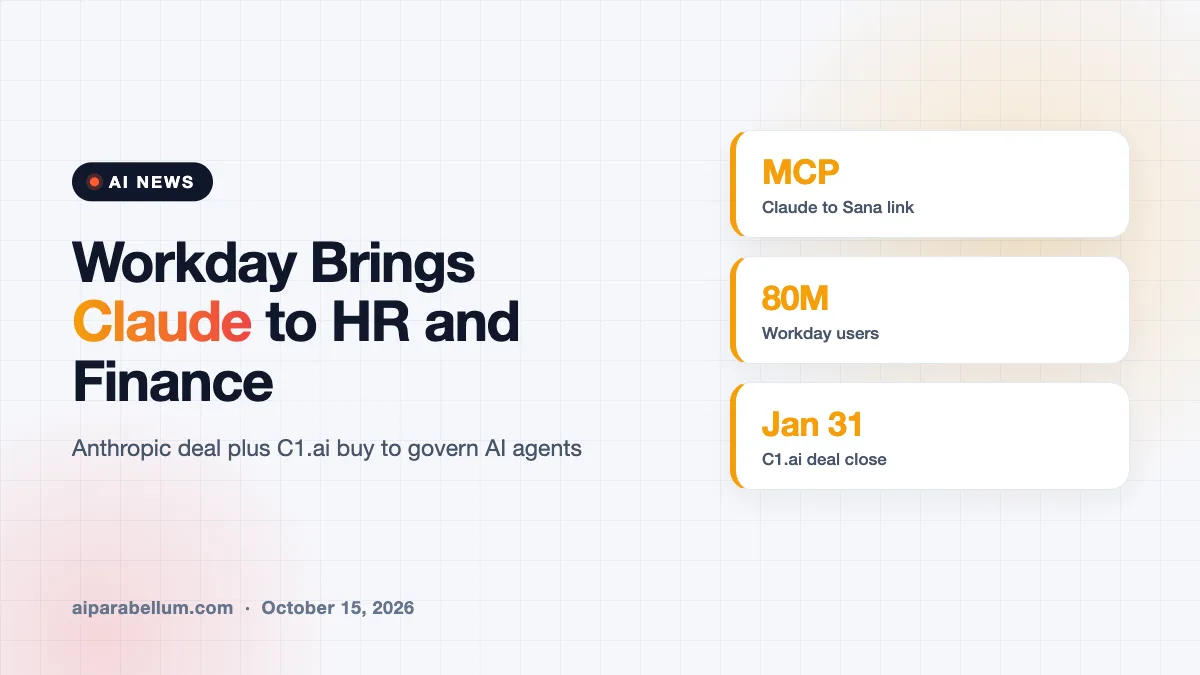
Workday is putting Claude to work inside HR and finance through a new partnership with Anthropic, and it is buying agent identity startup C1.ai to control what those AI agents can touch. Both moves landed at the company’s Workday Rising event in Las Vegas this week. If your employer runs payroll, hiring or expenses on Workday, the way you ask for time off or approve an invoice may soon run through an AI agent instead of a web form.
What the Workday and Anthropic Partnership Does
The deal connects Claude with Sana, the AI agent layer Workday bought last year for about $1.1 billion. The two systems pass information and tasks back and forth using the Model Context Protocol, an open standard for linking AI tools to business software. That means you can start a task in Claude and finish it in Sana, or the other way around, without losing your place.
Workday says the work will happen in whichever tool fits the job. Some tasks will run inside Sana, which coordinates Workday’s own agents, while others will happen in Claude. Either way, employees can ask questions in plain language and have Workday agents finish the work.
Guardrails Stay in Workday
Every request still runs through the customer’s existing Workday permissions, approvals and business rules. The user confirms each change before it happens. Workday also says outside AI tools never get direct access to its data.
The relationship runs both ways. Anthropic uses Workday for its own finance and people operations, while Workday’s own developers build with Claude Code. The Sana plugin for Claude is with early-access customers now, with general availability expected in late 2026.
The big idea is simple: let the smartest model do the thinking, but let the system of record decide who is allowed to do what.
Why Workday Is Buying C1.ai Alongside Anthropic
C1.ai, formerly known as ConductorOne, makes identity governance software. It hands people and AI agents the access they need, when they need it, and pulls that access the moment a job or role ends. Workday wants that same control for the growing number of agents its customers run.
Workday president Gerrit Kazmaier pitched the deal as the answer to how companies can secure agents at scale. C1 says 95% of large US companies already run autonomous agents, while Deloitte research cited in the announcement found only 21% of organizations have mature governance for them. The price was not disclosed, and the deal is expected to close by January 31, 2027.
Other Workday AI Agent Announcements
The Anthropic deal and the C1.ai purchase were the headliners, but Workday rolled out a long list of other AI updates at the same event. Here is a quick look at the biggest ones.
| Announcement | What It Does | Timing |
|---|---|---|
| Sana as Workday Home | Conversational home screen for HR, finance and IT tasks | Admins choose when to switch on |
| Sana Concierge | Resolves HR and IT requests before they become tickets | Early access now |
| Talent Acquisition Agent | Monitors open jobs, builds shortlists, drafts outreach | Early access, wider release early 2027 |
| Candidate Profile | Reusable job seeker profile with prefilled fields | Early 2027 |
| Sana in Claude | Use Workday agents and data from inside Claude | Early access, general release late 2026 |
| C1.ai acquisition | Access control for people and AI agents | Expected to close by Jan. 31, 2027 |
Sana will also show up inside Microsoft Copilot, Teams, Slack and Google Gemini Enterprise. The self-service version is available in those tools today, with the full Sana experience due in late 2026.
The Push for Lawful Agents
CEO Aneel Bhusri, who returned to the top job in February, called the event a re-founding moment for the company. His core argument is that AI guesses, but payroll cannot. Workday’s answer is to bind every agent to its existing business rules, approval chains and audit trails, a theme it calls lawful agent design.
The numbers give that pitch some weight. Workday says AI made up more than 25% of new annual contract value last quarter, and more than 5,500 customers use at least one Workday-built agent. The platform supports about 80 million users.
What This Means for You
Most people will feel this news through their employer, not by signing up for anything. If your company runs on Workday, here is what to expect over the next year:
- You may be able to request leave, check pay details or file HR tickets by chatting with Claude or Sana instead of clicking through menus.
- Agents will only see and change what your normal Workday permissions allow, so your access rules carry over.
- Job seekers applying through Workday sites may get a reusable profile that cuts down on retyping resumes.
- IT teams should start asking vendors how AI agents get access, and how that access is removed when the work is done.
If you already use the Claude AI assistant at work, this is another sign that it is becoming a front door to company systems. Teams that are planning to automate employee onboarding should watch how Sana Concierge performs once it leaves early access.
The access question is getting attention across the industry. Recent funding for startups that help companies secure AI agents shows how quickly this market is growing. Our look at how AI agents are replacing integration tools explains why governance matters more as agents take on real work.
Anthropic has been busy on the enterprise side as well, with its third-quarter revenue jump showing how much business demand is driving its growth. You can follow more updates like this on our daily AI news page.
Sources
This report draws on Workday’s Rising 2026 product announcements, along with coverage from CRN and iTWire.
Conclusion
Workday is betting that the future of HR and finance software looks less like a website and more like a conversation with an AI agent. Pairing Claude’s reasoning with Sana gives employees a smarter way to get work done, while the C1.ai purchase tries to make sure those agents never get more access than they should. Many of these features are still in early access, so the real test will come in 2027 as they roll out widely. For now, the message to businesses is clear: AI agents are coming to the back office, and the companies that control the rules will matter as much as the companies that build the models.