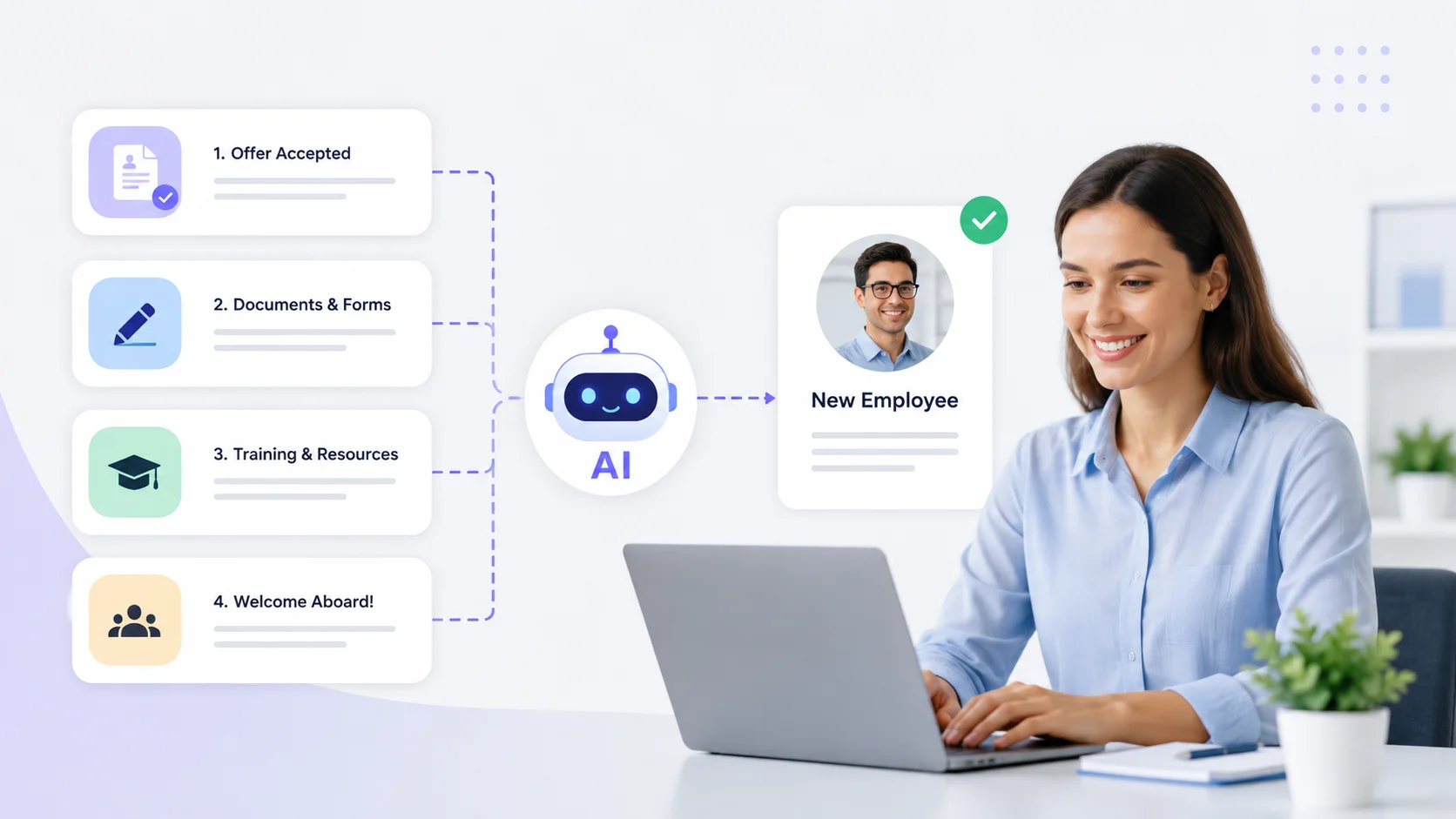
Bringing a new hire up to speed takes an enormous amount of time. Between paperwork, training schedules, IT setup, and introductions, most HR teams spend weeks getting a single employee onboarded. Multiply that by dozens of hires per quarter, and onboarding becomes one of the biggest time sinks in any organization.
AI tools are changing that entirely. From automated document processing to personalized training plans, AI can handle the repetitive parts of onboarding while your HR team focuses on what actually matters: making new employees feel welcome and prepared.
Why Employee Onboarding Needs Automation
Traditional onboarding is a manual, error-prone process. HR teams send the same welcome emails, schedule the same training sessions, and answer the same questions from every new hire. It is a workflow that practically begs to be automated.
Studies consistently show that companies with structured onboarding programs retain 82 percent of new hires compared to those without. But building and maintaining a structured program requires resources that many teams simply do not have. AI bridges that gap by automating the structure without requiring additional headcount.
The cost savings are significant too. When you factor in the hours HR staff spend on repetitive onboarding tasks, automation through AI business tools can reduce onboarding costs by 30 to 50 percent while actually improving the new hire experience.
What AI Can Automate in Onboarding
AI does not replace the human element of onboarding. It handles the administrative and repetitive tasks so your team can focus on personal connections and culture. Here is what AI automates most effectively.
Document Collection and Processing
New hires need to submit tax forms, identification documents, emergency contacts, and policy acknowledgments. AI-powered HR platforms collect these documents automatically, verify completeness, extract key data, and flag anything that is missing or incorrect.
Instead of an HR coordinator chasing down missing forms via email, the system sends automated reminders and guides the new hire through each required document step by step.
Personalized Training Schedules
Not every new hire needs the same training. A senior engineer joining the team has different needs than an entry-level marketing coordinator. AI analyzes the role, department, and experience level to generate customized training plans.
These plans adapt over time based on how the new hire progresses. If someone breezes through compliance training but struggles with the CRM system, the AI adjusts the schedule to provide more time and resources where they are actually needed.
IT Provisioning and Access Setup
Setting up email accounts, software licenses, security credentials, and hardware is one of the most time-consuming parts of onboarding. AI-driven IT automation tools can trigger provisioning workflows the moment an offer letter is signed.
By the time the new hire walks in on day one, their laptop is configured, email is active, and all necessary software access is in place. No tickets, no waiting, no forgotten accounts discovered three days into the job.
AI Chatbot for New Hire Questions
New employees have hundreds of questions in their first few weeks. Where is the break room? How do I submit PTO? What is the dress code? An AI chatbot integrated into your company’s communication platform answers these questions instantly, 24/7.
This is similar to how AI chatbots handle customer service inquiries, except the customers are your own employees. The chatbot learns from your company handbook, policies, and FAQs to provide accurate, context-aware answers without anyone from HR lifting a finger.
AI Onboarding Tools Compared
Several AI-powered platforms specialize in employee onboarding automation. Here is how the leading options stack up.
| Tool | Key Feature | Best For | Starting Price |
|---|---|---|---|
| BambooHR | Pre-boarding workflows and e-signatures | Small to mid-size companies | Custom pricing |
| Rippling | IT provisioning plus HR automation | Tech companies needing IT + HR | $8/user/month |
| Workday | AI-driven learning paths | Enterprise organizations | Custom pricing |
| Enboarder | Experience-driven onboarding workflows | Companies focused on culture | Custom pricing |
| Trainual | AI-generated training content | Growing teams needing SOPs | $249/month |
The right choice depends on your company size, existing tech stack, and which parts of onboarding cause the most friction. Smaller companies often start with BambooHR or Trainual, while enterprises typically need the depth of Workday or Rippling.
Building an AI-Powered Onboarding Workflow
You do not need to overhaul your entire HR process at once. Start by automating the most painful parts and expand from there. Here is a practical approach to building an AI onboarding workflow.
Phase 1: Pre-Boarding Automation
The onboarding experience should start before day one. As soon as an offer is accepted, trigger automated workflows that handle document collection, IT provisioning, and welcome communications.
- Send automated welcome emails with company information, first-day logistics, and required paperwork.
- Trigger IT setup workflows for email, software access, and hardware ordering.
- Share a digital onboarding portal where the new hire can complete forms, watch introduction videos, and read company policies at their own pace.
- Schedule first-week meetings with their manager, team members, and an HR orientation session.
This pre-boarding phase eliminates the chaotic first morning where new hires sit in a conference room filling out paperwork. They arrive ready to work instead.
Phase 2: First Week Automation
The first week sets the tone for the entire employment relationship. AI can ensure nothing falls through the cracks by managing a structured sequence of activities.
- Daily check-in messages from the AI system asking how things are going and offering relevant resources.
- Automated training module assignments based on role and department.
- Buddy system matching, where AI pairs the new hire with an experienced employee based on role similarity and interests.
- Automated reminders to managers about scheduled check-ins with their new team member.
The first week of a new job shapes how an employee feels about the company for months to come. AI ensures that critical touchpoints happen on schedule, every single time.
Phase 3: Ongoing Integration
Onboarding does not end after the first week. The best programs extend through the first 90 days. AI handles this extended onboarding by scheduling milestone check-ins, tracking training completion, and gathering feedback at regular intervals.
Automated pulse surveys at 30, 60, and 90 days give HR teams real-time visibility into how new hires are settling in. If someone reports feeling disconnected or overwhelmed, the system alerts their manager immediately so the issue can be addressed before it leads to turnover.
How AI Chatbots Transform the Onboarding Experience
AI chatbots deserve special attention because they solve one of the biggest pain points in onboarding: information overload. New hires are bombarded with policies, procedures, tools, and acronyms in their first few days. Remembering everything is impossible.
An AI chatbot acts as an always-available knowledge base. Instead of searching through a 200-page employee handbook, a new hire can simply ask “What is the company policy on remote work?” and get an instant, accurate answer.
Modern AI chatbots powered by large language models go beyond simple FAQ matching. They understand context, handle follow-up questions, and even detect frustration or confusion in the way someone phrases a question. This kind of intelligent assistance was previously only possible with a dedicated HR representative. Now AI-powered assistants can provide it at scale.
Automating Compliance Training With AI
Compliance training is one of the least exciting but most critical parts of onboarding. Every new hire needs to complete training on workplace safety, harassment prevention, data security, and industry-specific regulations.
AI automates this process by assigning the correct compliance modules based on role, location, and department. It tracks completion, sends reminders for overdue training, and generates reports that prove compliance during audits.
| Compliance Area | How AI Helps | Time Saved |
|---|---|---|
| Workplace safety | Auto-assigns modules by location and role | 2-3 hours per hire |
| Data security | Adaptive training based on access level | 1-2 hours per hire |
| Harassment prevention | Schedules and tracks completion automatically | 1 hour per hire |
| Industry regulations | Updates training content when regulations change | Ongoing |
The real value here is consistency. AI ensures that every single employee completes the required training, which protects the company legally and creates a safer workplace.
Measuring Onboarding Success With AI Analytics
One of the most overlooked benefits of AI onboarding is the data it generates. Traditional onboarding gives you almost no visibility into how effective the process is. AI-powered systems track everything and surface insights that help you continuously improve.
- Time to productivity, measuring how quickly new hires reach full performance in their role.
- Training completion rates and scores across different modules and departments.
- New hire satisfaction scores from automated pulse surveys.
- Bottleneck identification, showing where new hires consistently get stuck or delayed.
- Retention correlation, connecting onboarding experience quality to 6-month and 12-month retention rates.
This data analysis capability turns onboarding from a gut-feel process into one driven by actual metrics. You can see what works, what does not, and where to invest in improvements.
Common Mistakes When Automating Onboarding
AI onboarding automation is powerful, but it can backfire if implemented poorly. Avoid these common mistakes.
- Over-automating the human element. Automated welcome emails are fine, but the first meeting with a manager should never be replaced by a chatbot. Use AI for logistics, not relationships.
- Deploying without testing the experience yourself. Go through your own automated onboarding flow as if you were a new hire. If it feels cold, confusing, or overwhelming, fix it before real employees encounter it.
- Ignoring feedback from new hires. The people going through your onboarding are the best source of improvement ideas. Collect and act on their feedback regularly.
- Setting it and forgetting it. Company policies change, tools get updated, and team structures shift. Review and update your automated workflows at least quarterly.
- Not involving managers in the process. AI handles the logistics, but managers need to be actively engaged in welcoming and integrating new team members.
The goal of AI in onboarding is not to remove people from the process. It is to remove busywork from people so they can focus on what technology cannot do: building genuine human connections.
AI Onboarding for Remote and Hybrid Teams
Remote onboarding presents unique challenges that AI is particularly well suited to solve. When new hires are not physically present, it is easy for them to feel isolated and disconnected.
AI tools bridge this gap by creating structured virtual onboarding experiences. Automated introductions connect new hires with team members through scheduled video calls. Virtual office tours, interactive org charts, and AI-generated summaries of team projects help remote employees understand the company landscape without being physically present.
For hybrid teams, AI manages the complexity of coordinating in-office and remote schedules. It can suggest which days the new hire should come into the office during their first month to maximize face-to-face interactions with key team members. These productivity tools make remote onboarding feel almost as personal as being there in person.
Getting Started With AI Onboarding Automation
You do not need a massive budget or a dedicated IT team to start automating onboarding. Here is a practical path forward.
Start by mapping your current onboarding process end to end. Identify every task, email, form, and meeting that happens from offer acceptance through the first 90 days. Then classify each item as either automatable or human-required.
For small teams, you can begin with simple tools. Use a chatbot builder to create an FAQ bot trained on your employee handbook. Set up automated email sequences for pre-boarding communications. Use project management tools with automation features to create onboarding task checklists that trigger automatically when a new hire is added.
As your needs grow, consider dedicated platforms like Rippling or BambooHR that offer end-to-end onboarding automation. The key is to start small, measure results, and expand based on what delivers the most value. Many of the same principles that apply to AI agents replacing traditional workflows apply to onboarding automation as well.
The Future of AI in Employee Onboarding
AI onboarding tools are evolving rapidly. The next generation of platforms will use predictive analytics to identify which new hires are at risk of early turnover and intervene before it happens.
Personalization will become even more granular. AI will tailor not just the training content but the communication style, pacing, and channel preferences based on each individual’s behavior patterns during their first weeks. Business leaders who adopt these tools early will have a significant advantage in talent retention.
Integration with generative AI will also expand. New hires will be able to ask an AI assistant complex questions about company strategy, product architecture, or team history and get detailed, contextually accurate answers drawn from internal documents and knowledge bases.
Conclusion
Automating employee onboarding with AI tools transforms what is typically a chaotic, manual process into a smooth, consistent experience that benefits both the company and the new hire. AI handles document collection, training assignments, IT provisioning, compliance tracking, and FAQ answering so your HR team can focus on the personal touches that make employees feel valued from day one. The companies that get onboarding right see higher retention, faster time to productivity, and stronger employee engagement. AI makes getting it right repeatable and scalable, regardless of how many people you hire.