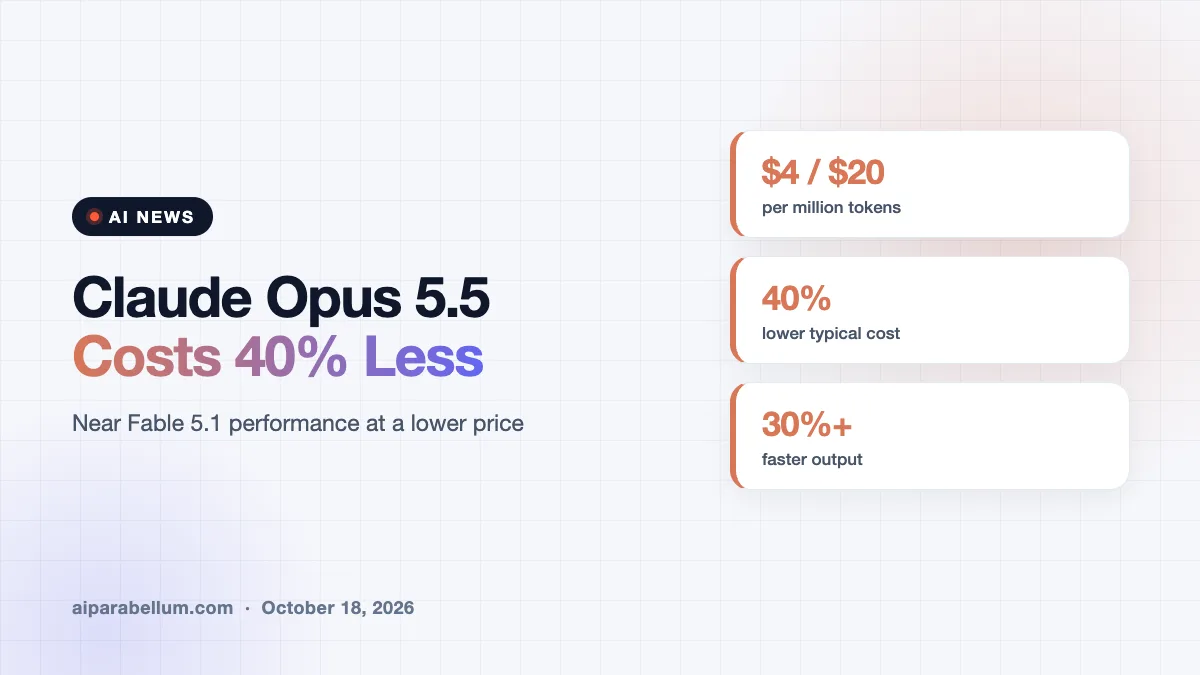
Anthropic has released Claude Opus 5.5, the first model in its new Claude 5.5 family, and the pitch is simple: top-tier performance for a lot less money. The company says Opus 5.5 works at roughly the level of its flagship Claude Fable 5.1 on most tasks while costing about 40% less to run than Opus 5. It is live now in the Claude apps, the Claude Platform, and on Amazon Web Services, Google Cloud, and Microsoft Azure.
What Claude Opus 5.5 Brings to the Table
Opus 5.5 is a big jump over Opus 5, according to Anthropic. The company says it now leads its own benchmarks in agentic coding, computer use, and everyday knowledge work. Anthropic also admits that benchmark gaps at this level are a weaker guide to real-world differences than they used to be.
The release comes shortly after CEO Dario Amodei argued that AI progress should be paced so safety keeps up. Anthropic calls Opus 5.5 its first release since that call, and says outside groups, including METR and Frontier Design, tested it before launch.
Here are the headline improvements Anthropic is claiming:
- Stronger results on long coding jobs, like migrations and full codebase audits
- Lower cost per task, because it charges less per token and uses fewer tokens
- Output that is more than 30% faster than Opus 5
- Clearer writing that puts the key point first and follows style rules
- The best score of any Claude model so far on Anthropic’s automated behavior audit
Opus 5.5 Pricing and Speed Compared
The price cut is the part most developers will notice first. Input and output tokens cost 20% less than Opus 5, and cache reads, which make up most of the cost of agent and coding work, dropped by 60%.
| Item | Claude Opus 5.5 | Change vs. Opus 5 |
|---|---|---|
| Input tokens | $4 per million | 20% lower |
| Output tokens | $20 per million | 20% lower |
| Cache reads | $0.20 per million | 60% lower |
| Typical workload cost | About 40% less | Fewer tokens per task |
| Fast mode | $8 input / $40 output per million | Up to 2.5x speed |
Subscribers get something too. Anthropic is raising five-hour usage limits on Pro, Max, Team, and seat-based Enterprise plans. It is also handing out a rate limit reset that users can save and spend whenever they like.
How It Stacks Up on Coding Tests
On FrontierCode, a test of whether an agent’s code changes would get merged, Anthropic reports a 54.6% score at default effort. That edges out GPT-6 Astra’s top score of 53.3% at about a fifth of the cost per task. On CursorBench, Opus 5.5 scored 52.5%, versus 46.6% for Opus 5 at max effort.
Some early tester stories are striking. One finished a 680,000-line code migration in under a day, and another audited and fixed a 200,000-line codebase in under three hours, where Opus 5 took more than 20. If you work in tools like Cursor for codebases, these are the kinds of long jobs where the savings add up.
Safety Upgrades in the New Claude Model
Anthropic says Opus 5.5 scored better than recent Claude models on nearly every misalignment measure across almost 2,000 simulated scenarios. In a new test of whether a model tries to break out of its set limits, it made such attempts about 85% less often than Opus 5. The company says every attempt was low severity and self-reported.
There is a catch that Anthropic flags itself. The model often seems to suspect it is being tested, which makes it harder to predict how it will act in real use. That concern echoes the company’s push for independent model evaluators and its recent AI safety bill proposal.
Tighter Rules for Cyber and Biology Work
Because Opus 5.5 is very strong in cybersecurity and biology, it ships with safeguards similar to Fable 5.1. Routine bug fixing still works, but most security tasks get quietly routed to Claude Opus 4.8. Labs and drug companies can apply to a new Life Sciences Verification Program for fuller biology access, and a wider Cyber Verification Program is coming in the next few weeks.
The model also launches with preserved thinking, the anti-copying feature built to block distillation attacks on newer API accounts. Thinking mode can no longer be switched off.
What This Means for You
For most people, the takeaway is more capable Claude for less. Here is how it may affect you:
- Claude app users on paid plans get higher five-hour limits and a reset they can bank for later.
- Developers can switch to the model name claude-opus-5-5 and should expect lower bills on agent and coding work.
- Teams running long, unattended jobs in Claude Code may see fewer steps and less rework.
- Security researchers may find some requests handled by an older model until they join the verification program.
Our take: the story here is not just a smarter model, it is frontier-level work becoming cheap enough to run all day.
Anthropic says Claude Sonnet 5.5 and Claude Haiku 5.5 will follow in the coming weeks with many of the same gains. If you are new to the lineup, our Claude AI overview is a good place to start, and you can follow more updates on our AI news page.
Sources
Details come from Anthropic, with launch coverage from Digit.
Conclusion
Claude Opus 5.5 shows Anthropic chasing two goals at once: matching its top model on everyday work and cutting the price sharply. The benchmark wins are company claims, so real-world testing will tell the full story. The safety picture looks better on paper, though Anthropic is open that its tests have limits. For developers and paid subscribers, cheaper and faster frontier AI is the clear win. Expect the smaller Sonnet and Haiku versions to bring similar gains soon.