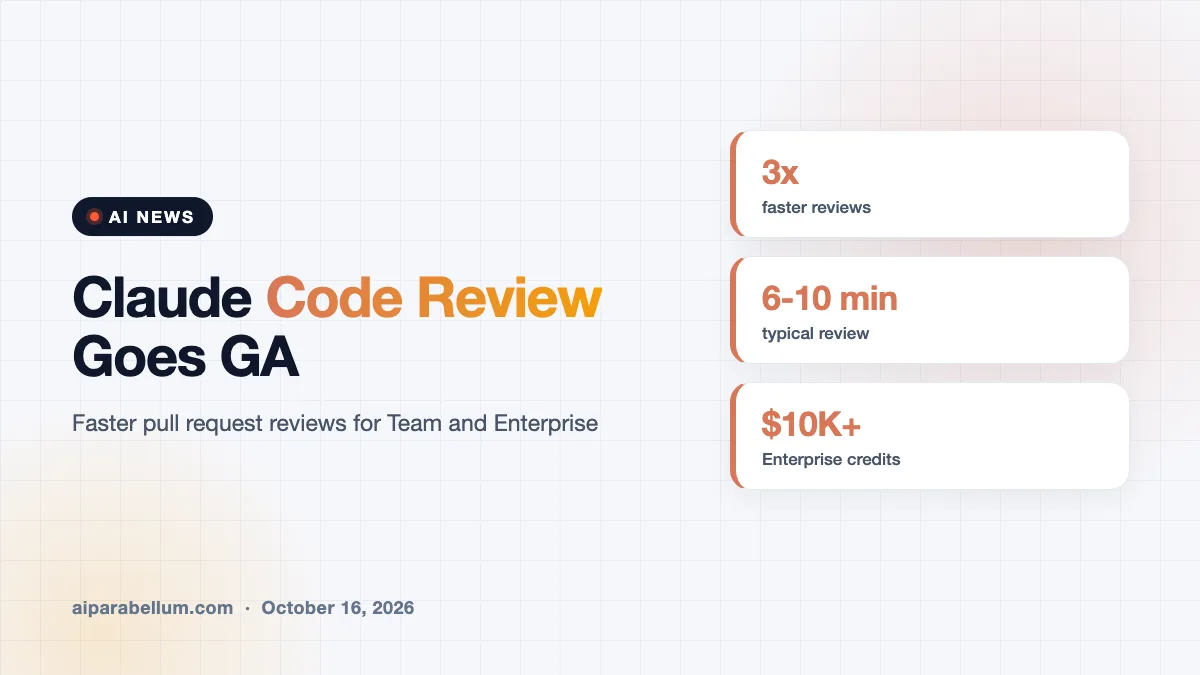
Anthropic has moved Claude Code Review out of research preview and made it generally available to Claude Team and Enterprise organizations. The tool reviews GitHub pull requests automatically, and the company says most reviews now finish about three times faster than they did during the preview. Admins can also pick how deep each repository’s review goes, which is a big deal for teams drowning in AI-written code.
The launch comes with a sweetener for big customers. Eligible Claude Enterprise organizations can claim at least $10,000 in Code Review credits, as long as they claim them by January 15, 2027.
Why Claude Code Review Matters Now
Coding agents have made it easy to write code quickly, but someone still has to check it. Anthropic says that review step is still the bottleneck for many teams, even as the pace of writing code keeps climbing.
Preview users told Anthropic the tool was catching real problems before a human looked at a pull request. What they wanted was reviews that were quieter, sized to each change and quicker to arrive.
The takeaway: as AI writes more of the code, the real race is about who can check it fast enough without letting bugs slip into production.
What Changed in the General Release
Anthropic grouped the upgrades into three areas. Here’s how they break down:
- Speed: most reviews now take about 6 to 10 minutes, down from roughly 20 minutes in the preview
- Quality: findings are shorter and state the problem, what triggers it and how to fix it in a few sentences
- Flexibility: admins choose a Quick, Standard or Deep review level for each repository
The Three Review Levels
| Level | What It Does | Trade-off |
|---|---|---|
| Quick | A lighter pass | Fastest and lowest cost |
| Standard | Balanced depth, speed and cost | The default setting |
| Deep | The most thorough pass | Slowest and most expensive |
The idea is simple. A routine internal tool can get a quick look, while the code that runs your payments or login system gets the deep treatment.
How Code Review Checks a Pull Request
According to Anthropic’s documentation, each review runs in four stages on Anthropic’s own infrastructure. The steps look like this:
- Find: several agents look at the diff and the code around it in parallel
- Verify: a checking step tests each candidate finding against the code and drops false positives
- Rank: the remaining findings are deduplicated and sorted by severity
- Post: the results land on the pull request
Developers see inline comments on the affected lines, a summary and a check run named Claude Code Review. That check run never ends as a failure, so the tool flags issues without blocking anyone’s merge.
What It Can and Can’t Touch
Inside a review, the tool has read-only access to your repository and doesn’t push commits. It works by reading the diff and nearby code, without building or running anything.
Teams can steer it with a REVIEW.md file, which is read only from the base or default branch. That means a pull request can’t quietly rewrite the rules it will be judged by.
Who Can Use Claude Code Review
The tool is for Team and Enterprise plans, and repositories must live on GitHub, including GitHub Enterprise Server and Enterprise Cloud with data residency. A Claude organization is required even if your developers reach Claude Code through Amazon Bedrock, Google Cloud or Microsoft Foundry.
There are some notable gaps. Code Review isn’t available to organizations with Zero Data Retention or the HIPAA configuration, isn’t covered by Anthropic’s Business Associate Agreement and doesn’t yet support customer-managed encryption keys.
What This Means for You
If your team already uses Claude, setup is short. An admin turns on Code Review in Claude Code settings, installs the GitHub App and picks repositories, and after that reviews run on new pull requests with no extra work from developers.
- Start with Standard on most repos, then move critical ones to Deep
- Write a short REVIEW.md so the tool flags what your team actually cares about
- Treat findings as a second set of eyes, not a replacement for human review
- Enterprise admins should set up repos before claiming credits, since credits expire 30 days after the claim
If you’re still learning the basics, our guide on Claude Code permissions is a good place to start. You can also see how Anthropic recently added agent tracing tools for teams that want more visibility. For a sense of how far AI coding has spread, even Linux kernel work now involves Claude Code.
Comparing options? Browse our code assistant directory or this list of developer AI tools. For daily updates, check the latest AI news roundup.
Sources
This article is based on Anthropic’s announcement on the Claude blog and its Claude Code documentation.
Conclusion
Claude Code Review’s general release is Anthropic’s answer to a problem its own tools helped create: more code than people can comfortably review. Faster reviews and per-repository depth settings make it more practical for everyday use. The read-only design and non-blocking check run also keep humans in charge of the final call. The data-retention and compliance gaps will keep some regulated teams out for now. For everyone else on Team or Enterprise plans, it’s an easy tool to try on a few repos this week.