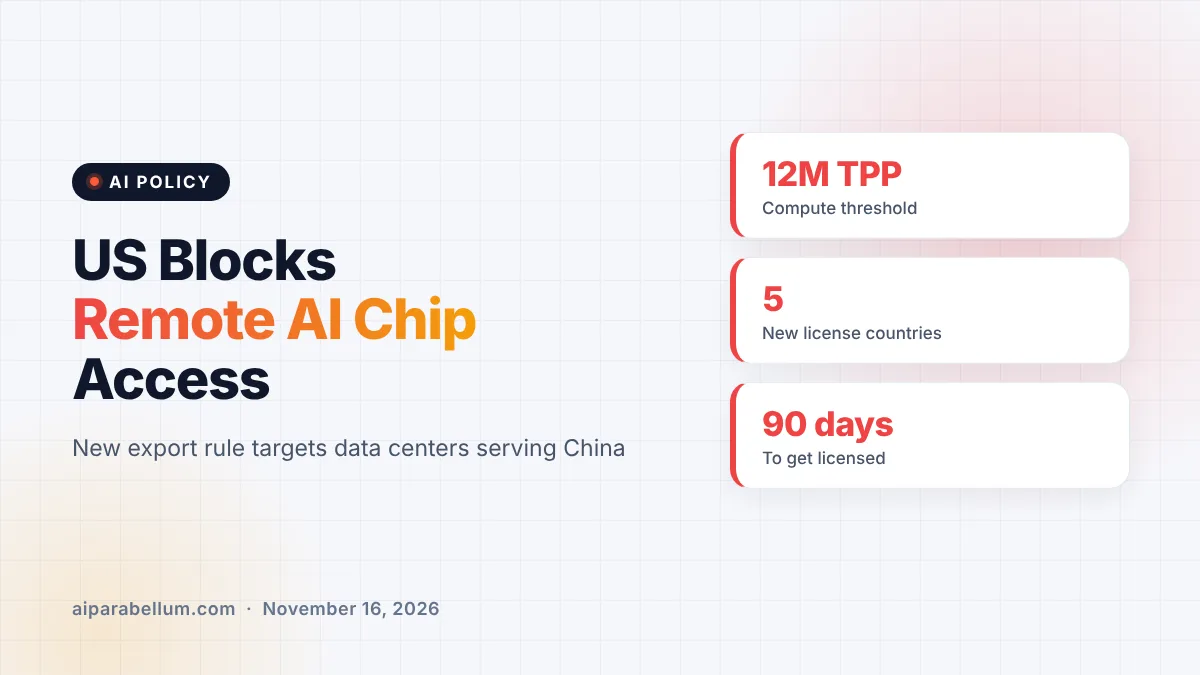
The US government just widened its AI chip export controls to cover something a shipping ban can’t stop: renting compute over the internet. On Monday, November 16, the Commerce Department’s Bureau of Industry and Security (BIS) released an interim final rule that requires licenses before advanced AI chips and servers go to data centers anywhere in the world that could sell computing power to companies from China and other restricted countries. The goal is to close a gap that let firms barred from buying top chips simply log in to them abroad.
What the New AI Chip Export Rule Does
Until now, US rules mostly controlled where chips physically went. A Chinese company couldn’t legally buy the most advanced Nvidia hardware, but it could often rent time on that same hardware sitting in a data center in a third country. BIS says the new rule lines up remote access with the controls that already apply to physical shipments.
According to the agency, the rule was written by and at the direction of the Treasury Department and the National Security Council. The text frames it as a “logical extension of existing controls” meant to stop companies in countries of concern from using US chips to train advanced AI models.
Who the rule targets
The remote-access limits focus on companies headquartered in the US government’s D:5 group of countries. That list includes China, Russia, Iran and North Korea, plus about 18 others. Data center operators also have to check who owns and controls their customers, and the rule covers indirect access through brokers or other go-betweens.
Key Details at a Glance
Here is a quick summary of the main pieces, based on the BIS release and reporting on the rule text.
| Item | What the rule says |
|---|---|
| Issued by | Commerce Department’s Bureau of Industry and Security |
| Type | Interim final rule, released November 16, 2026 |
| Main target | Remote access to advanced AI compute by D:5 country firms |
| Compute threshold | Data centers or networks above 12 million TPP |
| Rough equivalent | About 750 Nvidia H100 or H200 chips |
| New license countries | Malaysia, Singapore, Indonesia, Thailand, Brazil |
| Grace period | 90 days for existing operators to get licenses |
| Carve-out | Commercial recommendation systems |
TPP stands for total processing performance, the metric US export rules use to measure computing power. Smaller setups below the threshold fall outside the remote-access licensing requirement.
Chip Export Controls Expand to Five Countries
The rule also adds license requirements for exporting advanced chips to Malaysia, Singapore, Indonesia, Thailand and Brazil. The Commerce Department says these countries carry a higher-than-normal risk of diversion. Chips headed to companies based in the US are exempt from that extra step.
Southeast Asia has become a major hub for new AI data centers, including big projects like Google’s Malaysia investment. Last week there were reports that Chinese AI companies were racing to lock in overseas computing capacity before tighter limits arrived.
Biden-era diffusion rule is gone
The new rule formally rescinds the AI Diffusion Rule issued under President Biden in January 2025. That framework set country-by-country caps on advanced chip exports. The Trump administration said in May 2025 that it would scrap it, arguing it placed needless limits on US companies and allies.
Why This Is Happening Now
The timing is not random. The rule arrives days after Jensen Huang stepped down as Nvidia’s chief executive amid a scandal involving an alleged Chinese spy linked to one of the chipmaker’s customers. US officials have reportedly wanted to add that customer, Megaspeed, to a restricted list over claims it bought thousands of Nvidia chips to serve Chinese businesses.
Lawmakers had already been pressing Nvidia on chip location tracking and other ways to stop smuggling. The rule also lands just before President Trump is scheduled to travel to China for an economic summit with Xi Jinping.
Markets reacted fast
Chip stocks fell on Monday morning as the news spread. Here is how some of the moves looked early in the trading day:
- Nvidia dropped more than 2% after opening, after being down as much as 3.9% before the bell.
- Intel fell by more than 6%.
- Micron fell by more than 7%.
- The Philadelphia Semiconductor index sank by more than 5%.
What This Means for You
If you just use AI tools like chatbots or image generators, you probably won’t notice any change. The rule targets large-scale computing contracts, not everyday apps. It does matter more for some groups, though.
- Cloud and data center operators outside the US need to review customer ownership and may need licenses within 90 days.
- Companies building in Southeast Asia or Brazil should expect slower or more paperwork-heavy chip deliveries.
- Investors in chip stocks should watch how strictly the licenses get enforced, since that shapes foreign demand.
- Developers relying on overseas GPU rentals should confirm their provider’s compliance plans.
It also fits a wider trend of countries treating AI as a strategic asset. China is moving the other way too, with its own draft AI export controls on key models and technologies. You can follow these policy shifts in our latest AI news.
Sources
Primary source: Bureau of Industry and Security press release. Additional reporting from TechCrunch, The New York Times and Business Insider.
Conclusion
The new BIS rule shifts US AI chip export controls from tracking boxes to tracking access. By requiring licenses for data centers that could serve Chinese and other restricted firms, and by adding five higher-risk countries to the license list, Washington is trying to shut the rental loophole that let banned companies use top chips anyway. How hard it bites will depend on enforcement over the next 90 days. For now, it is one of the clearest signs yet that compute itself, not just hardware, is now treated as a national security asset.