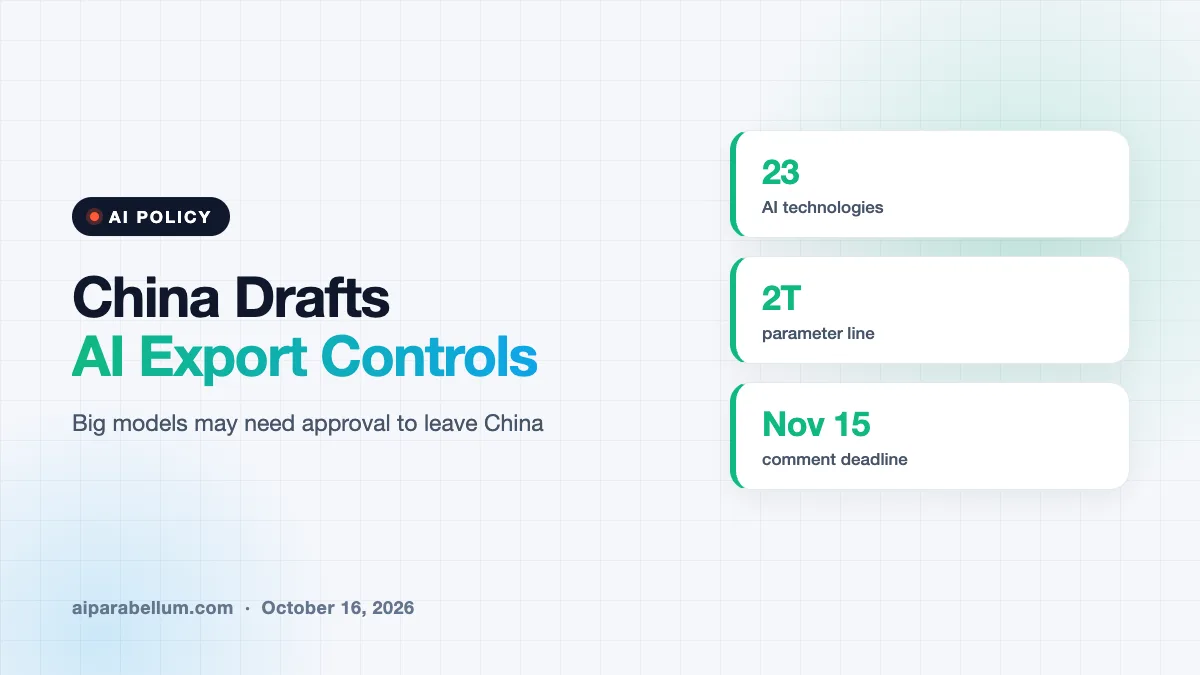
China has proposed new AI export controls that could restrict overseas transfers of its most powerful models, AI agents, and advanced chip designs. The draft adds 23 AI technologies to the country’s list of restricted or banned exports. Open-source releases and app-based access stay largely untouched, but the rules give Beijing a new way to keep its top AI tech at home.
What the China AI Export Controls Would Cover
The draft comes from China’s Commerce Ministry together with other government ministries. It is part of a wider update covering 40 technologies, which also includes 12 solar items and five biomedical ones, such as gene therapy platforms.
On the AI side, the 23 items span large language models, AI agents, computing clusters, data processing, and chip design. The public can comment on the draft until November 15.
Which Models Could Be Restricted
The core technology behind a large model, including its weights and source code, would face export limits once the model passes certain lines. Here is how the reported thresholds break down:
| Trigger | Threshold in the draft |
|---|---|
| Model size | At least 2 trillion parameters |
| Global ranking | Top 10 worldwide on measures such as performance, usage, or safety |
| Training compute | About 10^26 FLOPs, per one report on the draft |
| Training data | Models trained on China’s sensitive “important data” |
| Chip design | AI chips at 14 nanometers or more advanced, or using 2.5D and 3D packaging |
Reports name Moonshot AI’s Kimi K3 and Alibaba’s Qwen3.8-Max as models above the size line, though the draft itself names no model. AI tools that can write or change malware on their own to attack critical systems would face a full ban.
What China’s AI Export Controls Leave Open
Beijing is clearly trying not to choke its own open-source boom. Technology and research already in the public domain is exempt, and open-source releases can get “automatic licensing” when a company files the paperwork.
Several kinds of use also stay outside the controls:
- Overseas users reaching Chinese models through apps, websites, or APIs
- Chinese firms running covered models on their own cloud servers abroad, which can qualify for fast-track approval
- Research with foreign partners and work on international standards, which get simpler procedures
Installing a covered model on someone else’s servers abroad, however, would count as an export and need a standard license. A temporary rule requiring companies to register exports of listed items took effect on October 16, and it applies to deals that are still in progress.
Why Beijing Says It Is Acting
A Commerce Ministry spokesperson said the goal is to prevent misuse and abuse and to keep AI under human control. The ministry also says the plan does not target any particular country or company.
Why These AI Export Rules Matter Globally
Analysts see a bigger strategic message. OpenAI’s Dean Ball wrote that the draft does not shut down Chinese open-weight models but gives Beijing the option to block future ones, calling it a mirror image of US controls on model weights.
That matters because Chinese open-weight models have become popular with developers worldwide. Companies outside the US and China, especially in Europe, could find their access to top open models less certain if both superpowers can restrict them.
What This Means for You
If you build with open-weight models from Chinese labs, nothing changes overnight. But it is smart to plan ahead:
- Models you already downloaded and that are public stay usable, since public releases are exempt.
- Future giant models above 2 trillion parameters may face extra steps before they leave China.
- App and API access from abroad is not covered, so hosted services should keep working.
- Keep a backup plan with other open-weight models, such as US options like Nvidia’s Nemotron open model.
The move adds to a busy stretch for AI policy, from UK regulation talks to Apple’s China launch. You can follow more updates in our AI news section.
Sources
This article is based on reporting from The Next Web and The Decoder.
Conclusion
China’s draft would add 23 AI technologies to its export control list, targeting models above 2 trillion parameters or in the global top 10, along with advanced chip designs. Open-source releases, public research, and access through apps and APIs stay largely free, and firms running models on their own overseas clouds get a fast track. A temporary registration rule is already in force, and comments close November 15. For developers worldwide, it is a reminder that access to top open models now depends on policy as much as technology.