
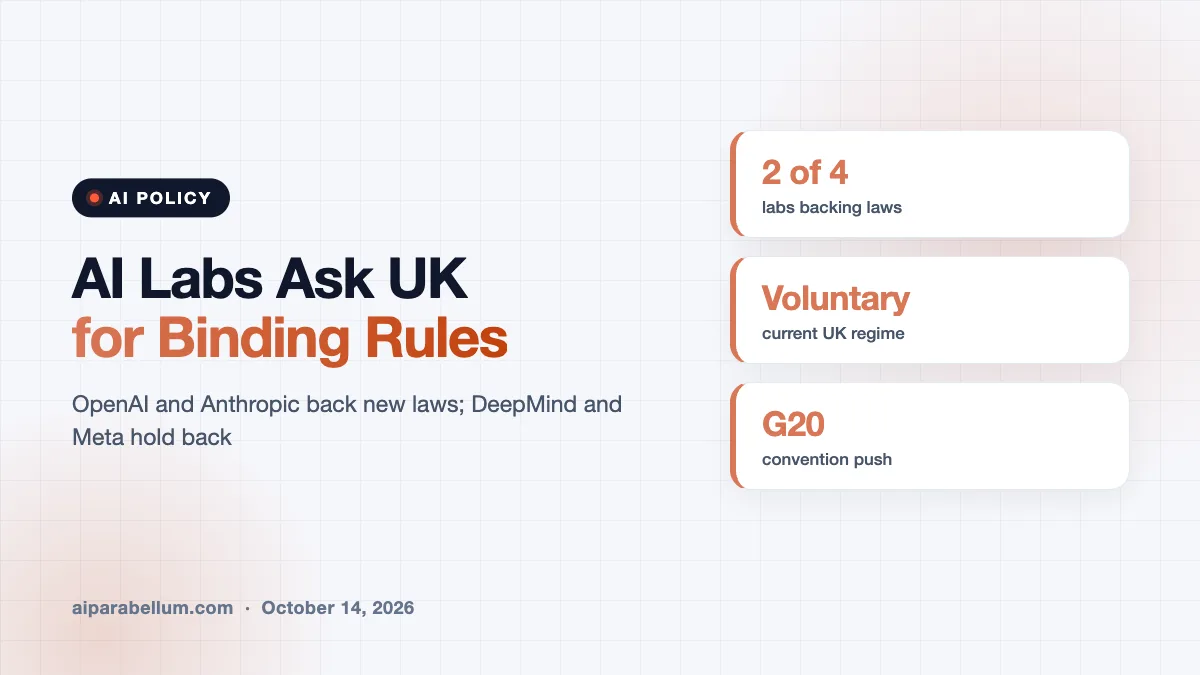
Two of the biggest AI labs just told British lawmakers something you rarely hear from tech companies: please regulate us. At a parliamentary hearing on Tuesday, representatives for OpenAI and Anthropic said voluntary safety pledges are no longer enough and backed binding UK AI regulation. Google DeepMind and Meta, testifying at the same session, declined to support new laws.
The split puts the industry’s disagreement over AI rules on the official record in a second country. It also showed how little power the UK actually has over the most advanced models today.
What Happened at the UK AI Regulation Hearing
The session was run by the House of Commons Business, Innovation, Science and Trade Committee, a cross-party group of MPs. It heard from four frontier AI companies, four former lab staff who have become critics, and senior British civil servants.
Committee chair Liam Byrne said the goal was to expose the gap between the companies and to show that self-regulation can’t be relied on. He later said his committee will spend a lot of time on how the UK should approach AI as a “middle power.”
Where each company stands
Here is a quick look at how the four labs answered the central question of whether AI safety needs a legal framework.
| Company | Representative | Position on binding rules |
|---|---|---|
| Anthropic | Liam Booth-Smith, head of Europe | Supports binding rules; says voluntary commitments are not enough |
| OpenAI | Tom Duff Gordon, vice president | Backs a statutory framework and an international convention, starting with mandatory incident reporting |
| Google DeepMind | Owen Larter | Did not back new laws; pointed to a focus on standards |
| Meta | Rob Sherman | Did not back new laws; pointed to the UK’s existing regulators |
Anthropic was the most direct. Booth-Smith told MPs the company has long believed companies should face binding rules. OpenAI was more measured, saying some elements should be mandatory and that relying only on voluntary promises for frontier risk is not a good long-term plan.
Why UK AI Regulation Is Back on the Table
Right now, the UK’s system runs on goodwill. The AI Security Institute (AISI) tests frontier models before release, but only when companies choose to share them.
Officials were candid about that under questioning. AISI director Henry de Zoete said the institute depends entirely on cooperation from companies and foreign governments. Cat Little, the top civil servant at the Cabinet Office, confirmed that the whole regime is voluntary “at the moment.”
De Zoete also admitted AISI could not stop a company from releasing a model it judged too dangerous. The institute does not certify or approve models, and he noted that the frontier builders are American or Chinese, which limits what the UK can do on its own.
The Washington factor
The hearing made clear that British access to new models often runs through the US. OpenAI said it shares models before release with CAISI, the US counterpart to AISI, and will keep sharing with the UK as long as the US government allows it.
Anthropic offered a concrete example. Booth-Smith said the company was not able to give UK AISI full, unrestricted access to its Mythos 5.1 model at first, calling that a question for the US government, though he added that AISI now has access.
Former Insiders Push for Stronger Oversight
Four former lab researchers also testified, and they were blunt. Their main points included:
- Daniel Kokotajlo, formerly of OpenAI, said he does not think the companies can be trusted to regulate themselves.
- Steven Adler, who left OpenAI in late 2024, said he is not confident in the safety culture across the industry.
- Geoffrey Irving argued that labs believe they are stuck in a race governments won’t interrupt, and said both beliefs are false because the companies could simply stop.
On the same day, MI5 director Ken McCallum used his annual threat update to warn that AI could raise the stakes on bioweapons. He described it as a risk not yet realized but the misuse case he takes most seriously. Byrne pointed to the contrast between that warning and officials admitting the AI safety system is voluntary.
What This Means for You
If you use tools like ChatGPT or Claude AI, nothing changes overnight. But this debate could shape how those products are tested and released in the years ahead.
- Expect more talk of mandatory incident reporting. Both OpenAI and Anthropic signaled support for it, which makes it a likely first step in any new law.
- Watch for a UK AI bill. The committee is now pushing ministers, and the industry split gives lawmakers political cover to act.
- Look for global coordination. Byrne wants the UK to use its coming G20 presidency, with South Korea after it, to push for an international AI convention.
- Keep an eye on company safety reports. Anthropic has published research on topics like distillation defenses, and that kind of disclosure may become required rather than optional.
This hearing also follows Microsoft’s Brad Smith calling for the UK to lead global rules, so pressure from inside the industry is clearly building. You can follow more updates in our AI news coverage.
Sources
This article is based on reporting from WIRED, which covered the committee hearing and spoke with the committee chair afterward.
Conclusion
The UK hearing drew a clear line through the AI industry. OpenAI and Anthropic now say binding rules are needed, while Google DeepMind and Meta prefer standards and existing regulators. At the same time, British officials admitted they cannot block a dangerous model or demand access to one. With lawmakers pushing for a statutory framework and an international convention, the question is shifting from whether AI should be regulated to how fast it happens. For anyone who relies on AI tools every day, that shift could mean safer, more transparent products down the road.
