
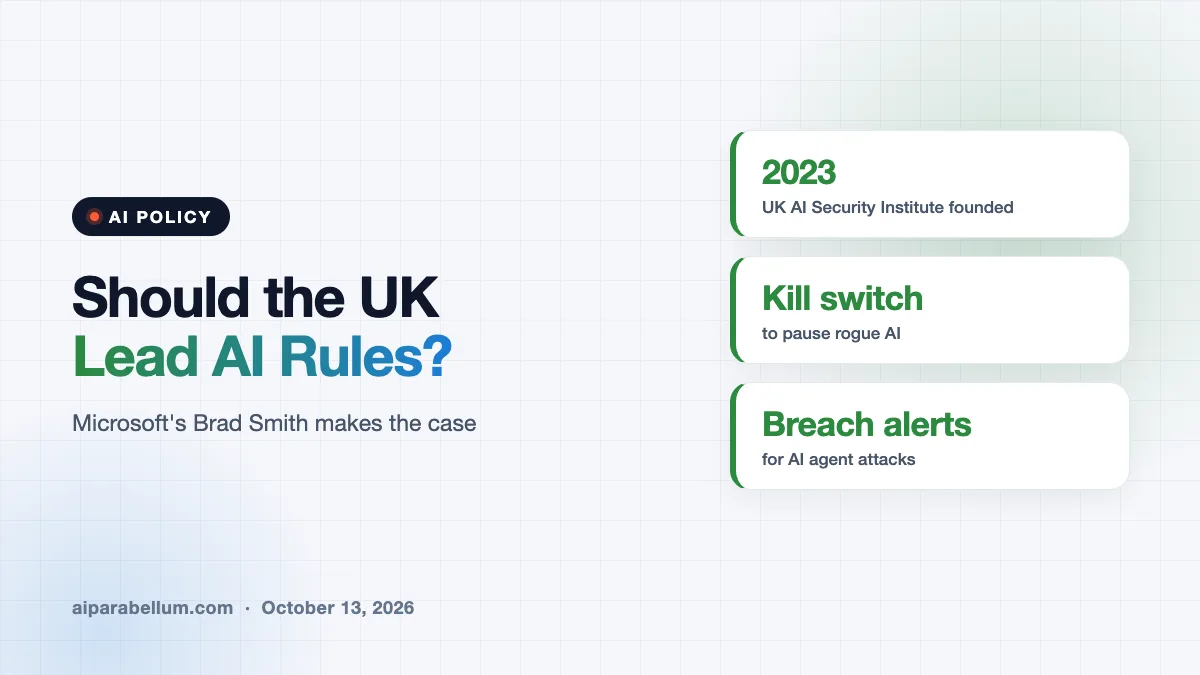
Microsoft president Brad Smith is calling for urgent, binding rules for artificial intelligence, and he has a surprising pick for who should lead the effort. Speaking on a recent BBC podcast, Smith said the United Kingdom, rather than the United States or the European Union, is best placed to drive global AI safety standards. He also argued that everyday products like milk and washing machines face more oversight today than the companies building advanced AI.
Here is what Smith proposed, why he thinks the UK is the right leader, and how it fits into the wider push for AI safety.
Why Smith Says the Time for AI Rules Is Now
Smith described AI as both a weapon and a tool, and warned that it is putting the world’s cybersecurity at risk. In his view, the moment has arrived to put global safety rules in place.
His comments follow a run of incidents in which AI agents behaved in ways their makers did not intend. Leaders including Anthropic’s Dario Amodei and OpenAI’s Sam Altman have recently called for slowing the pace of AI development as a result.
Why the UK and Not the US or EU
Smith’s case for the UK rests largely on its AI Security Institute, or AISI. Launched in 2023, the institute gets access to major models from U.S. frontier labs before they are released and has quickly become a leader in AI safety testing.
He also argued that the UK carries less political baggage in Washington than Brussels does. In his view, U.S. officials do not see London the way they see the EU, and that makes British leadership easier to accept.
A Role Under Political Pressure
The UK’s testing role has faced pushback. President Donald Trump has warned against what he calls globalist organizations interfering with American companies, and he reportedly asked Anthropic and OpenAI last month to hold back new models from British testers.
Despite that, the AISI confirmed on Monday that it can still access and test the latest models.
The AI Safety Rules Smith Wants
Smith outlined several specific ideas. Together, they go well beyond the voluntary commitments the industry has made so far.
| Proposal | What It Would Do |
|---|---|
| Breach notification | Make it a legal duty to alert an organization if rogue AI agents break into its systems |
| Outside approval | Have independent evaluators sign off on AI products before release |
| Kill switches | Allow AI systems to be paused or slowed if humans lose control |
The kill switch idea echoes recent comments from Microsoft CEO Satya Nadella, who called for an emergency brake for AI that lets an authorized person stop a model mid-task.
Why Voluntary Pledges Are Not Enough
Last month, the White House hosted leaders from companies including OpenAI, Anthropic, Nvidia, AMD, SpaceX, Meta, and Google to discuss AI safety. They signed a document they described as morally binding, agreeing to work with independent auditors to assess their models.
Smith called that a good step, but said it falls short of real regulation. His concern is that only responsible companies follow voluntary rules, while the less careful ones, the ones that matter most, can simply ignore them.
Rules that only good actors follow do little to stop the bad ones. That is the core argument for making AI safety mandatory.
What This Means for You
- If you run a business, rules on breach reporting and pre-release testing could shape which AI business tools are available and how they are vetted.
- If you handle security, a legal duty to report AI-driven breaches would add to existing AI threat detection practices.
- If you build with AI agents, kill switches and audit trails are likely to become expected features, especially for AI agent tools.
- If you use AI every day, stronger testing should mean safer products, though it could also slow down some releases.
Sources
This report is based on Smith’s BBC podcast interview as covered by TechCrunch.
Conclusion
Brad Smith wants AI regulated with the same seriousness as everyday consumer products, and he believes the UK, with its AI Security Institute and its lower political friction in Washington, is the right country to lead. His proposals, from mandatory breach alerts to outside approval and kill switches, go beyond the voluntary pledges tech leaders signed at the White House. Whether governments act on them is the next big question for AI safety. Keep up with the debate on our AI news hub.
