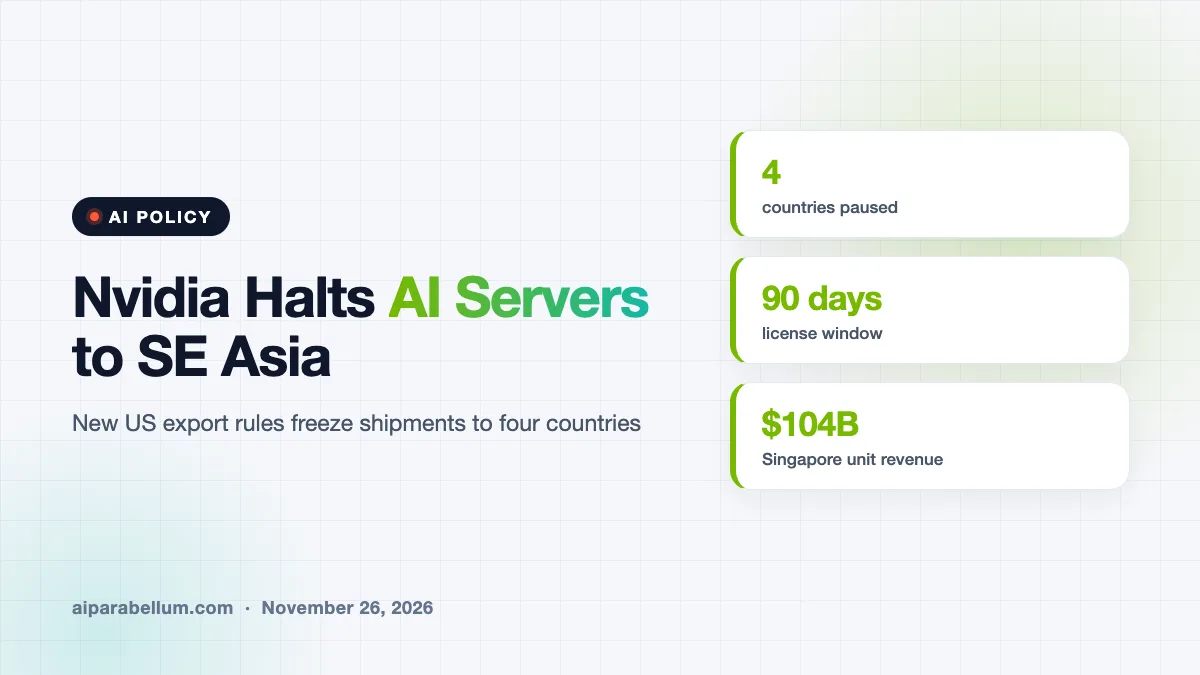
Nvidia has reportedly told its hardware partners to stop shipping AI servers to Malaysia, Singapore, Thailand and Indonesia. The Nvidia server shipment halt, reported on November 26 and based on three people familiar with the matter, follows new US export rules meant to keep advanced AI computing power away from Chinese developers. Nvidia has not commented, and nobody knows yet how long the pause will last.
What We Know About the Nvidia Server Shipment Halt
According to the Financial Times, server makers that build systems around Nvidia chips, including Dell and Supermicro, have told buyers in the four countries that Nvidia will not allow their orders to ship. The report cites three people with knowledge of the matter. Nvidia, Dell and Supermicro have not publicly responded.
It is still unclear whether this is a short pause or something longer. The people quoted in the report said Nvidia and its partners are still working out how to comply with Washington’s new export controls. In other words, the freeze may lift once a compliance process is in place, or it may stick.
The four countries affected
- Malaysia, where investors have poured billions into large AI data centers
- Singapore, home to the Nvidia subsidiary that books a huge share of its revenue
- Thailand, a growing data center market
- Indonesia, which reports say is hit hardest alongside Malaysia
The US Export Rule Behind the Pause
The pause traces back to a rule the US Commerce Department’s Bureau of Industry and Security released on November 16. We covered that move when it landed as a remote access crackdown. Its goal is to stop companies in China and other restricted countries from renting large amounts of US AI compute through data centers in third countries.
The rule adds a license requirement for advanced computing chips shipped to Indonesia, Malaysia, Singapore, Thailand and Brazil. US officials say these five places carry a “higher-than-normal risk of diversion,” though none of them is under an embargo. Brazil is not part of the reported shipment halt.
| Rule detail | What it means |
|---|---|
| Covered countries | Indonesia, Malaysia, Singapore, Thailand and Brazil |
| License review | Case by case, weighing each country’s export controls and cooperation |
| US-headquartered buyers | Exempt from the license, but exporters file monthly reports |
| Sites already serving Chinese customers | 90 days after the rule takes effect to get a license |
One executive told the newspaper there is no clear guidance yet on how to apply for those licenses. That gap helps explain why Nvidia might hold shipments rather than risk sending servers that later turn out to need approval.
Why the Nvidia Server Halt Hits Southeast Asia Hard
The region is big business for the chipmaker. Nvidia booked $104 billion in revenue through its Singapore subsidiary in 2025, a 72 percent jump in a year, according to company accounts cited in the report. Some of that figure also includes Taiwan and China revenue routed through the Singapore unit.
Southeast Asia has also become a favored route for Chinese AI developers trying to reach Nvidia’s most advanced AI chips, which Washington restricts. That is exactly the pattern the new rule targets. The move comes just after Nvidia reported record quarterly revenue, so any lasting slowdown here would be watched closely.
Data center projects caught in limbo
The freeze leaves billions of dollars in regional data center plans uncertain. Lenders have reportedly held back about $500 million in financing for Singapore-based cloud provider Aolani, which had planned to lease computing capacity to ByteDance. Malaysia’s trade ministry has said it does not enforce other countries’ unilateral export controls, though local firms are expected to consider them.
A Rough Stretch for Nvidia on China
The halt lands during intense scrutiny of how Nvidia chips reach China. US investigators have been looking at chip diversion and smuggling networks, including questions around Singapore-based cloud firm Megaspeed. Lawmakers have also pressed the company on whether chip tracking is possible.
Leadership turmoil has added to the pressure. CEO Jensen Huang resigned earlier this month amid reports linking him to a suspected spy, and the board reinstated him on November 23. The company also set up a board security committee focused on national security and export controls.
What This Means for You
Most people will never buy an Nvidia server, but this still ripples outward. Here is what to keep in mind:
- Cloud AI capacity in Southeast Asia could tighten for a while, which may slow new AI services launched from the region.
- If you run workloads on regional cloud providers, check with them about delays or price changes on GPU capacity.
- Expect more rules like this. Washington is now watching where chips end up, not just who buys them first.
- For a wider view of the chip race, keep an eye on our AI news coverage as Nvidia and its partners respond.
The takeaway: US export policy now reaches well beyond China’s borders, and the countries in between are starting to feel it directly.
Sources
This story rests on a report citing anonymous people familiar with the matter; Nvidia has not commented. Reporting from News18, Modern Diplomacy and BusinessToday Malaysia.
Conclusion
Nvidia’s reported pause on AI server shipments to Malaysia, Singapore, Thailand and Indonesia shows how fast new US export rules are reshaping the AI supply chain. The company has not said whether the halt is temporary, and partners say license guidance is still missing. Billions in data center investment now hang on how quickly that gets sorted out. For Nvidia, it is one more China-related headache in an already turbulent month. Watch for an official statement or license guidance as the next real signal.