Nvidia’s board has set up a new export control committee with a national security brief, giving directors a direct line into how the chipmaker follows US trade rules. The company announced the National Security and Export Control Oversight Committee on November 17, 2026, only hours before its first earnings report under an interim chief executive. It is a standing committee, which means it is meant to be permanent rather than a short-term review.
The timing matters. Nvidia makes the chips that power most advanced AI systems, and Washington is paying closer attention than ever to where those chips end up.
What the Nvidia Export Control Committee Will Do
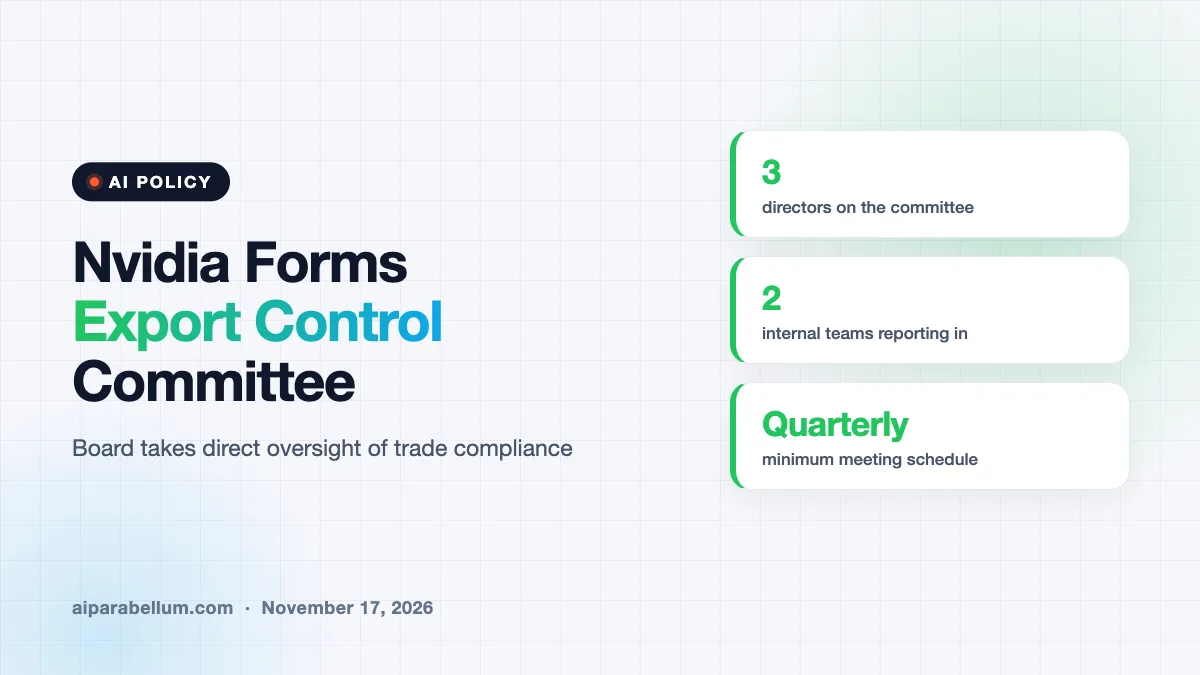
According to the company’s announcement, the committee handles board-level oversight of three areas: national security policies, export control compliance and global trade risk management. In plain terms, a small group of directors will now watch how Nvidia decides who can buy its most powerful hardware.
Two internal groups already do this work day to day, the National Security Team and the Global Trade Compliance Team. Both will now report directly to the committee, and also to interim CEO Colette Kress for daily operations. The committee is also tasked with overseeing efforts to strengthen those two teams.
Nvidia says the committee will bring in independent outside experts in law, national security and trade compliance. That gives directors advice that does not come only from the company’s own managers.
Committee at a Glance
| Detail | What Nvidia Announced |
|---|---|
| Full name | National Security and Export Control Oversight Committee |
| Type | Standing committee of the board |
| Chair | Suzanne Nora Johnson |
| Other members | Stephen C. Neal and John O. Dabiri |
| Meeting schedule | At least once a quarter, including executive sessions |
| Teams reporting in | National Security Team and Global Trade Compliance Team |
| Outside help | Independent legal, national security and trade experts |
Who Sits on the New Committee
Suzanne Nora Johnson will chair the group. She is a former vice-chair of Goldman Sachs who joined Nvidia’s board in July, according to the Financial Times.
Two more directors fill the remaining seats: Stephen Neal and John Dabiri.
Board chairman Harvey Jones framed the move as a duty that comes with the company’s position. He said Nvidia has “both a responsibility and an opportunity” to lead the industry on these questions. Jones also said the company wants to work with government and industry partners on a framework that protects national security while still supporting innovation.
Why Nvidia Formed an Export Control Committee Now
The announcement lands in the middle of the most turbulent stretch in the company’s history. On November 8, the board opened an independent investigation after reports that founder Jensen Huang had been targeted by a foreign intelligence effort. Four days later, Huang resigned and Kress stepped in as interim CEO, with Jones named the board’s first-ever chair.
Pressure from Washington has grown since then. The Financial Times reports that the board has been criticized for loose governance, and that lawmakers from both parties are backing bills to limit sales of sensitive chips overseas. The same report says Treasury Secretary Scott Bessent questioned over the weekend whether Nvidia had a real culture of compliance around export restrictions.
Regulators are moving too. On November 16, the Commerce Department’s Bureau of Industry and Security issued an interim rule aimed at remote chip access, which targets the use of data centers in third countries to get around existing limits. The Financial Times also reports that the Commerce and Justice departments have confirmed an investigation into Megaspeed, a Singapore-based Nvidia customer.
How It Differs From the Earlier Investigation
It is easy to confuse the two board efforts, so here is the difference. The November 8 investigation is a one-time review of a specific set of events, run by independent directors with outside counsel. The new committee is a permanent part of how the board works, and its job is ongoing supervision of compliance programs.
Nvidia’s announcement does not say how the two efforts will interact. It also gives no detail on budgets, staffing or which outside experts will be hired.
What This Means for You
You may not buy AI chips yourself, but the tools you use every day run on them. How strictly Nvidia polices its own sales shapes where AI computing power gets built and who can rent it.
- If you work in AI or cloud services, expect customer screening and paperwork around advanced chips to get tighter, not looser.
- If your company rents computing power from overseas data centers, watch how the new federal rule and Nvidia’s own checks affect your providers.
- If you follow Nvidia as an investor or customer, the committee’s quarterly meetings and outside experts are signals to track, along with the search for a permanent CEO.
- If you care about AI policy, this is a sign that chip makers are being pushed to treat export rules as a board-level issue.
There are open questions as well. Former CEO Huang has agreed to testify before Congress, and a lawmaker has said Nvidia privately described chip tracking as feasible. Both threads could shape what the committee is asked to do next.
You can follow the story as it develops in our AI news section.
Sources
Primary source: Nvidia’s committee announcement. Additional reporting from the Financial Times. Background from Nvidia’s CEO transition announcement and the Bureau of Industry and Security rule release.
Conclusion
Nvidia’s new committee puts national security and export compliance under permanent board supervision for the first time. Three directors, led by Suzanne Nora Johnson, will hear directly from the teams that handle those issues and from independent experts. The move follows a CEO resignation, a board investigation and a fresh federal rule on remote access to advanced chips. It does not answer every question about past sales, and the company has shared few details on how the committee will operate. Still, it shows that the world’s most important AI chipmaker now treats trade compliance as a matter for its highest level of leadership.