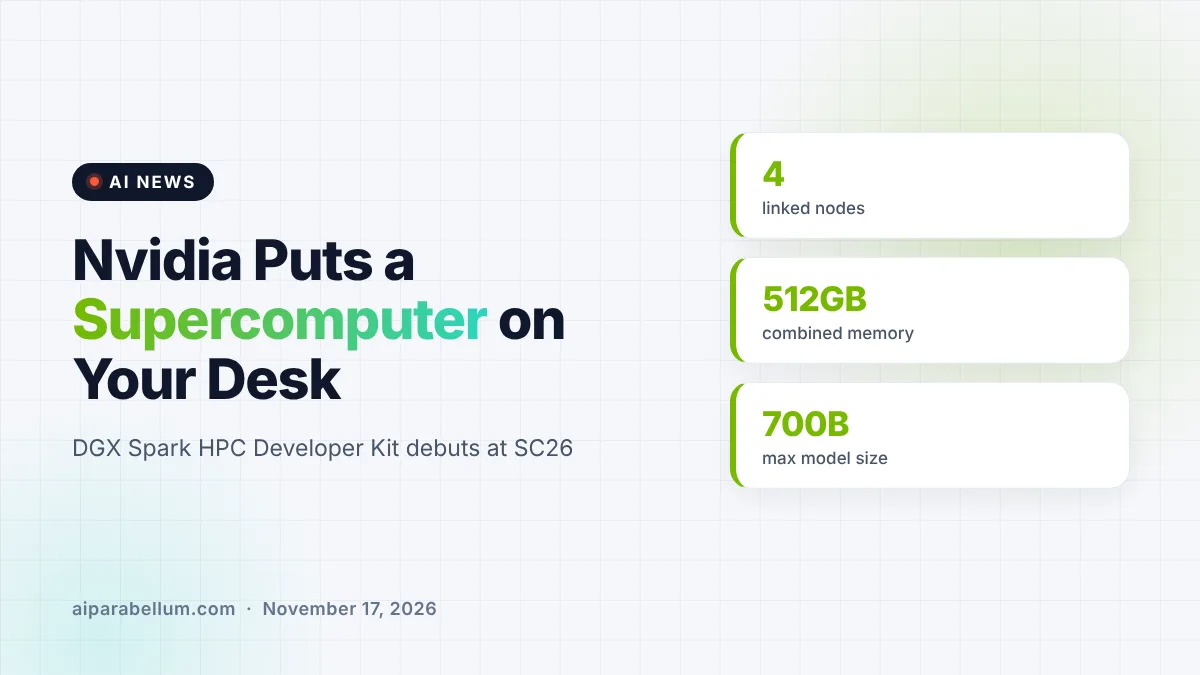
Nvidia has introduced the DGX Spark HPC Developer Kit, a four-node desktop cluster built for researchers who are tired of waiting in line for shared supercomputer time. The kit links four DGX Spark systems together so scientists can run simulations, AI models and agents right at their desks. Nvidia announced it at SC26, the big supercomputing conference happening this week in Chicago, and says the kit is already on sale.
The pitch is simple. Instead of submitting every test job to a busy campus or company cluster, a research team can build, debug and try out multi-node work locally, then save its server hours for the big production runs.
What the DGX Spark HPC Developer Kit Includes
The kit is made of four DGX Spark machines, each powered by Nvidia’s GB10 Grace Blackwell Superchip. Each node connects directly to its two neighbors in a ring using Nvidia ConnectX-7 networking. That design means there is no network switch to buy or configure.
You do not have to start with all four, either. Nvidia says the setup scales from a single node up to four, so a lab can grow into it.
The Key Numbers
| Spec | Four-Node Kit |
|---|---|
| Nodes | 4 DGX Spark systems in a ring |
| Chip per node | GB10 Grace Blackwell Superchip |
| Combined memory | 512GB |
| Combined storage | 20TB NVMe |
| Largest local model | Up to 700B parameters with NVFP4 |
| Networking | ConnectX-7, direct links, no switch |
Nvidia says the 700-billion-parameter ceiling is enough to run models such as DeepSeek V4.1 locally across the four systems, using its compact NVFP4 number format.
Why a Desktop Supercomputing Cluster Matters
Many researchers get a fixed slice of compute time on a shared cluster. Every small test eats into that budget and often sits in a queue first. A local cluster lets teams iterate freely and only spend shared hours when the code is ready.
There is also a privacy angle. Nvidia points out that keeping work on premises means unpublished results and proprietary datasets never have to leave the building. For labs handling sensitive data, that alone can be a strong reason to look at a machine like this.
Software Coming to the Kit
Nvidia says an installation playbook for its HPC SDK is “coming soon.” It will bring GPU-accelerated C, C++ and Fortran compilers, math libraries and message passing tools, the same toolchain used on Nvidia-powered supercomputers.
With that, teams can check how work is split across nodes and catch communication bugs before moving to a bigger system. Until the playbook lands, buyers should expect some of that setup to be manual.
Early Results From Research Labs
Nvidia shared several examples of groups already using DGX Spark hardware. These are company-reported results, but they show the kinds of jobs Nvidia is targeting.
- The Rubin Lab at UC Berkeley’s Innovative Genomics Institute used a DGX Spark with Nvidia’s Evo 2 model to predict bacterial traits from genome sequences, getting results 15x sooner by skipping 11-hour cluster queues.
- The Hartwig Group at UC Berkeley fine-tuned the 120B-class Nemotron 3 Super model on a single device for chemistry work, running eight- to 24-hour training fits back to back.
- Kvantify reports simulating quantum-chemistry circuits with up to 70 qubits and 975 gates on one DGX Spark.
- CYRAN AI, a spin-out from IIT Delhi, uses the hardware to speed up decoding of large satellite images.
Nvidia also says four-system runs of LAMMPS and NAMD, two common molecular simulation tools, have been demonstrated. The wider DGX Spark community has validated others, including GROMACS, OpenFOAM and the WRF weather model.
AI Agents and Models for Science
Beyond classic simulations, Nvidia wants the kit to be a home for AI-assisted research. It describes agent workflows that prepare simulation inputs, launch runs and summarize results, while scientists check the setup and conclusions.
The company is also releasing a new open dataset and post-training recipes for Nemotron 3.5 Super VL, Nvidia’s open vision model, aimed at life sciences and chemistry. Researchers can also train smaller AI models that stand in for slow simulations, such as narrowing down wing designs for low drag before booking supercomputer time.
Where to Buy the DGX Spark Kit
Nvidia says the developer kit is on display at SC26 and available now. DGX Spark systems and the needed cables are sold through Nvidia Marketplace and OEM partners including Acer, ASUS, Dell Technologies, GIGABYTE, H3C, HP, Lenovo, MSI and xFusion.
Nvidia’s announcement did not list a price for the full four-node kit, so check with the partners for current pricing.
What This Means for You
If you work in a research lab, a university or an R&D team, this kit is aimed squarely at you. Here is how to think about it:
- If shared cluster queues slow your work down, a local multi-node setup could speed up testing and debugging a lot.
- If you handle private or unpublished data, keeping it on a machine you control is a real plus.
- If you mainly need one GPU box for local AI agents, a single DGX Spark may be enough, and you can add nodes later.
- Wait for the HPC SDK playbook if your work depends on multi-node Fortran or C++ codes.
For broader picks beyond hardware, our roundup of AI research tools is a good next stop, and you can follow more updates on our AI news page.
Sources
Primary source: Nvidia’s DGX Spark HPC Developer Kit announcement.
Conclusion
Nvidia’s DGX Spark HPC Developer Kit turns the idea of a personal supercomputer into something a single lab can buy and set up without a network switch. With 512GB of combined memory, room for models up to 700 billion parameters and a full HPC toolchain on the way, it gives researchers a place to test ideas before they spend scarce cluster hours. The early lab results are promising, though they come from Nvidia itself. If your team spends more time waiting in queues than doing science, this kit is worth a close look.