DeepSeek has shipped DeepSeek V4.1 Flash 1017, a refreshed version of its fast model that the company says finishes coding and agent tasks quicker, with shorter answers and lower costs. The update is live in DeepSeek’s website, app and API, and the open weights are free to download under the MIT License. The company is also opening its in-house web search engine to outside developers for the first time.
DeepSeek calls this a minor update, but its own numbers make a bold claim. It says the smaller Flash model now tops much larger rivals on several coding and agent tests while costing a fraction per task. Here is what changed and what it means for you.
What Is New in DeepSeek V4.1 Flash 1017
The new snapshot builds on the earlier V4.1 Flash model. According to the model card, it improves reasoning, coding, agent work and visual benchmarks while cutting both task time and output length. Shorter outputs matter because you pay per token, so a model that says less to finish the same job costs less to run.
For building full software projects from scratch, DeepSeek leaned on a training method called reinforcement learning with self-feedback. In plain terms, the model uses its own confidence scores or self-written critiques as the reward, instead of relying on human graders or a separate reward model. DeepSeek says this helped with projects ranging from simple games to 3D modeling and design work.
Where it is meant to run
DeepSeek tuned the model for specific coding environments. It recommends its own DeepSeek Harness tool (version v0.2.1-rc.1 or later), along with Tencent’s CodeBuddy and WorkBuddy apps.
DeepSeek V4.1 Flash Benchmarks and Cost per Task
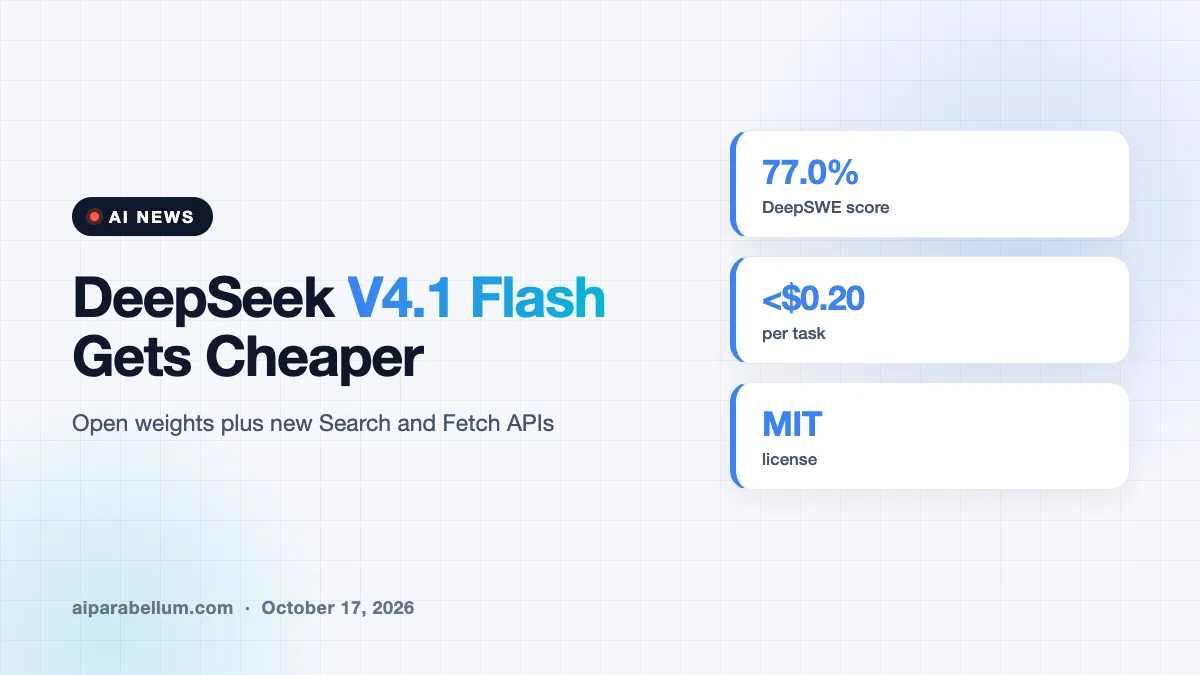
The headline claim comes from a cost chart on the DeepSWE coding benchmark. DeepSeek says the new model scores 77.0 percent at an average of just under 20 cents per task. Its earlier version scored 74.2 percent at about 50 cents.
| Model setting | DeepSWE score | Approx. cost per task |
|---|---|---|
| V4.1 Flash 1017 (top setting) | 77.0% | Just under $0.20 |
| V4.1 Flash 1017 (low setting) | Above 72% | About $0.10 |
| Previous V4.1 Flash | 74.2% | About $0.50 |
| Large rivals in the same chart | Lower than 77% | $2 to over $10 |
DeepSeek also says the update beats bigger models such as Claude Opus 5, GPT 5.6-Sol, Kimi K3 and GLM 5.3 in several coding and agent categories. Keep in mind these are the company’s own tests, and independent results have not been published yet. Benchmark scores also do not always match how clean or maintainable the code feels in real projects.
One detail is worth noting for fans of Anthropic’s Claude. DeepSeek ran its Terminal-Bench 4.0 test inside the Claude Code harness, which shows how common that tool has become as a testing ground.
DeepSeek Opens Its Search Engine to Developers
Alongside the model, DeepSeek launched two new developer tools. The Search API finds web pages for a query and returns structured results, while the Fetch API grabs a single page and returns it as Markdown. DeepSeek says the search engine behind them already handles hundreds of millions of queries per day.
- Pricing is per successful request, reported at $0.75 per 1,000 calls for each endpoint.
- Failed requests, empty search results and timeouts are not billed.
- Search and Fetch have separate rate limits, set per account rather than per API key.
- Server-side tool calls made through DeepSeek Harness, Claude Code or Codex are free until billing starts at midnight Beijing time on November 1, 2026.
This gives agent builders a built-in way to pull live web content without wiring up a separate search provider. It also puts DeepSeek in more direct competition with search APIs used by tools like Perplexity and ChatGPT.
Open Weights, License and a Policy Question
The weights sit on Hugging Face and ModelScope under the MIT License, one of the most permissive licenses around. The release skips a standard chat template file. Instead, DeepSeek ships a Python reference encoder plus a new toolkit called deepseek-recipe, a set of Rust libraries with Python bindings that converts common API request formats into DeepSeek’s prompt format.
There is a cloud over future releases, though. China is reportedly weighing tighter rules on publishing powerful open-weight models, as we covered in our report on China’s draft export controls. If those rules land, top Chinese labs may find it harder to keep releasing weights like this.
What This Means for You
If you build with AI coding agents, DeepSeek V4.1 Flash 1017 is a strong candidate for cheap, high-volume tasks. It joins a crowded wave of open models, including StepFun’s Step 5 Preview and Reflection’s Beam model, all chasing agent workloads.
- Run your own tests on real tasks before trusting the benchmark claims.
- Compare total cost per finished task, not just price per token.
- Try the Search and Fetch APIs before November 1 while some tool calls are free.
- Check company and legal rules before sending code or data to a China-based API.
If you plan to test it inside Claude Code, our guide on Claude Code permission settings can save you some clicks. You can follow more model launches in our daily AI news.
Sources
This article is based on the official DeepSeek V4.1 Flash 1017 model card, DeepSeek’s Search and Fetch API guide, and release coverage from The Decoder.
Conclusion
DeepSeek V4.1 Flash 1017 is a small version bump with a big pitch: faster, shorter and much cheaper agent work from an open model anyone can download. The company’s own charts show it beating far larger rivals on coding tasks for pennies, but outside testing has not caught up yet. The new Search and Fetch APIs make DeepSeek a fuller platform for agent builders. If cost is your biggest concern, this model deserves a spot in your next round of tests.