Reflection AI Beam is now out in the open. On October 16, the US startup released the full weights of Beam, its first open-weight model, under the permissive Apache 2.0 license, so anyone can download it, run it on their own servers and customize it.
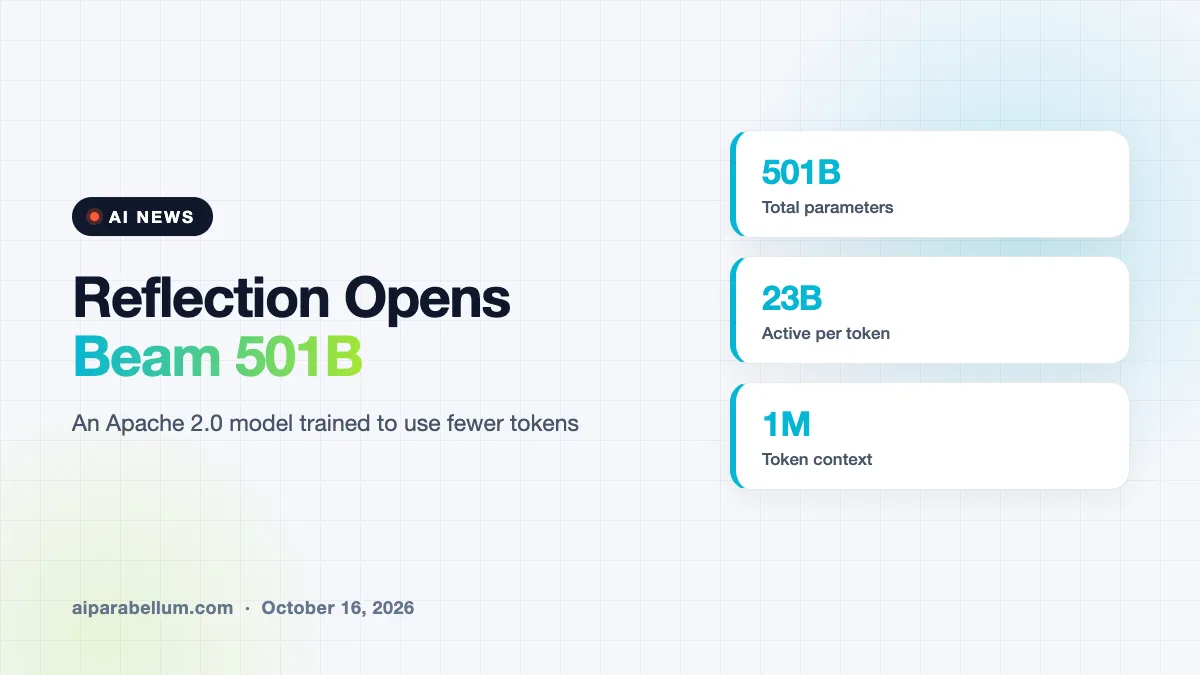
Beam is a 501-billion-parameter model aimed at coding and agent work. Its big pitch is not raw size but efficiency: Reflection says it trained the model to finish tasks using fewer tokens, which can make each finished job cheaper even if every token costs a bit more.
What Reflection AI Beam Actually Is
Beam uses a mixture-of-experts design. The model holds 501 billion parameters in total, but only about 23 billion of them do the work for any single token, so it runs closer to the speed of a much smaller model.
Here are the key specs Reflection and its launch partners shared:
- 256 experts in each expert layer, with 8 picked for every token
- A context window of up to 1 million tokens
- Text in, text out, with no image or audio support yet
- Five reasoning settings, from low to max, with medium as the default
- Weights in BF16, FP8 and NVFP4 formats, plus a small drafter model for faster output
Reflection first previewed Beam on October 5 with a waitlist, while it finished red-teaming. This week’s release adds a model card with final benchmarks and a safety technical report.
How it was trained
The company says it pretrained Beam on 23.8 trillion tokens. It then ran four weeks of reinforcement learning on 10,500 Nvidia GB300 GPUs, with more than 100 million practice attempts, or rollouts.
Counting tests and experiments, Reflection says it used about 1.3 billion sandboxes, peaking at 883,006 virtual CPUs across 23 cloud clusters. Its largest training run used clusters on both Google Cloud and Amazon Web Services.
How Reflection AI Beam Tries to Save Tokens
During training, Reflection applied a length penalty that discouraged the model from using tokens it did not need. Longer practice runs let Beam work through multi-step problems, so the goal was a model that solves the task and stays brief at the same time.
That matters because your AI bill is price per token multiplied by tokens used. You can also tune this yourself, since lower reasoning settings give shorter answers and higher ones allow more thinking on hard tasks.
A cheaper token is not a cheaper task. If one model needs a third of the tokens to fix the same bug, it can win on cost even at a higher sticker price.
Reported benchmark scores
These numbers come from Reflection’s own testing, so treat them as company claims until independent results land.
| Benchmark | What it tests | Beam score |
|---|---|---|
| GPQA Diamond | Graduate-level science questions | 90.5% |
| SWE-bench Verified | Fixing real software issues | 80.9% |
| AIME 2026 | Competition math | 97.8% |
| Terminal-Bench 2.1 | Agent tasks in a command line | 80.1% |
| MCP Atlas | Using real tools through MCP servers | 78.7% |
A Busy Week for US Open-Weight Models
Beam lands in the same week Meta opened up its own large Muse Spark Open model, and shortly after Nvidia expanded its Nemotron family. For a long stretch, Chinese labs set the pace in open models, so US companies now have more homegrown options to weigh.
Reflection frames Beam as more than a model. It calls the launch an “open operating system for agents,” backed by more than 40 partners and integrations, from serving tools like vLLM and SGLang to fine-tuning kits from Nvidia, Hugging Face and others.
If you want the backstory, our earlier look at Meta’s open model and the latest Nemotron release covers the rest of the field.
Running Beam on Your Own Hardware
The full BF16 checkpoint is about 1 TB, which is far beyond a home PC. The 4-bit NVFP4 version shrinks that to roughly 280 GB for Nvidia’s Blackwell chips, and the suggested setup is four B200 GPUs to leave room for long contexts.
If you don’t own that kind of gear, you have easier options:
- Reflection’s own API, now in a public beta that is free to start
- Cloud and inference partners such as AWS, Google Cloud, Microsoft Azure, Baseten, Fireworks, Together AI and OpenRouter
- Dell and HPE setups for on-premises or air-gapped deployments
Reflection also open-sourced Mirror CLI, a terminal agent harness trained alongside Beam, similar in spirit to Claude Code but built around an open model. Hugging Face is offering $10,000 in Hub credits for the best community projects built with Beam.
What This Means for You
For most people, Beam is a developer story first. Still, it shows where open models are heading, and it gives teams one more US-made option when they pick an AI coding assistant or agent backbone.
- If you build with AI, compare cost per finished task, not just cost per million tokens.
- Apache 2.0 means you can use and modify Beam commercially with few strings attached.
- Try the free API beta before paying for big GPUs to self-host.
- Wait for independent benchmarks before swapping a production model.
You can follow more launches like this on our AI news page, along with guides on building AI agent tools into your work.
Sources
This report draws on the Hugging Face technical launch post and release details from Unite.AI.
Conclusion
Reflection AI’s Beam is a serious new entry in the open-model race, with 501 billion parameters, a 1-million-token context window and a clean Apache 2.0 license. Its real bet is efficiency, training the model to finish work in fewer tokens so each task costs less. The benchmark numbers look strong, but they come from the company, so independent tests will tell the fuller story. Together with Meta’s release this week, it gives US companies more homegrown choices than they had a week ago. If you build with AI, Beam is worth a test run, especially if your bills are driven by long agent sessions.