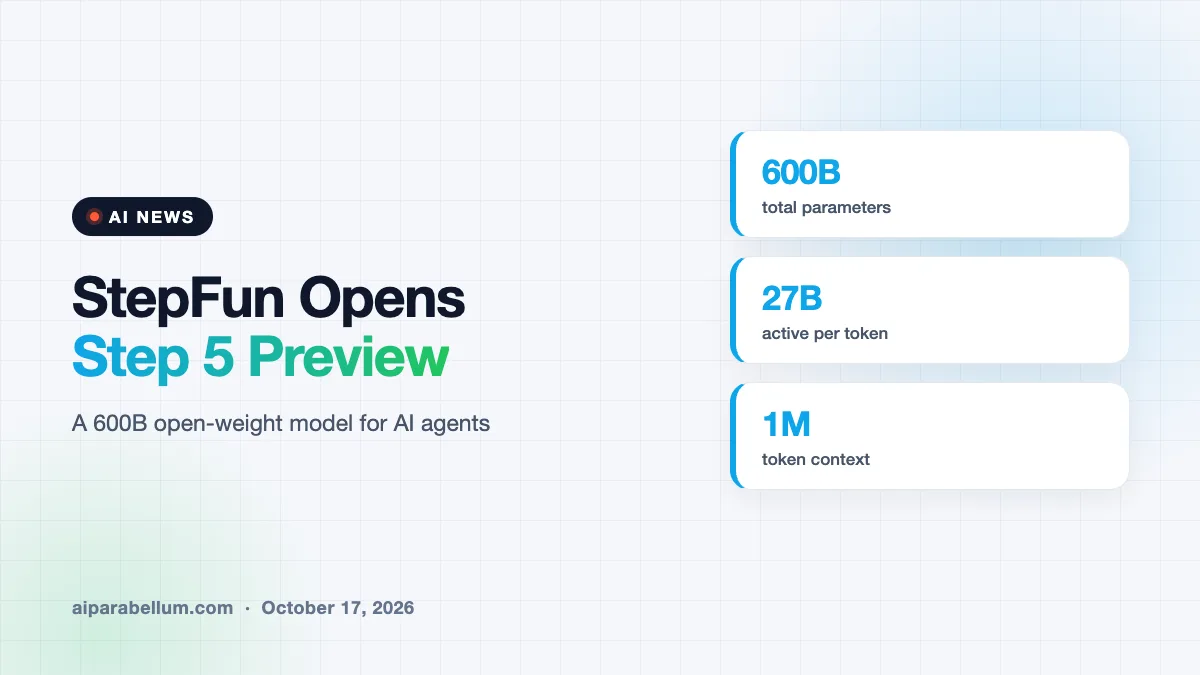
Chinese AI lab StepFun has released the weights for StepFun Step 5 Preview, its flagship model for long, multi-step agent work. The model packs 600 billion parameters, handles up to 1 million tokens of context, and can now be downloaded in FP8 and BF16 formats. It adds one more serious open-weight option for teams that want to run a big coding and research model on their own hardware.
The model first launched through StepFun’s API in September, and the weights arrived on October 15, the date the company had promised. StepFun pitches it for software engineering, professional knowledge work and finance. Here is what you need to know.
What StepFun Step 5 Preview Is Built For
Step 5 Preview is a sparse Mixture-of-Experts model. Out of its 600 billion total parameters, only about 27 billion switch on for each token, which keeps it cheaper to run than its size suggests.
The model takes text, images and video as input. StepFun says it can work across large codebases, make coordinated changes in many files, run code, check the results and try again. It is also meant to read long documents, charts and screenshots, then turn them into structured reports.
The main use cases
- Repository-level coding, including front-end and visual development
- Agent tasks that need many tool calls, checks and revisions in a row
- Research and analysis across long reports, images and video
- Finance work that mixes number crunching with document review
How Step 5 Preview Stacks Up So Far
The model has picked up real usage quickly. As of October 15, it ranked second on both the weekly and daily token-usage charts at OpenRouter, with about 18.8 trillion tokens processed over seven days.
On quality, it scored roughly 44 on the Artificial Analysis Intelligence Index, which places it among the top three open models. StepFun says it beats the open models Kimi K3 and GLM-5.3 on several agent, finance and research tests, trailing only closed leaders like Claude Opus 5 and GPT-6 Astra. Keep in mind those head-to-head claims come from the company’s own testing.
| Detail | Step 5 Preview | Why it matters |
|---|---|---|
| Total / active parameters | 600B / 27B | Big model, lighter compute per token |
| Context window | Up to 1M tokens | Fits very long codebases and reports |
| Artificial Analysis index | About 44 | Top three among open models |
| Average cost per task | $0.71 vs. $5.86 for Claude Opus 5 | About one-eighth the cost, per Artificial Analysis data |
| OpenRouter usage | No. 2 weekly and daily | Developers are already using it heavily |
What It Takes to Run the Model
Do not expect to run this on a laptop. According to the model card, the FP8 version fits on a single server with four Nvidia B300 GPUs or eight H200 GPUs. The BF16 version needs eight B300s or two servers with 16 H200s in total.
StepFun provides serving guides for vLLM and SGLang with an OpenAI-compatible API, plus a Transformers option for offline use. That makes it easier to plug the model into existing agent tools, much like other open releases such as Reflection’s Beam model from earlier this week.
Under the hood
The model stacks 92 transformer layers in a narrow, deep design, which StepFun says helps with reasoning that hops across many pieces of a long context. Three out of four attention layers use a cheaper sliding-window approach, and the rest use a sparse full-attention method that only looks at about 4,096 selected past tokens. Reinforcement learning ran across roughly a million checkable environments covering coding, science and office work.
Access and License Details for StepFun Step 5
The weights are hosted on Hugging Face and ModelScope. For non-developers, StepFun has also connected the model to Tencent’s WorkBuddy app with a two-week free trial.
The license is not a standard open-source one. The weights come under the StepFun Model License 1.0, which the company calls Apache-2.0-style but with extra attribution rules and commercial-license conditions.
What This Means for You
For most everyday users, Step 5 Preview will show up through apps and routers rather than a direct download. For developers and companies, it is another sign that open models are closing in fast on agent work, alongside recent releases like Meta’s Muse Spark and Nvidia’s Nemotron update.
- Test it through a hosted API or router before committing to hardware.
- Run your own task tests, since the strongest benchmark claims come from StepFun itself.
- Budget for data-center GPUs if you plan to self-host for privacy or control.
- Read the license terms carefully if your use is commercial.
If you are building with AI agents, it also helps to know how to use an assistant for understanding legacy code. You can follow more open model releases in our daily AI news.
Sources
This article draws on the official Step 5 Preview model card on Hugging Face, release coverage from Pandaily, and a technical breakdown published by 36Kr.
Conclusion
StepFun Step 5 Preview is a large open-weight model aimed squarely at long-running agent tasks in coding, research and finance. It is already one of the most used models on OpenRouter, and outside data suggests it runs at a fraction of the cost of top closed models. It still trails the leaders, and many of its best results come from StepFun’s own tests. If you need a self-hostable model for heavy agent work, it is worth a careful trial.