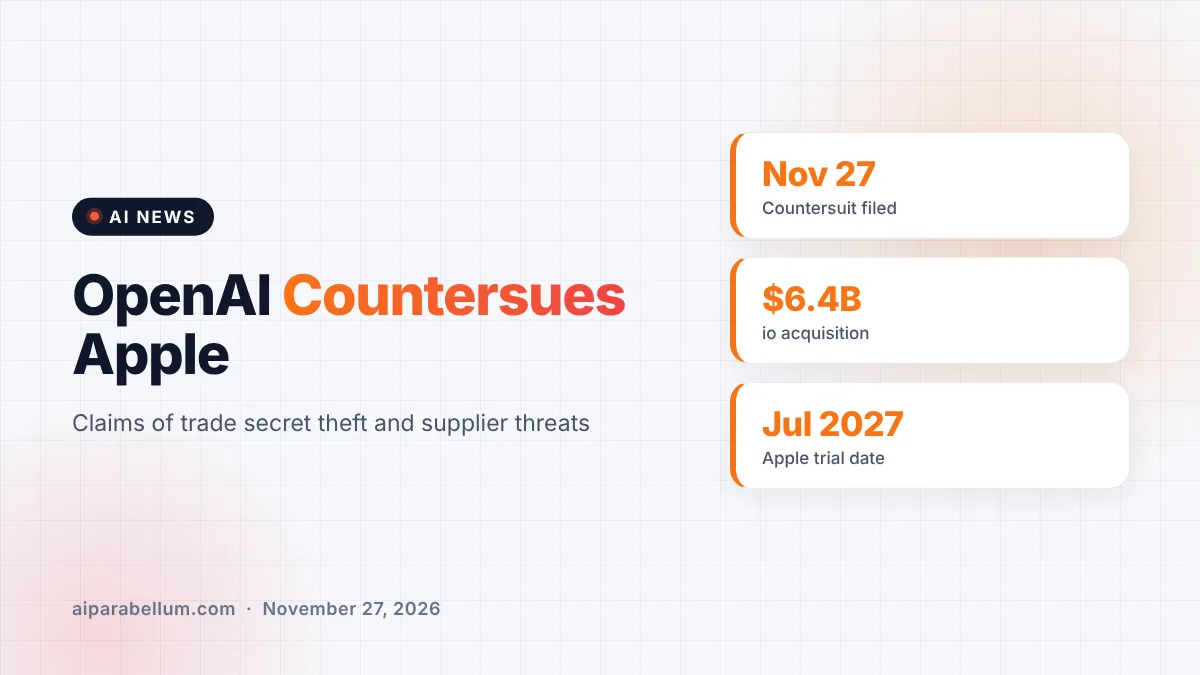
The OpenAI Apple lawsuit just turned into a two-way fight. OpenAI filed its own case against Apple in a California court on Friday, November 27, accusing the iPhone maker of taking its trade secrets and pressuring hardware suppliers that work on OpenAI’s upcoming devices. It is a sharp escalation of a dispute that Apple started in July.
What OpenAI Claims in Its Countersuit Against Apple
According to the Financial Times, which first reported the filing, OpenAI says Apple is willing to use almost any tactic to compete unfairly. The complaint argues that Apple is using its size and wealth to hold back a new rival before its products even reach stores. Apple did not immediately respond to requests for comment.
The filing lays out several separate accusations. Here are the main ones as reported so far:
- Supplier pressure: OpenAI alleges Apple is pressuring and threatening component makers and manufacturers that also work with OpenAI.
- Leaked product plans: OpenAI says a former employee who went back to Apple shared details about its device plans and its suppliers.
- Loose file habits: the complaint claims Apple encouraged its own staff to keep corporate files on personal devices and personal cloud accounts.
- Broader misconduct: OpenAI accuses Apple of a wide range of unlawful and unfair conduct.
The complaint also takes a colorful swipe at Apple’s culture. It compares working there to the song “Hotel California,” where you can check out but never leave. That line frames Apple’s own lawsuit as a way to scare employees away from changing jobs.
Why suppliers matter so much here
Apple has long used its buying power to lock up factory capacity and the newest chips, often paying in advance. That is a normal, if aggressive, business tactic. OpenAI’s claim goes further, saying Apple crossed a line by threatening suppliers that might help build OpenAI hardware.
How the OpenAI Apple Lawsuit Got Here
This fight has been building for months, and it is tied to OpenAI’s push into consumer devices. OpenAI bought io, the hardware studio led by former Apple design chief Jony Ive, for about $6.4 billion in May 2025. The company now says its devices could compete with Apple on Apple’s home turf.
| When | What happened |
|---|---|
| July 2026 | Apple sues OpenAI, io Products and former Apple employees Tang Tan and Chang Liu over alleged trade secret theft. |
| August 2026 | OpenAI denies taking Apple secrets and calls the suit an attempt to stop it from hiring Apple staff. |
| October 2026 | A judge gives Apple expanded access to evidence, and OpenAI says a returning Apple employee sent over 100 of its confidential files to personal accounts. |
| November 27, 2026 | OpenAI files its own lawsuit against Apple in a California court. |
| July 19, 2027 | Scheduled trial date for Apple’s original case. |
Tan, who once led iPhone and Apple Watch product design, is now OpenAI’s chief hardware officer. Apple claims confidential engineering and supply chain details were taken to help OpenAI’s device work. You can read our earlier coverage of the discovery ruling for more on that phase of the case.
In October, OpenAI said the files that went to personal accounts included device images, engineering data and supplier details. Apple responded at the time that its own investigation had not found OpenAI’s confidential information. We covered that back-and-forth when OpenAI first raised the device file claims.
A Partnership Turned Rivalry
The irony is hard to miss. Just two years ago, Apple and OpenAI struck a deal to bring ChatGPT into the iPhone, and many people still reach ChatGPT through Siri today. Now the two companies are trading accusations in court.
The shift reflects how fast the AI race is moving into hardware. OpenAI wants its own devices, and Apple sees that as a direct threat to its most profitable products. Talent and supply chains have become the battlefield.
What This Means for You
For everyday users, nothing changes right away. Your iPhone, your Mac and the ChatGPT app all keep working as before. Still, a few things are worth watching:
- OpenAI device timing: if suppliers feel squeezed, OpenAI’s first gadgets could face delays or design changes.
- Apple and ChatGPT ties: a deeper legal fight raises questions about how long ChatGPT stays a featured option inside Apple’s own AI features.
- Job mobility in tech: the case could shape how freely engineers move between rival AI and hardware companies.
- Court filings ahead: more details will likely surface as both cases move toward trial in 2027.
If you are comparing assistants right now, our guide to top AI assistants covers how ChatGPT, Claude and Gemini stack up. You can also follow every update on our AI news page.
Sources
The filing was first reported by the Financial Times. Reporting from 9to5Mac and CNA.
Conclusion
OpenAI’s countersuit turns Apple’s trade secret case into a much bigger fight about hardware, suppliers and talent. OpenAI says Apple is using its power to block a rival, while Apple says OpenAI built its device effort on stolen information. Neither side has proven anything yet, and Apple’s original case is not set for trial until July 2027. For now, the clearest takeaway is that the AI race has moved firmly into devices. Expect more filings, and more friction, as both companies push to own the next gadget in your pocket.